Banning Chinese apps a "digital strike": Union Minister Ravi Shankar Prasad

Kolkata: Calling the ban on Chinese apps a "digital strike", Union Communication and Information Technology Minister Ravi Shankar Prasad on Thursday said India wants peace but if someone casts an evil eye the country is capable of giving a befitting reply.
Hailing the "strong" leadership of Prime Minister Narendra Modi, he asserted, if India lost 20 soldiers in the Galwan Valley border clash, the toll is double on the Chinese side.
"Now you can hear about only two 'Cs' Coronavirus and China. We believe in peace and solve problems through discussion, but if somebody casts an evil eye on India, we will give a befitting reply. When people from China tried to create pressure on LAC, our soldiers gave them a befitting reply...if our 20 jawans have sacrificed their lives, the toll is double on the Chinese side.
"You all must have noticed that they have not come out with any figure," Prasad, also the Union law and justice minister, told a virtual rally for the people of West Bengal.
He said people will remember the retaliatory assault mounted by India after terrorist strikes in Uri and Pulwama.
"When our PM is saying that the sacrifice of our jawans won't go in vain, it has a meaning in terms of national security. Our government has the will to deliver. All of us are aware of the courage of our PM."
Prasad said the India of 2020 will neither "stop nor bow its head" before anyone. "It's not the India of 1962," he said, referring to the India-China war in which the country was defeated because of the superior Chinese war machine.
Insisting that India carried out a "digital strike" to protect the data of countrymen, Prasad sought to know why the TMC was opposing the ban on Chinese apps.
"For us, the privacy and protection of data of our countrymen are supreme. As IT minister, we decided to ban 59 apps to protect data. We won't compromise on the issue of data security and national integration. India knows how to protect its borders and also knows how to carry out a digital strike," he asserted.
Launching a scathing attack on the Congress party for questioning the Centre for its handling of the Indo-China military standoff at the Line of Actual Control in eastern Ladakh, the senior BJP leader said, the entire country should be fighting this crisis together instead of targeting the government.
Taking a dig at the Congress on the funding of the Gandhi family-run Rajiv Gandhi Foundation, he wondered what prompted the RGF to conduct a study in favour of a free trade agreement with China.
"Every day we see Congress raising questions against the government. This is the time to keep aside differences and fight the crisis together. The Rajiv Gandhi Foundation received funds from the Chinese embassy and the Chinese government. The RGF also conducted a study after it received funds from China, advocating free trade between the two countries. We have those documents," he said.
Amid the ongoing war of words over the Sino-India border standoff, BJP chief J P Nadda had last week alleged that the RGF had accepted funds from China in 2005-06 for conducting studies that were not in the national interest.
The Congress, however, dismissed the allegation as an attempt to divert the attention of the country from issues of national security. Prasad also attacked the CPI-M over its "silence" on the Sino-India border confrontation.
"I am surprised why the CPI-M has not criticised China. We saw an article in CPI(M) mouthpiece where it said India had angered China by removing article 370 from Kashmir.
Is it the same CPI-M that it was in 1962? Is it still speaking the same language of 1962 in 2020?" he said. He criticised the state's ruling TMC for not supporting the Centre on the issue of banning the Chinese apps.
"We are witnessing a strange trend in Bengal. The ruling TMC had earlier asked why we were not banning the apps. Now they want to know why we are banning the apps. This is strange, why can't they stand with the government at the time of crisis," he said.
Trinamool Congress MP Nusrat Jahan had on Wednesday termed the Centre's decision to ban 59 Chinese apps, including the hugely popular TikTok an "eyewash and an impulsive decision", and said the Union government should substitute them with Indian apps as the livelihood of many people associated with these applications had been affected.
Indicating that the Citizenship (Amendment) Act will be a major electoral plank in the West Bengal assembly polls due next year, Prasad wondered why the anti-CAA protesters had gone silent on the issue of China.
"This law was brought in to help the refugees, what is the harm in it? In Bengal we used to witness a lot of protests in some universities, our union ministers and the state governor were not allowed to enter. I wonder where are those anti-CAA protesters, why have they gone silent on China issue? We need to raise this question in public," he said.
Accusing the Mamata Banerjee government of "mishandling" the COVID-19 crisis in the state, Prasad said the inter-ministerial central team that visited the state for assessing the situation had to face several roadblocks.
The senior BJP leader assailed the West Bengal government for not joining several central schemes, including Ayushman Bharat, meant for the poor.
On West Bengal's alleged unwillingness to bring back migrant labourers stranded during the lockdown, Prasad said it was the only state not keen on the return of its people.
"UP brought back its 25 lakhs migrant workers, Bihar brought back 20 lakhs workers. I want to ask how many Shramik special trains were allowed in Bengal. She (Mamata) had said that these special migrant trains were bringing more COVID cases to the state. Such statements are unacceptable," he said.
Prasad, while referring to the assault on BJP state president Dilip Ghosh on Wednesday, said the ruling TMC, despite the pandemic, had not stopped its attack on opposition leaders.
The Union minister said West Bengal could not become a beneficiary of the 'Garib Kalyan Rojgar Abhiyaan' because the state government had not provided data on migrant labourers.
"How will those who call Shramik Special trains 'Corona Express' provide data on migrant labourers? Why should they bother about the welfare of migrants labourers?" he said.
West Bengal Finance Minister Amit Mitra had recently criticised the Union government for not including the state in the 'Garib Kalyan Rojgar Abhiyaan', a job scheme for migrant labourers, and termed the allegation of not providing data as "absolutely untrue".
Let the Truth be known. If you read VB and like VB, please be a VB Supporter and Help us deliver the Truth to one and all.
Putin meets Iran's FM Araghchi, says Russia ready to do its best to help bring peace to West Asia
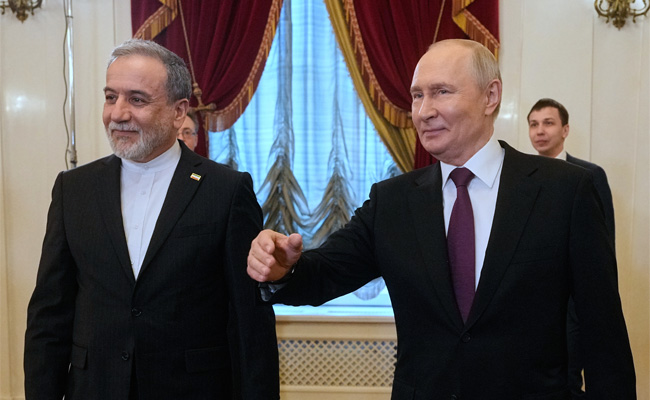
Moscow (PTI): Iran's Foreign Minister Abbas Araghchi on Monday met Russian President Vladimir Putin, who hailed the Iranian people for fighting bravely and heroically for their sovereignty and said Moscow is ready to do its best to help bring peace to West Asia as soon as possible.
Araghchi, who held talks with Omani and Pakistani leadership before arriving in Russia, met Putin in St. Petersburg and thanked him for supporting Iran, state-owned TASS news agency reported.
"Russia is ready to do everything in its power to ensure that peace in the Middle East is achieved as soon as possible," Putin said during his meeting with Araghchi, which was also attended by Russian Foreign Minister Sergey Lavrov.
Revealing that he received a message from Iranian Supreme Leader Mojtaba Khamenei last week, Putin asked Araghchi to convey his "gratitude for this message and best wishes for his health and well-being."
He praised the Iranian people for fighting "bravely and heroically" for their sovereignty, Iran's state-run PRESS TV reported.
"We really hope that, based on the courage and desire for independence, the Iranian people, under the guidance of the new leader, will weather this difficult period of trials and peace will come,” Putin said.
He also stressed that Russia “intends to maintain” its strategic relations with Iran.
Araghchi said that the world witnessed Iran’s strength in countering the US during the recent war, and that the Islamic Republic is a "stable and powerful establishment."
"With their courage, the Iranian people succeeded in resisting the US aggression and will be able to endure it,” he said.
He said that it became clear that Iran has “great friends and allies” like Russia, and conveyed “warmest greetings” from Supreme Leader Mojtaba Khamenei and President Masoud Pezeshkian to the Russian leader.
Araghchi said relations between Moscow and Tehran represent a “strategic partnership at the highest level” and will continue to develop "regardless of circumstances."
"We are grateful to you for the solid and strong positions in support of the Islamic Republic of Iran," he said.
Foreign Minister Lavrov said that the talks between President Putin and the Iranian Foreign Minister were "useful and constructive."
Kremlin Spokesman Dmitry Peskov later said that Russia is "ready to provide any good offices, any mediation services that are acceptable to the parties."
"We will be ready to do everything so that ultimately peace ensues, guaranteed peace, and that there is no return to hostilities," Peskov was quoted as saying by TASS.
He was asked how Moscow can assist in future negotiations on the Iranian settlement.
Araghchi arrived in Russia after his whirlwind trip to Islamabad, which, according to him, was “very productive” and involved “good consultations" with Pakistan's Army Chief Field Marshal Asim Munir, amid uncertainty over the second round of peace talks to resolve the war in West Asia.
"We held good consultations with our friends in Pakistan. The trip was successful. We assessed the outcome of our recent (meetings) and discussed in what direction and under what conditions talks can move on,” Araghchi said in a video posted on his Telegram channel upon his arrival in St Petersburg.
Referring to the second round of talks between the US and Iran to resolve the conflict in West Asia, Araghchi said: "Developments have taken place in the negotiations."
"Despite some progress in earlier rounds, the talks failed to reach their objectives due to the Americans' approach, the excessive demands they made, and the wrong approaches they adopted. Therefore, it was necessary to consult with our friends in Pakistan to review the latest situation,” Iran's official news agency IRNA quoted him as saying.
He said that the trip to Pakistan was a good opportunity to review developments related to the US-Israeli war against Iran, expressing confidence that “these consultations and coordination between the two countries will be highly significant.”
Araghchi arrived at St. Petersburg's Pulkovo Airport early Monday, where he was welcomed by Russian officials and Iran’s ambassador to Russia, Kazem Jalali, the report said.
The first round of peace talks between Iran and the US, held on April 11 and 12, failed to bring the desired result for the parties to the conflict.
The Iranian minister arrived in Islamabad for the second time on Sunday after a short visit to Oman, where he held talks with Sultan Haitham bin Tariq al-Said on security in the Strait of Hormuz and diplomatic efforts to end the Iran-US conflict.
After Araghchi left Pakistan for Oman on Saturday, President Donald Trump announced that US negotiators Steve Witkoff and Jared Kushner would no longer be going to Islamabad for talks with Iran, contending that Washington held all the cards on the matter.
Trump on Sunday reiterated that the US and Iranian officials can talk by phone for a peace solution to the conflict.
On Tuesday, Trump extended the two-week ceasefire with Iran indefinitely to give Tehran more time to prepare a unified proposal to end the war, just hours before the truce was set to expire.
The war began when the US and Israel jointly attacked Iran on February 28, killing Iranian Supreme Leader Ayatollah Ali Khamenei and several top commanders. The retaliation by the Islamic Republic extended the war to the entire Gulf region.