Bar Council of India lashes out at retired Supreme Court judge J Chelameswar
The Press release consistently misspells his name
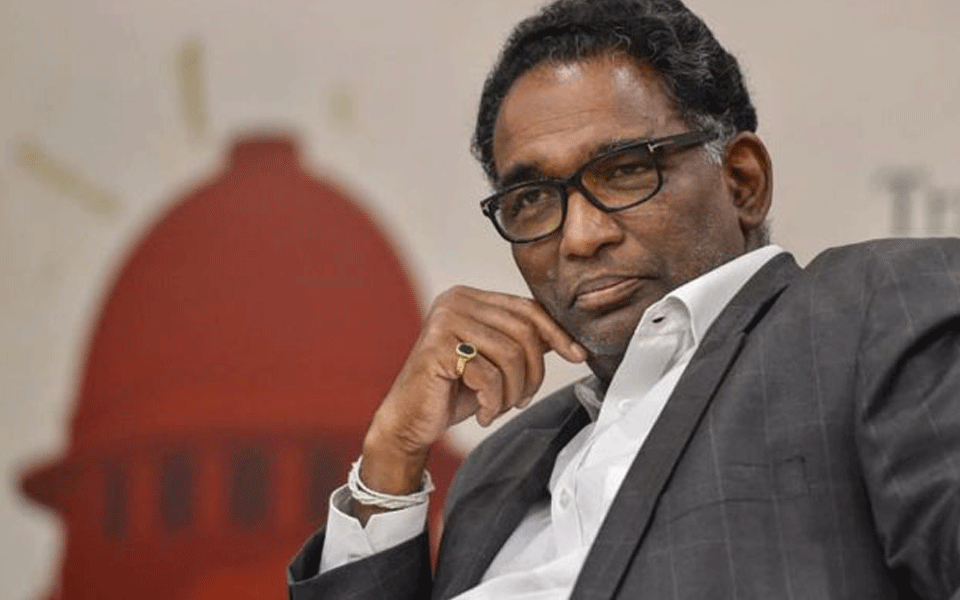
The following is the full text of a press release issued by the Bar Council of India two days after the retirement of now-former Supreme Court judge Justice J Chelameswar. Besides slamming the former judge for interviews given to the media, the press release also condemns him for the damage done to the Supreme Court of India by him. Further, the release consistently misspells his name throughout the press release.
The statement is being reproduced here verbatim and is not edited.
BAR COUNCIL OF INDIA
(Statutory Body Constituted under the Advocates Act, 1961) 21, Rouse Avenue Institutional Area, New Delhi - 110 002
-: Press Release :-
Self restraint by the Hon'ble judges of the highest court seems to be a forgotten virtue. They have to prevent themselves from issuing statements without giving any thought to the consequences such statements could entail., The manner in which Hon'ble Justice Chemeleshwar went to the media and gave controversial and, irrelevant statements Immediately upon retirement, was not expected of a person holding such a high post and was infact against the dignity of the post he had held. Such statements and comments are liable to be deprecated. Such statements cannot be tolerated, accepted or digested by the Advocates including the rest of the countrymen.
Justice Chemeleshwar has resorted to usage of such controversial words like" Bench fixing". Now if a handful of Lawyers of the highest court filed matter/ s and mentioned it before Justice Chemeleshwar and other chosen judges, and tried to get it listed, then that would have been "Bench fixing". Such instances have been repeated not once but on two-three occasions. Justice Chemeleshwar should have raised an objection at that point in time. But Justice Chemeleshwar did not do so and, infact accepted and agreed to hear certain matters himself which led to the beginning of a wrong practice. Had such irregular or unlawful orders been sought to be set aside by the Chief Justice or by some other judge then there would have been no harm done. Before issuing any statements relating to judges meeting politicians, Justice Chemeleshwar should himself do an self introspection.
The fact that Justice Chemeleshwar met CPI Leader and Rajya Sabha M.P. D Raja immediately after his Press Conference, clearly deciphers the mystery and the motive behind the controversial statements being issued by Justice Chemeleshwar. The amount of damage which has been done to the institution since last January, would take a long time to be repaired and rectified. However, we have full and utmost faith that the Lawyers of the country, especially the younger generation would criticise and dislike such kind of statements and do their level best to salvage and protect the dignity and decorum of the Highest Court of the Land.
For the purpose of self consolidation and for fulfilling selfish and vested interests, not only some political leaders, but some Advocates and even infact some judges have attempted to misuse and malign the institution but they have woefully failed. It is the great fortune of the country that 99.9 of the legal fraternity and the judges have seen through this ulterior motive and mindset and such people who have attempted to bring disrepute to the institution for their vested interests, have had to suffer a setback at each step. The judiciary of the land is by far the holiest and the most powerful institution and in which even today, each citizen of the country has full and unflinching faith. Any and every judge should first do a self introspection and look at himself/herself, their actions, deeds before making or issuing any statements against the judiciary and they should make concerted efforts to safeguard and maintain the dignity and decorum of the institution.
Manan Kumar Mishra Chairman
Satish A Deshmukh Vice-Chairman
Apurva Kumar Sharma Chairman, EC
T.S. Ajith Co-Chairman
Amit Rana Co-Chairman
The press statement has not been edited by Vartha Bharati and has been reproduced verbatim.
Let the Truth be known. If you read VB and like VB, please be a VB Supporter and Help us deliver the Truth to one and all.
AIITA welcomes Karnataka’s ban on obscene songs in school events

Bhatkal: The Karnataka unit of the All India Ideal Teachers Association (AIITA) has welcomed the Karnataka government’s decision to strictly ban school children from dancing to obscene songs during educational and cultural programmes in government, aided, and private schools across the state.
AIITA Karnataka State President M. R. Manvi congratulated the government for taking what he termed an important step to preserve the sanctity of education.
“Such decisions to safeguard the dignity of school children and uphold the values of education are the need of the hour. This rule should not be limited to government schools alone but must be strictly implemented in all private educational institutions as well,” he said.
He further urged the government to address other concerns within school programmes.
“The government should not only prohibit obscene dances in the name of school anniversaries, but also ensure that plays and dialogues that incite religious hatred are avoided. Schools should be centres of harmony, not platforms for spreading hatred,” he added.
According to a recent circular issued by the Department of School Education and Literacy, obscene dances are adversely affecting the mental health and moral values of students.
In this regard, schools have been advised to use songs that promote nationalism, positive thinking, the greatness of Kannada culture, and value-based traditions instead of inappropriate content during programmes.
The circular also emphasises that students should be dressed in decent attire.
AIITA also backed the department’s warning that disciplinary action would be taken against head teachers if such guidelines are violated. The association has further demanded that district Deputy Directors of Public Instruction strictly monitor the implementation of these rules.