Before Pulwama, CRPF officer wrote to HQ about holes in anti-terror training
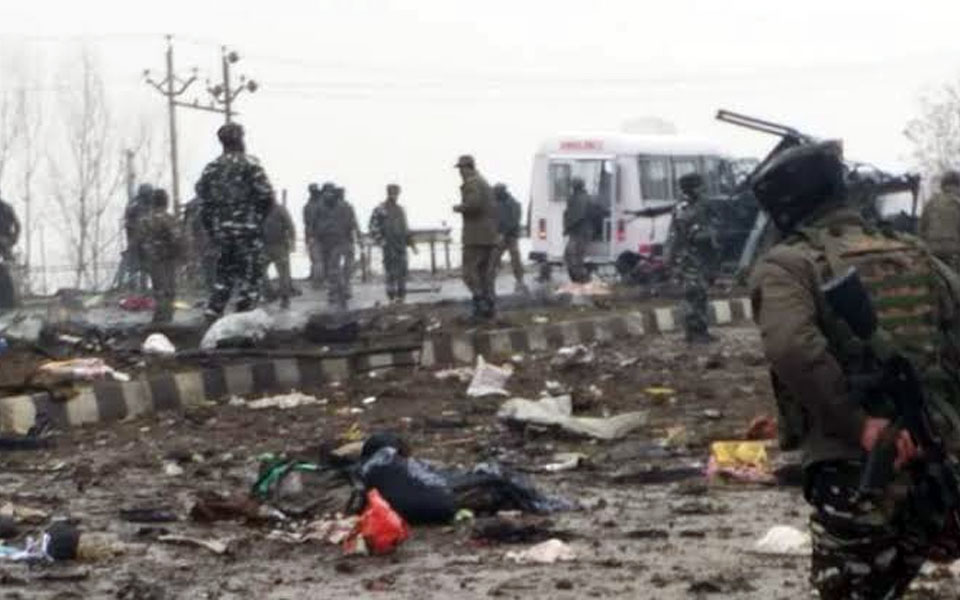
This is the essence of a report and a series of letters sent between January and November 2018 by a senior officer to the CRPF headquarters in New Delhi highlighting the poor condition of its counter-terror training apparatus.
New Delhi : It is a key training centre for the largest force fighting insurgency and terrorism in the country. But it has no permanent structure, no firing range, no boundary wall. In the last four years, over 150 training and administrative staff have been posted there “to merely fill the vacancies”. And, it does “not offer a single CIAT (Counter Insurgency and Anti Terrorism) related course”.
This is the essence of a report and a series of letters sent between January and November 2018 by a senior officer to the CRPF headquarters in New Delhi highlighting the poor condition of its counter-terror training apparatus.
The last of these letters was sent by CRPF IG Rajnish Rai on November 22, 2018, less than two months before the Pulwama terror attack on February 14 this year when 40 CRPF men lost their lives.
Rai was in charge of the CRPF’s 175-acre CIAT school in Andhra Pradesh’s Chittoor, one of the three such schools allotted to the force by the Union Home Ministry, which envisaged 21 such facilities in 2007 for various forces.
A 1992-batch IPS officer of the Gujarat cadre, Rai was serving as CRPF IG (Northeast Sector) till June 2017, when he was asked to take charge of the CIAT school in Chittoor. The transfer came three months after he had called for a probe into what he alleged was a fake encounter — by a joint team of Army, CRPF, SSB and police — in Assam’s Chirang on March 30.
Last December, Rai was suspended by the Home Ministry for “unauthorised handing over of charge” after he quit the service citing an application for voluntary retirement in August, which had been rejected. In January, the Central Administrative Tribunal (CAT) stayed the Centre’s action; Rai has since moved the Gujarat High Court.
In his letters, Rai pointed out that the CRPF schools only provide theatre-specific, short-term pre-induction (PI) training to personnel headed for Kashmir, the Northeast or LWE areas.
Rai was not available for comment. But a senior CRPF officer, speaking on condition of anonymity, said that “some kind of training” could have been started in Chittoor by Rai despite the drawbacks.
“It is true that the Chittoor school has no infrastructure. There is no proper infrastructure at the Silchar and Shivpuri schools, either. Bureaucracy has its own pace. But as officers we have to learn to use the resources available to us in the best possible way. Some kind of training could have been started at Chittoor. After all, PI training is also a form of counter-terror training,” the officer said.
In his letter on February 5, 2018, Rai wrote: “Presently, CRPF has three CIAT Schools in the country; yet, contrary to what the name suggests, we do not offer a single CIAT related course in any of these locations. This is even more surprising since we know very well that CRPF is in the forefront of facing three internal security challenges: terrorism in Kashmir Valley, the insurgency in Northeast, and left-wing extremism (LWE) in Central India.”
On November 22, 2018, Rai wrote: “…even when no training was conducted… almost full strength of officers/men were posted at CIAT School, Chittoor since its inception, and salaries and allowances were paid to the CRPF personnel posted here.”
The Chittoor school, spread over 175 acres, was set up in 2014 — the other two CRPF schools are in Assam’s Silchar and Madhya Pradesh’s Shivpuri.
When contacted by The Indian Express, the CRPF did not respond specifically to the contents of Rai’s report and letters. However, it said that through “multiple centres across the country”, it provides training to soldiers and officers in “over 20 different courses ranging from basic training for recruits to jungle warfare and IED training to those being deployed in LWE area, Kashmir and the Northeast”.
It said training of 15,256 personnel is envisaged in 2019 at its four Central Training Colleges while 6,903 personnel would be trained at CIAT schools. It also said that a CIAT course for a Quick Action Team (QAT) has been started in Chittoor, and 1,274 personnel were being trained.
“These schools impart theatre-specific specialised training on CIAT operations. NE-theatre specific training is imparted at CIAT Silchar. LWE theatre specific training is imparted as CIAT Shivpuri,” the CRPF said.
In his letters, Rai pointed to the difference between PI and CIAT training. “PI training introduces participants to the new operational theatres… whereas, CIAT training are essential for understanding the geographical and cultural terrain, operational tactics, and the psychological profiles of insurgents/terrorists. While PI training provides perspectives on challenges facing an operational theatre, strategic insights on how to deal with insurgents/terrorists in specific contexts can be acquired only through in-depth CIAT training,” he wrote.
“Lack of truthful and transparent analysis of operations has meant the CRPF has little institutional ability to learn from its mistakes,” he wrote.
n 2016, when Rai was posted in the Northeast, he had pointed out that no CIAT training was being conducted at the Silchar school since September 2015. Sources told The Indian Express the CRPF has recently been holding QAT training there while a similar course focused on LWE areas was started in Shivpuri this year.
Incidentally, Rai was the supervising officer with Gujarat’s CID-Crime probing the Sohrabuddin Sheikh fake encounter case – in 2007, he had arrested three top officers, D G Vanzara, M N Dinesh, Rajkumar Pandiyan.
Rai’s CIAT letters red-flagged a number of issues at the Chittoor school:
* It was operating out of 44 pre-fabricated (PF) huts with no permanent structure. There are plans to construct 26 more PF huts.
* Only 39 training staff have been sanctioned for around 800 personnel. Out of 15 sanctioned officers in supervisory roles, only four are “physically present”.
* It has not conducted a training needs analysis and there is “no clear direction” for providing counter-terror training.
* No boundary wall or fencing, Battle Obstacle Assault Course infrastructure, running track and IED lane for IED-related training.
* No firing range. The 169 acres allotted for the range is stuck in a land dispute, and the state police range, 70 km away, is subject to availability. There is also lack of access to a jungle, and no indoor classrooms for elaborate training on jungle survival, or sand-model tutorials.
* Only one of the five sanctioned borewells has been set up, which is not adequate for the three storage tanks of 8 lakh litres each.
* The 25 KVA transformer is “grossly inadequate” — an audit had shown that the school needs a 100 KV transformer and two generator sets.
Let the Truth be known. If you read VB and like VB, please be a VB Supporter and Help us deliver the Truth to one and all.
Vijay''s TVK wins an impressive 108 seats in TN polls

Chennai (PTI): Vijay-led TVK secured an impressive 108 seats trouncing the incumbent DMK led by M K Stalin which finished with only 59 seats in the Tamil Nadu Assembly elections held on April 23, as per the final tally of the ECI on Tuesday.
The opposition AIADMK won 47 seats while its allies the PMK obtained 4 and the BJP and AMMK clinched one seat each respectively in the election, according to the data available on the Election commission of India's website.
The DMK's allies - the Congress managed to win 5 seats, the IUML, CPI, CPI (M), and VCK: 2 each and DMDK secured one seat, among a total of 234 Assembly constituencies in the state.
The votes were taken up for counting on May 4 and the final tally was announced on Tuesday.
Actor-politician Vijay's Tamilaga Vettri Kazhagam on Monday created a record of sorts in the electoral history of Tamil Nadu and emerged as the single largest party by delivering a shock defeat to DMK and its president Stalin in his Kolathur constituency, while the AIADMK was pushed to a distant third spot.
Vijay won from both Perambur and Tiruchirappalli East constituencies.
The TVK has clocked nearly 35 per cent (34.92) vote share in its debut polls.
This will be the first time in Tamil Nadu that a party will assume power a little over two years after its founding in February 2024.