Bengaluru accounts for over 51% of all cybercrimes in metro cities in 2023: NCRB data

Bengaluru: In a concerning revelation, Bengaluru has emerged as the leading city in cybercrime incidents, contributing to over 51% of all cybercrimes reported across India's 19 major metropolitan cities in 2023, according to newly released data by the National Crime Records Bureau (NCRB).
According to data, as cited by The Hindu, out of the 21,889 cases registered across the state, Bengaluru alone reported 17,631 cases. The alarming rise in cybercrime incidents underscores the city's vulnerability, with the IT hub’s cybercrime rate standing at a worrying 207.4 cases per lakh population — over seven times the national average.
Of the 21,889 cases registered across the state, Bengaluru alone reported 17,631 cases. The alarming rise in cybercrime incidents underscores the city's vulnerability, with Bengaluru's cybercrime rate standing at a worrying 207.4 cases per lakh population — over seven times the national average.
Over the past three years, Bengaluru has witnessed a massive spike in cybercrimes. From 6,423 cases in 2021, to 9,940 in 2022, and now over 17,600 in 2023, the surge reflects an evolving threat landscape. The NCRB data identifies two primary motives behind these crimes: fraud and sexual exploitation.
Though the number of cases slightly decreased in 2024, with 22,468 reported incidents, preliminary data from 2025 suggests a slight dip in cases, with 7,293 recorded so far, revealed State Crime Records as cited by The Hindu.
However, experts caution that while the frequency of crimes may be slowing, their complexity and the financial losses associated with them are escalating.
Senior law enforcement officials point to several key factors behind the surge in cybercrimes: lack of cyber hygiene, inadequate cybersecurity, low cyber awareness, and a dynamic modus operandi that succeeds due to this lack of awareness.
Another officer highlighted Karnataka’s proactive approach to tackling cybercrime. “We have better reporting mechanisms than any other state. For example, several States do not register cases where the financial loss is less than one lakh; in Karnataka, not only do we register cases with no monetary loss, but victims are encouraged to file complaints at all stations,” The Hindu quoted the officer as saying.
Despite the challenges, Karnataka's authorities are optimistic that with increased awareness, improved cybersecurity measures, and ongoing efforts by the Cyber Command Unit, the state will be better equipped to combat the growing threat of cybercrime in the coming years.
Let the Truth be known. If you read VB and like VB, please be a VB Supporter and Help us deliver the Truth to one and all.
India, New Zealand ink free trade agreement
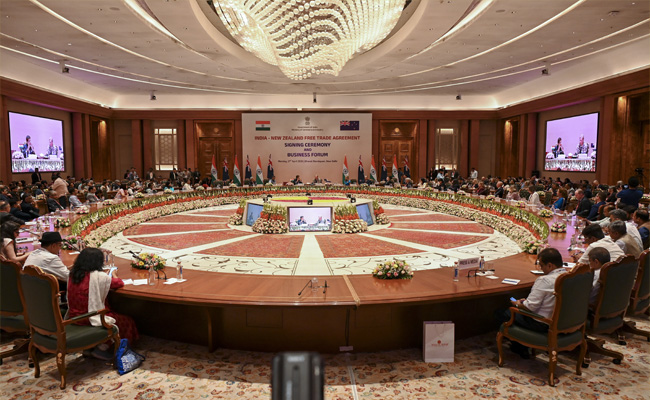
New Delhi (PTI): India and New Zealand on Monday inked a free trade agreement, aimed at boosting two-way commerce and investments.
The pact was signed by Commerce and Industry Minister Piyush Goyal and visiting New Zealand's Trade and Investment Minister Todd McClay.
The FTA provides duty-free access for 100 per cent of India's exports to New Zealand, covering all tariff lines or produce categories, and is expected to significantly boost MSMEs and employment by enhancing competitiveness in labour-intensive sectors such as textiles, apparel, leather, footwear, gems and jewellery, engineering goods, and processed foods.
Earlier, New Zealand maintained peak tariffs of up to 10 per cent on key Indian exports, including ceramics, carpets, automobiles, and auto components.
With zero-duty market access from entry into force as New Zealand's other trade partners, Indian products will be fully competitive in that country, enjoying a level playing field.
ALSO READ: Cal HC urges EC to dispose of TMC complaint over police observer's meeting with BJP nominee
Significantly, India also secured duty-free inputs for its manufacturing sector, including wooden logs, coking coal, and waste and scraps of metals, lowering production costs and enhancing the global competitiveness of the Indian industry.
On the other hand, India has offered tariff liberalisation on 70.03 per cent of tariff lines covering 95 per cent of bilateral trade value, while keeping 29.97 per cent of tariff lines excluded to protect India's sensitive sectors.
The products that are kept in exclusion are mainly -- dairy (milk, cream, whey, yoghurt, cheese etc.), animal products (other than sheep meat), agricultural products (onions, chana, peas, corn, almonds), sugar, artificial honey, animal, vegetable or microbial fats and oils, arms and ammunition, gems and jewellery, copper and articles thereof (cathodes, cartridges, rods, bars, coils), aluminium and articles thereof (ingots, billets, wire bars) among others.
On 30 per cent of tariff lines of New Zealand, India will provide duty elimination on goods such as wood, wool, sheep meat, and leather-raw hides.
Similarly, 35.60 per cent of tariff lines are subject to phased elimination over 3, 5, 7, and 10 years, including petroleum oil, malt extract, vegetable oils, selected electrical and mechanical machinery, and peptones.
New Zealand products which enjoy tariff reductions include wine, pharmaceutical drugs, polymers, aluminum, iron and steel articles, and goods that only 0.06 per cent fall under tariff rate quotas, including Manuka honey, apples, kiwi fruit, and albumins, including milk albumin.
The FTA also includes a commitment to facilitate USD 20 billion in investment into India.
A rebalancing clause is incorporated into the Agreement to provide a framework for addressing any shortfall in investment delivery, thereby ensuring robust and tangible economic outcomes.
Total bilateral trade in goods and services reached USD 2.4 billion in 2024.