Bihar survey: Mahagathbandhan gets 46% Dalit support, NDA at 32%
Patna, July 23: A ground-breaking survey jointly conducted by the National Confederation of Dalit and Adivasi Organisations (NACDAOR) and The Convergent Media (TCM) has offered a rare, in-depth look into the political mood and social concerns of Bihar’s Dalit communities. What makes this initiative unique is that it was entirely led by Dalit activists themselves, making it the largest participatory survey of its kind ever conducted in the state.
The survey covered 18,581 respondents across 49 Assembly constituencies, including 11 reserved for Scheduled Castes (SC), and spanned six major regions Kosi, Mithilanchal, Seemanchal, Bhojpur, Champaran, and Magadh-Patliputra. A team of 98 Dalit youth, trained through four residential workshops in Patna, Begusarai, and Darbhanga, carried out the fieldwork over 25 days between June 10 and July 4, 2025.
Releasing the findings at a press conference, NACDAOR Chairman Ashok Bharti and TCM directors Prem Kumar and Ranjan Kumar said this was not just a survey but a model of participatory research. “This survey is by Dalits, for Dalits. It goes beyond data collection—it's about ownership of narratives and political self-awareness,” they said.
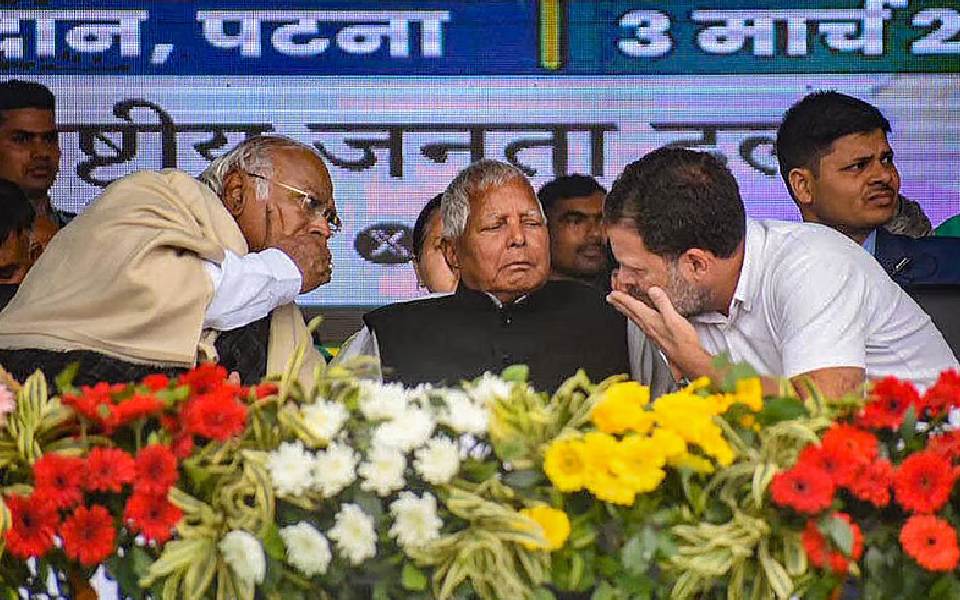
The results indicate that the Mahagathbandhan, the alliance led by RJD and Congress, has emerged as the leading political choice among Dalit communities, securing 46.13% support compared to the NDA's 31.93%. The alliance’s presence is particularly strong in the Kosi and Bhojpur regions. In contrast, NDA finds its stronghold in Seemanchal.
One of the most telling findings of the survey is the decline in support for Chief Minister Nitish Kumar, especially among Mahadalits. Communities like the Dusadhs have shown only 18.79% support for him, and other Mahadalit sub-castes report backing ranging between 20% and 33%. This reflects a weakening connect between the JD(U) and the very communities it once claimed to empower.
When asked about individual leaders, Tejashwi Yadav emerged as the most popular among Dalit respondents with 28.83% support, closely followed by Chirag Paswan at 25.88%. Nitish Kumar trailed behind with 22.80%, suggesting that generational change and new voices are gaining ground within the Dalit political imagination.
Unemployment has clearly emerged as the top concern for Dalit communities in Bihar. More than 58% of the respondents identified it as their primary issue, with even higher figures in economically weaker regions like Kosi (80.5%) and Bhojpur (61.4%). Other concerns include poor education and healthcare facilities, and corruption.
In terms of national leaders, Prime Minister Narendra Modi remains the most popular with 47.5% support, but he is closely followed by Congress leader Rahul Gandhi at 40.3%, a notable number considering the Congress’s limited organisational strength in Bihar. Respondents also gave significant credit to both Rahul Gandhi (30.81%) and Tejashwi Yadav (27.57%) for pushing the caste census agenda, while only 33.15% credited Modi.
Late Dalit icon Ram Vilas Paswan continues to hold a strong emotional connection among the community, with 52.35% describing him as the most influential Dalit leader. His influence is particularly high among Dusadhs and smaller sub-castes. Babu Jagjivan Ram also continues to inspire, especially among Ravidas and Chamar communities.
The survey paints a grim picture of the public mood regarding the current state government. Nearly half of the respondents—48.43%—gave the Nitish Kumar-led government a negative rating, especially in Bhojpur and Kosi. Communities like Mehtar, Hadi, Valmiki and Pasi showed relatively more favourable responses, but discontent remains high overall.
Distrust in institutions was another theme that emerged from the responses. Only 51.22% of Dalits surveyed said they trusted the Election Commission, while over 27% felt it was not functioning impartially. A significant 71.56% of respondents said they feared being removed from voter lists, with the fear being highest among Ravidas, Pasis and Dalits in Seemanchal and Kosi regions.
There was also an overwhelming demand for expanding the scope of reservation, with 82.89% supporting reservation beyond the current limits.
Interestingly, the survey challenges the stereotype that Dalits vote only on caste lines. While caste remains a factor, 44.66% of respondents said they vote based on individual candidates, 32.51% based on party, and only 10.09% cited caste as the primary factor. This suggests that the Dalit electorate in Bihar is increasingly making choices based on issues, leadership, and performance.
The survey included all 23 Dalit sub-castes in Bihar and was especially representative of the state’s three largest Dalit groups—Dusadh (31%), Ravidas (30.7%), and Musahar (17.1%). Together, these three communities represent nearly 98% of Bihar’s Dalit population.
The findings have significant implications for upcoming elections in Bihar and highlight a shift in the state's Dalit politics from identity-based mobilisation to issue-driven choices. They also reflect a growing demand for representation, dignity, and structural change within marginalised communities.
Let the Truth be known. If you read VB and like VB, please be a VB Supporter and Help us deliver the Truth to one and all.
AIITA welcomes Karnataka’s ban on obscene songs in school events
Bhatkal: The Karnataka unit of the All India Ideal Teachers Association (AIITA) has welcomed the Karnataka government’s decision to strictly ban school children from dancing to obscene songs during educational and cultural programmes in government, aided, and private schools across the state.
AIITA Karnataka State President M. R. Manvi congratulated the government for taking what he termed an important step to preserve the sanctity of education.
“Such decisions to safeguard the dignity of school children and uphold the values of education are the need of the hour. This rule should not be limited to government schools alone but must be strictly implemented in all private educational institutions as well,” he said.
He further urged the government to address other concerns within school programmes.
“The government should not only prohibit obscene dances in the name of school anniversaries, but also ensure that plays and dialogues that incite religious hatred are avoided. Schools should be centres of harmony, not platforms for spreading hatred,” he added.
According to a recent circular issued by the Department of School Education and Literacy, obscene dances are adversely affecting the mental health and moral values of students.
In this regard, schools have been advised to use songs that promote nationalism, positive thinking, the greatness of Kannada culture, and value-based traditions instead of inappropriate content during programmes.
The circular also emphasises that students should be dressed in decent attire.
AIITA also backed the department’s warning that disciplinary action would be taken against head teachers if such guidelines are violated. The association has further demanded that district Deputy Directors of Public Instruction strictly monitor the implementation of these rules.