Gujarat: Bilkis Bano's family surprised on release of 11 life term convicts
gang rape and kin murder case
Ahmedabad, Aug 16: The husband of Bilkis Bano on Tuesday said they were surprised after coming to know from the media about the release of all 11 convicts sentenced to life imprisonment for her gang rape and murder of seven members of her family during the 2002 Gujarat riots.
Bilkis Bano's husband Yakub Rasul told PTI that he does not intend to comment on the latest development in the case on Monday.
Rasul said he, his wife and five sons, the eldest now aged 20, continue to live without a fixed address, more than 20 years after the incident.
The 11 convicts on Monday walked out of the Godhra sub-jail after the Gujarat government allowed their release under its remission policy.
A special Central Bureau of Investigation (CBI) court in Mumbai on January 21, 2008, sentenced the 11 accused to life imprisonment on the charge of gang rape and murder of seven members of Bilkis Bano's family. Their conviction was later upheld by the Bombay High Court.
Rasul said he came to know about their release from the media.
"We had no knowledge about when they (convicts) processed their application and which judgement the state government took into consideration. We never received any kind of notice and were not told about this. There was no way we could have known about this in advance," he said.
Asked about his reaction to the government's decision, Rasul said he does not know what to say.
"We don't intend to say anything on this. I can talk only after getting the details. All we want to do is pray for peace of the souls of our near and dear ones we lost their lives in the riots. Everyday we remember those who were killed in the incident, including our daughter," he said.
Rasul said the Gujarat government paid the family a compensation of Rs 50 lakh as directed by the Supreme Court.
"But the government has not yet made any arrangements for a job or house as directed by the Supreme Court," he said.
The family continues to live virtually in hiding without a fixed address, he said.
"We have no fixed address yet, we can't yet talk about where we live, it is quite difficult for us to do so," he said.
The compensation money, he said, was being used for the education of his sons.
The 11 convicts who were granted premature release are Jaswantbhai Nai, Govindbhai Nai, Shailesh Bhatt, Radheshyam Shah, Bipin Chandra Joshi, Kesarbhai Vohania, Pradeep Mordhiya, Bakabhai Vohania, Rajubhai Soni, Mitesh Bhatt, and Ramesh Chandana.
Radheshyam Shah, the convict whose plea for premature release paved the way for all the 11 life sentence convicts to walk out of jail, said he feels happy to be released.
"The Gujarat government has released us as per the order of the Supreme Court. I feel glad to be out as I will be able to meet my family members and begin a new life," he said.
"We were convicted and lodged in jail. When I was not released after completing 14 years in jail, I approached the Supreme Court for remission. The apex court directed the Gujarat government to take a decision, after which we were released," he said.
The convicts were released on Monday under the Gujarat government's remission policy after they completed more than 15 years in jail.
On March 3, 2002, Bilkis Bano's family was attacked by a mob at Randhikpur village in Limkheda taluka of Dahod district during the post-Godhra riots. Bilkis, who was five months pregnant at that time, was gang-raped and seven members of her family were killed.
The Supreme Court had in April 2019 directed the Gujarat government to give Rs 50 lakh compensation, a job and accommodation to Bilkis.
The 11 convicts who walked out of the jail were convicted for gang rape of a pregnant woman, murder and unlawful assembly under sections of the Indian Penal Code.
While convicting them, the special court had acquitted seven accused citing lack of evidence.
One of the accused had died during the course of the trial.
The Bombay High Court had on May 3, 2017 upheld their conviction. It also convicted seven others, including five policemen and two doctors, under IPC sections 218 (not performing their duties) and 201 (tampering with evidence).
Riots had erupted in Gujarat following the burning of a Sabarmati Express coach that killed 59 'karsevaks 'on February 27, 2002.
The violence had claimed the lives of 1,044 people, mostly Muslims, across different parts of the state.
The central government had informed the Rajya Sabha in May 2005 that 254 Hindus and 790 Muslims were killed in the post-Godhra riots.
Let the Truth be known. If you read VB and like VB, please be a VB Supporter and Help us deliver the Truth to one and all.
Rajnath to top commanders: Outmaneuver adversaries with strategic surprise
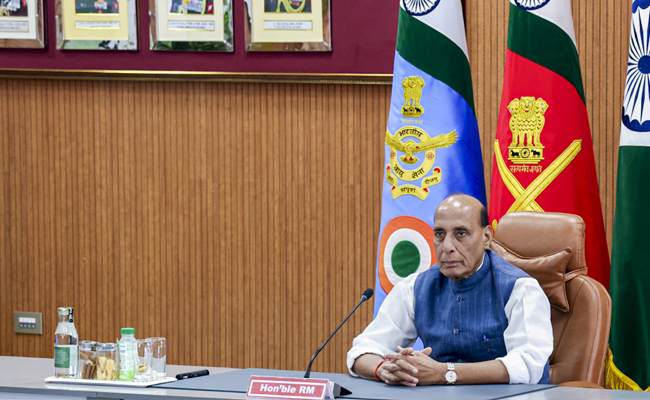
Jaipur/New Delhi (PTI): Defence Minister Rajnath Singh on Friday directed the top military commanders of the three services to integrate an "element of surprise" into modern warfare to outmaneuver India's adversaries and bolster strategic posture.
In his address at the joint commanders conference in Jaipur, Singh also described the Operation Sindoor as a testament to the "swift, precise, and joint response" of the Indian armed forces to safeguard national interests and called upon the military to remain ready to deal with any security challenges.
In their two-day deliberations, the commanders carried out a comprehensive review of the combat preparedness of the military in the wake of the evolving regional security situation.
Operation Sindoor was a demonstration of India's growing capabilities and a symbol of the nation's collective resolve and new military ethos, Singh said, a day after the first anniversary of Operation Sindoor.
He also unveiled a 'Joint Doctrine for Integrated Communication Architecture' that is aimed at strengthening doctrinal clarity, interoperability and integrated communications across the armed forces in future multidomain operations.
The joint commanders' conference, themed 'Military Capability in New Domains', brought together the top leadership of the defence ministry and the three services to deliberate on emerging security challenges and future readiness.
Comprehensive deliberations were held on future warfare, multidomain operations, technological transformation and joint capability development.
The conference witnessed extensive discussions on cognitive warfare, cyber resilience against evolving quantum and AI-enabled threats, military capability development in emerging domains, indigenous innovation and AI-enabled warfighting concepts.
It was attended by Chief of Defence Staff Gen Anil Chauhan, Chief of the Naval Staff Admiral Dinesh Kumar Tripathi, Chief of the Army Staff Gen Upendra Dwivedi, Chief of the Air Staff Air Chief Marshal AP Singh and Defence Secretary Rajesh Kumar Singh among others.
In his remarks, Singh asked the commanders to remain "future-ready" by learning from the operation as well as the current global security landscape.
He underscored the need to strengthen capabilities in artificial intelligence, autonomous systems, data analytics and secure communication networks to stay prepared in the rapidly evolving geopolitical security scenario. He emphasised that future conflicts will increasingly be shaped by hybrid threats, information dominance and operations conducted simultaneously across cyber, space, electromagnetic and cognitive domains, according to an official readout.
Highlighting the transformative impact of emerging technologies, Singh stressed on the importance of ensuring integrated national preparedness across all spectrums of conflict, it said.
Singh's remarks at the conference came a day after the first anniversary of Operation Sindoor.
The defence minister appreciated the progress achieved in enhancing jointness, integration and technological adoption across the three services, the readout noted.
Singh said that jointness constitutes a pivotal dimension within the transformative changes sweeping across the global defence sector.
"Future wars will not be won solely through weaponry, but through innovative thinking and enhanced synergy," he said.
The defence minister exhorted the commanders to cultivate the "element of surprise" to remain unpredictable to the nation's adversaries and secure a strategic edge in any given situation.
He, however, urged them to remain vigilant of the element of surprise of the enemy and always stay two steps ahead.
Singh also reiterated the Narendra Modi government's commitment to enhancing the capabilities of the defence forces through state-of-the-art weapons and platforms. He added that special focus is being laid on research in niche domains.
During the conference, he released a documentary film on Operation Sindoor.
The film reaffirms the nation's and defence forces' commitment to operational preparedness and decisive national response capabilities.
Demonstrations of advanced systems and platforms developed for intelligence fusion, operational planning and information management were also showcased during the conference reflecting growing integration of cutting-edge technologies into joint operational structures, according to the defence ministry.
The discussions will contribute significantly towards shaping India's future military transformation and integrated operational preparedness, it said.