Bill to ban triple talaq to be brought again: Minister Ravi Shankar Prasad
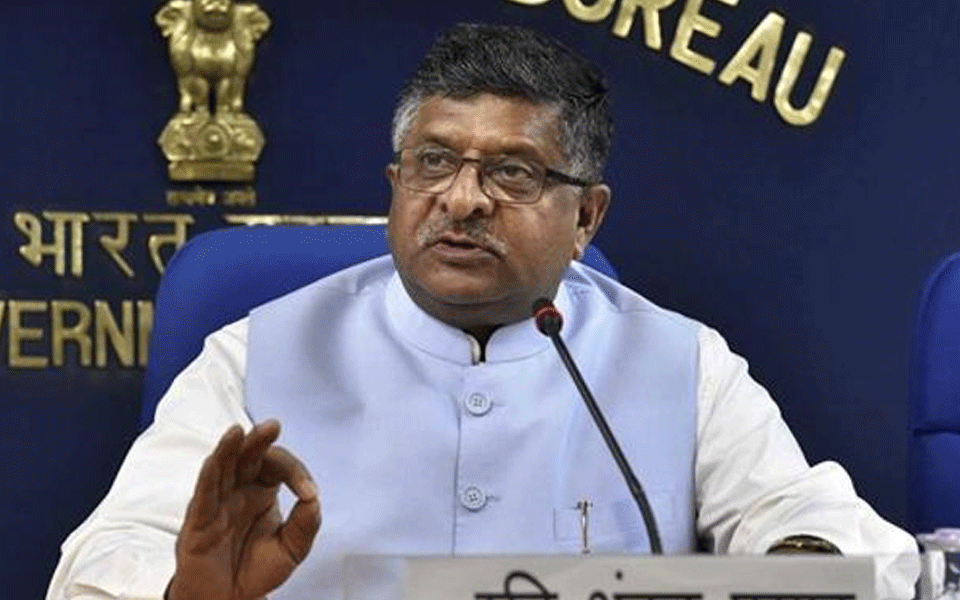
New Delhi: The government will bring a bill to ban the practice of instant triple talaq again in Parliament, Law Minister Ravi Shankar Prasad said Monday.
With the dissolution of the 16th Lok Sabha last month, the contentious bill on banning triple talaq had lapsed as it could not be passed by Parliament and was pending in Rajya Sabha.
Bills that are introduced in Rajya Sabha and pending there do not lapse with the dissolution of Lok Sabha. Bills passed by Lok Sabha, and pending in the Rajya Sabha, however, lapse.
The opposition had been opposing provisions of the bill in Rajya Sabha where the government lacked numbers to ensure its passage.
Asked whether the bill on triple talaq would be brought again, Prasad said, "Obviously. (The issue of) triple talaq is part of our (BJP) manifesto. Why not?"
Responding to a question on uniform civil code, he said the government would hold "political consultations" on the issue even as he goes through the Law Commission report on the issue.
On August 31 last year, the law panel had issued a consultation paper instead of a full-fledged report on the issue, saying a uniform civil code is "neither necessary nor desirable" at this stage. It had suggested changes in laws relating to marriage, divorce, alimony, and marriageable age for men and women.
The Muslim Women (Protection of Rights on Marriage) Bill, which made the practice of instant triple talaq (talaq-e-biddat) a penal offence, was opposed by the opposition parties which had claimed that jail term for the husband for divorcing his wife is legally untenable.
The government had promulgated the ordinance on triple talaq twice. Under the Muslim Women (Protection of Rights on Marriage) Ordinance, 2019, divorcing through instant triple talaq will be illegal, void and will attract a jail term of three years for the husband
A Bill to convert the earlier ordinance, issued in September 2018, was cleared by the Lok Sabha in December and was pending in the Rajya Sabha
Since the Bill could not get parliamentary approval, a fresh ordinance was issued.
Seeking to allay fears that the proposed law could be misused, the government has included certain safeguards in it such as adding a provision for bail for the accused during trial.
These amendments were cleared by the Cabinet on August 29, 2018. While the ordinance makes it a "non-bailable" offence, an accused can approach a magistrate even before trial to seek bail.
In a non-bailable offence, bail cannot be granted by police at the police station itself. A provision was added to allow the magistrate to grant bail "after hearing the wife", the government had said.
Let the Truth be known. If you read VB and like VB, please be a VB Supporter and Help us deliver the Truth to one and all.
Family of injured driver in murder of Suvendu's aide seeks exemplary punishment
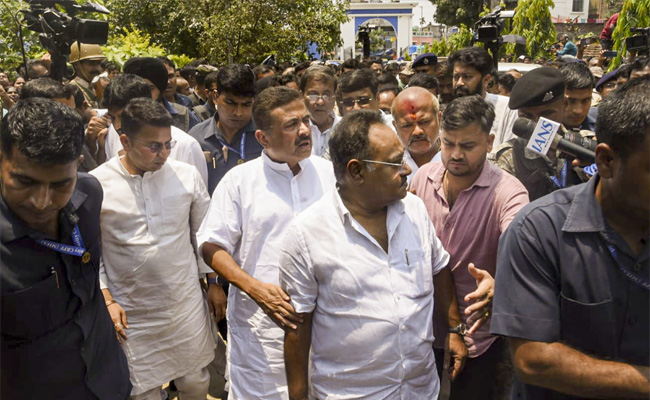
Kolkata (PTI): The family of Buddhabeb Bera, the driver injured in the shooting that killed BJP leader Suvendu Adhikari's close aide Chandranath Rath, demanded exemplary punishment for those responsible and urged the new government to ensure such incidents do not happen in West Bengal.
Rath was shot dead in Madhyamgram near Kolkata on Wednesday night, triggering a political storm in the state. Bera, who was driving the vehicle at the time of the attack, sustained gunshot wounds and is currently undergoing treatment at a private hospital.
Family members said they learned about the incident through television and immediately left for Kolkata.
ALSO READ: Trump says EU has until July 4 to approve last year's trade deal or it will face higher tariffs
"We came to know from TV reports that my nephew had been shot. We still do not know who carried out the attack or why it happened," Buddhabeb's uncle Biswajit Bera said.
"Our only wish now is that he recovers and returns home safely," he added.
Buddhabeb, 25, hails from Majnaberia village in the Chandipur police station area in Purba Medinipur district.
According to family members, he mostly stays in Kolkata for work and visits home occasionally during weekends.
Besides his parents, his younger brother, sister-in-law and several relatives have also travelled to Kolkata following the incident.
Demanding strict action against the perpetrators, the uncle said, "We want the government to conduct a proper investigation and identify those directly involved in the crime. They should be given exemplary punishment so that such incidents do not happen again in West Bengal and no other family has to go through this grief."
A neighbour, Ranjana Ghorai, also sought stringent punishment for those behind the attack.
"In our neighbourhood, we call him Sona. We want exemplary punishment for the people responsible for this incident," she said.
Rath's family members have demanded life imprisonment for the accused, while Adhikari has called for capital punishment for those involved in the killing.