Bishop's statement on political martyrs: Church says his statement misinterpreted
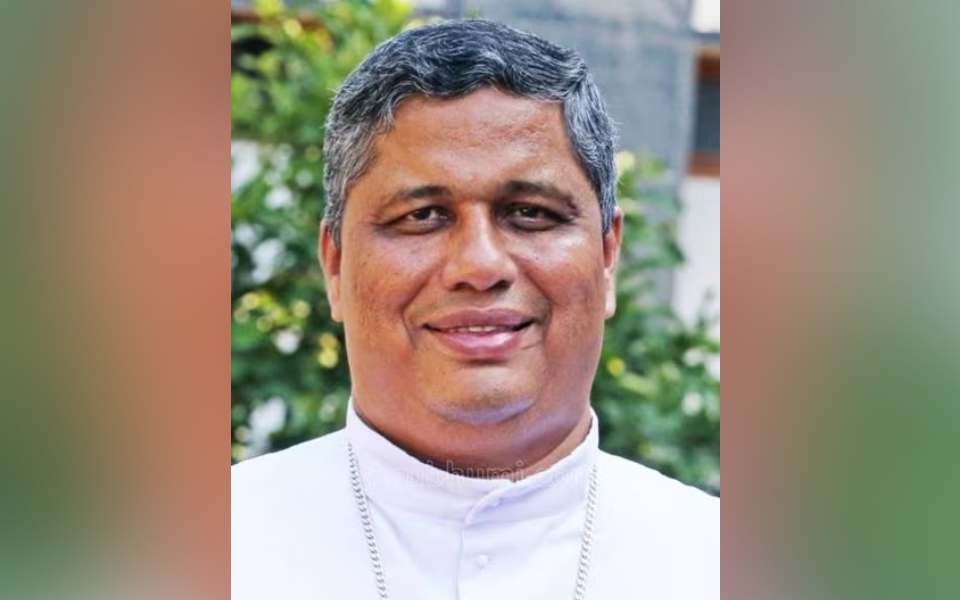
Kannur (PTI): The Thalassery archdiocese of the Catholic church has condemned the "misinterpretation" of its archbishop's statement on political martyrs and said the church has a history of respecting the martyrs.
Thalassery Archbishop Mar Joseph Pamplany had on Saturday courted controversy by stating that political martyrs are those who died after getting into "unnecessary fights".
At an event of the Kerala Catholic Youth Movement (KCYM) held on Saturday, the Bishop had said that the martyrdom of the 12 apostles of Jesus was different from that of political martyrs.
The archdiocese, in a statement issued on Sunday night, said that some persons were "misinterpreting the statement of the Bishop".
"The church has a long history of respecting martyrs...There are people who were martyred for their ideology and values just like the apostles...It's a fact that there are such martyrs cutting across political lines. But some were sacrificed for vested interests and the Bishop warned against such incidents," the statement read.
It condemned "such misinterpretation of a general statement" which did not have any "political implication".
The church also said that they respect those who were martyred for the country and its independence.
"The martyrdom of the Apostles is not like that of the political martyrs. Some of the political martyrs are those who got shot after getting into unnecessary fights with someone or some are those who fell from bridges while fleeing from the police after some protests. But the 12 martyred apostles (of Jesus) are those who sacrificed their lives for truth, and the wellbeing of the world," Pamplany had said.
The video went viral on Sunday after which senior Left leaders including LDF convenor E P Jayarajan and senior Left leader P Jayarajan had criticised the statement.
P Jayarajan had asked Pamplany whether Gandhiji was killed after he engaged in some "unnecessary fight" with someone.
"How can he insult the martyrs? They are called martyrs after they lost their lives when the communal or fascist forces murdered them. There are martyrs from various political parties and religions," E P Jayarajan said.
The LDF convenor had also said that "such baseless comments" against martyrs who sacrificed their lives for society cannot be accepted.
"Earlier, he (Bishop Pamplany) made the statement that BJP will get a seat if the rubber price is increased to Rs 300 per kg. So we are not giving any importance to his statement," P Jayarajan said.
He was referring to Pamplany's statement on March 19 this year in which he said that if the Centre promised to increase the rate of rubber procurement to Rs 300 per kg, BJP's dearth of an MP from the southern state would be addressed. His statement had created ripples in the political waters of the state.
P Jayarajan had also pointed out that many Christians were martyred in the recent Manipur riots.
Meanwhile, the BJP had come out in support of the Bishop and had said that the "attack" on the senior cleric was anti-democratic.
"It is the CPI(M) which makes martyrs out of those who get into unnecessary fights with others...The Bishop exposed the CPI(M). Political violence happens only in places where the Left party is strong. They are the ones who celebrate the death of martyrs," BJP state chief K Surendran had claimed.
Let the Truth be known. If you read VB and like VB, please be a VB Supporter and Help us deliver the Truth to one and all.
India, New Zealand ink free trade agreement
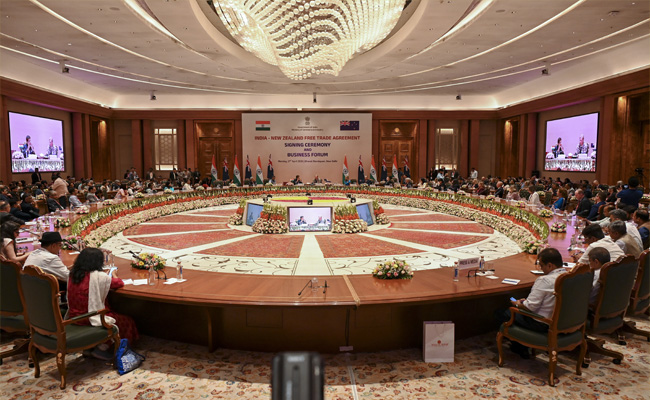
New Delhi (PTI): India and New Zealand on Monday inked a free trade agreement, aimed at boosting two-way commerce and investments.
The pact was signed by Commerce and Industry Minister Piyush Goyal and visiting New Zealand's Trade and Investment Minister Todd McClay.
The FTA provides duty-free access for 100 per cent of India's exports to New Zealand, covering all tariff lines or produce categories, and is expected to significantly boost MSMEs and employment by enhancing competitiveness in labour-intensive sectors such as textiles, apparel, leather, footwear, gems and jewellery, engineering goods, and processed foods.
Earlier, New Zealand maintained peak tariffs of up to 10 per cent on key Indian exports, including ceramics, carpets, automobiles, and auto components.
With zero-duty market access from entry into force as New Zealand's other trade partners, Indian products will be fully competitive in that country, enjoying a level playing field.
ALSO READ: Cal HC urges EC to dispose of TMC complaint over police observer's meeting with BJP nominee
Significantly, India also secured duty-free inputs for its manufacturing sector, including wooden logs, coking coal, and waste and scraps of metals, lowering production costs and enhancing the global competitiveness of the Indian industry.
On the other hand, India has offered tariff liberalisation on 70.03 per cent of tariff lines covering 95 per cent of bilateral trade value, while keeping 29.97 per cent of tariff lines excluded to protect India's sensitive sectors.
The products that are kept in exclusion are mainly -- dairy (milk, cream, whey, yoghurt, cheese etc.), animal products (other than sheep meat), agricultural products (onions, chana, peas, corn, almonds), sugar, artificial honey, animal, vegetable or microbial fats and oils, arms and ammunition, gems and jewellery, copper and articles thereof (cathodes, cartridges, rods, bars, coils), aluminium and articles thereof (ingots, billets, wire bars) among others.
On 30 per cent of tariff lines of New Zealand, India will provide duty elimination on goods such as wood, wool, sheep meat, and leather-raw hides.
Similarly, 35.60 per cent of tariff lines are subject to phased elimination over 3, 5, 7, and 10 years, including petroleum oil, malt extract, vegetable oils, selected electrical and mechanical machinery, and peptones.
New Zealand products which enjoy tariff reductions include wine, pharmaceutical drugs, polymers, aluminum, iron and steel articles, and goods that only 0.06 per cent fall under tariff rate quotas, including Manuka honey, apples, kiwi fruit, and albumins, including milk albumin.
The FTA also includes a commitment to facilitate USD 20 billion in investment into India.
A rebalancing clause is incorporated into the Agreement to provide a framework for addressing any shortfall in investment delivery, thereby ensuring robust and tangible economic outcomes.
Total bilateral trade in goods and services reached USD 2.4 billion in 2024.