BJP condemns Pragya's praise for Nathuram Godse, asks her to apologise
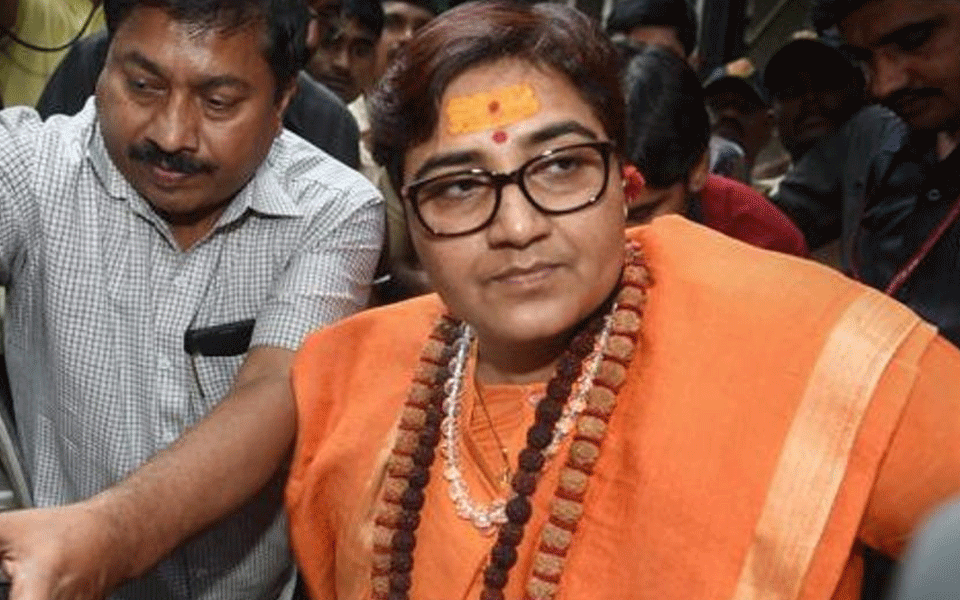
New Delhi, May 16: The BJP on Thursday condemned its Bhopal Lok Sabha seat candidate Pragya Singh Thakur's praise for Mahatma Gandhi's assassin Nathuram Godse as "patriot" and asked her to tender a public apology.
"We completely disagree with her statement with regard to Mahatma Gandhi. We strongly condemn this statement. The party will seek clarification from her as to why she gave this. It would be proper for her to seek and tender a public apology for her objectionable statement," BJP spokesperson G V L Narasimha Rao said in a statement.
But she stopped short of an apology, despite BJP leaders calling for one.
"It was my personal opinion. My intention was not to hurt anyone's sentiments. If I've hurt anyone I do apologise. What Gandhi Ji has done for the country cannot be forgotten. My statement has been twisted by the media," she told news agency ANI.
Thakur, an accused in the Malegaon blast case, ignited a fresh controversy Thursday by claiming that Godse "is and will remain a patriot".
Talking to a news channel in Madhya Pradesh, she said, "Nathuram Godse was a deshbhakt (patriot), he is and will remain a deshbhakt. Those calling him a terrorist should instead look at themselves. They will be given a befitting reply in this election."
Thakur said this in response to a question over actor-turned-politician Kamal Haasan's remarks that free India's first extremist was a Hindu, a reference to Godse.
This is not the first time her extreme views have embarrassed the BJP after it fielded her from Bhopal against Congress leader Digvijay Singh, projecting her as a "victim" of the UPA government's "fake Hindu terror" theory.
She was earlier forced to apologise after claiming that IPS officer Hemant Karkare, who was killed by terrorists during the 2008 Mumbai terror attack, died as she had cursed him after her arrest in Malegaon blast case.
Let the Truth be known. If you read VB and like VB, please be a VB Supporter and Help us deliver the Truth to one and all.
Marxism will remain relevant despite Left electoral's losses, says general secretary M A Baby
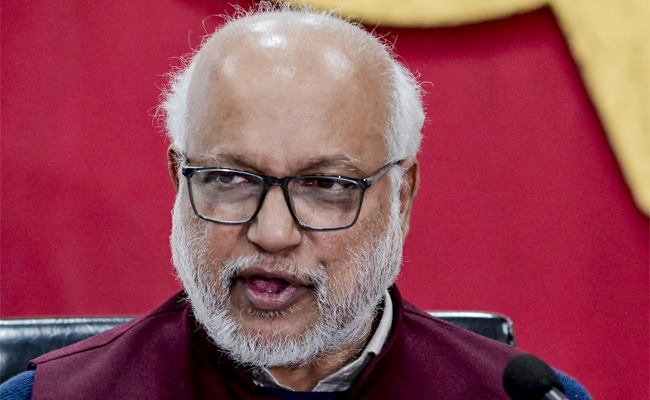
New Delhi (PTI): CPI(M) General Secretary M A Baby on Thursday asserted that the Left movement would remain relevant despite not being in power in any state, saying the ideology would continue to endure as long as social and economic inequalities persist.
Hitting back at BJP leader Rajeev Chandrasekhar over his reported remarks that Marxism had become irrelevant, Baby, in an interview with PTI Videos, said, "So long as there is division in society, so long as there is exploitation of the majority of workers, peasants and ordinary masses by a handful of billionaires, Marxism will remain relevant."
"That perhaps Mr Rajeev Chandrasekhar may not be able to understand, but this is the fact of the matter," he said.
Baby acknowledged that the CPI(M)-led Left was currently without an elected government in any state, but maintained that electoral setbacks would not diminish the movement's role.
"We may not have an elected government in any state. There were occasions when we didn't have a government. But the red flag and the commitment to organise and struggle for the rights of the dispossessed, marginalised and exploited will always be upheld by CPI(M) and the Left movement," he said.
He said the Left continued to enjoy support among workers, peasants, agricultural labourers, youth, students and women, and argued that the movement remained necessary because "oppression and assault" continued in society.
"So long as such problems exist in society, the red flag and the working class movement will continue to work among the masses," the Left leader said.
Exuding confidence on the Left's revival, Baby said the party would reflect on the reasons behind its electoral loss.
"We may be rejected in one election, but we will stage our comeback by understanding what went wrong with us," he said, adding, "We will listen to people and we will come back with higher strength."
Baby also criticised the Congress over reported factional tensions in Kerala after the Congress-led United Democratic Front's victory in the state.
"The way they are behaving is being watched by the people of Kerala," he said, referring to infighting within the Congress.
"Those who have given a massive majority to Congress and UDF would be watching all this," he added, while urging party leaders to "settle the problem in an amicable, democratic manner".
Referring to West Bengal, Baby alleged that violence had escalated following the BJP's victory in the state assembly polls.
"It is quite unfortunate that the moment BJP snatched a massive victory in West Bengal, violence has also started on a big scale," he said.
He also accused the Trinamool Congress of being "notorious for violent activities" and alleged that the "RSS-controlled BJP" had "unleashed violence in many places" after the election results.
"This is not good for Bengal, not good for the country. We wish and hope that normalcy would be restored as soon as possible," he said.
Baby said the CPI(M) and the Left in West Bengal would continue efforts to "pacify people" and avoid violence and confrontation.
Asked about former Kerala chief minister Pinarayi Vijayan not reacting publicly to the election results, Baby said Vijayan would respond "at an appropriate time".