BJP hits back at Congress, says Rafale deal profitable
New Delhi, July 27 : The BJP on Friday hit back at Congress over its allegations on the Rafale fighter jet deal, saying it had been "profitable" to the country.
THe party said the Modi government negotiated the deal with France at nine per cent less cost compared to that done by the former UPA.
The BJP posted a video with headline "Facts you need to know about Rafale deal!" on its official twitter handle claiming that the "most ambitious fighter aircraft aquisition project" from France was fixed at Euro 91.75 mn/aircraft (Rs 733.66 crore, as per current exchange rate: one Euro equals to Rs 79.96).
According to the video, Prime Minister Narendra Modi and his team put their best efforts to rework the Rafale deal with France in 2016 and "it successfully finalised the deal at 9 per cent less cost" by buying 36 aircraft at Rs 733.66 crore apiece."
The video also claimed that in 2011 the price negotiated by the UPA for 126 Rafale aircraft was Euro 100.85 mn/aircraft (Rs 806.43 crore/aircraft).
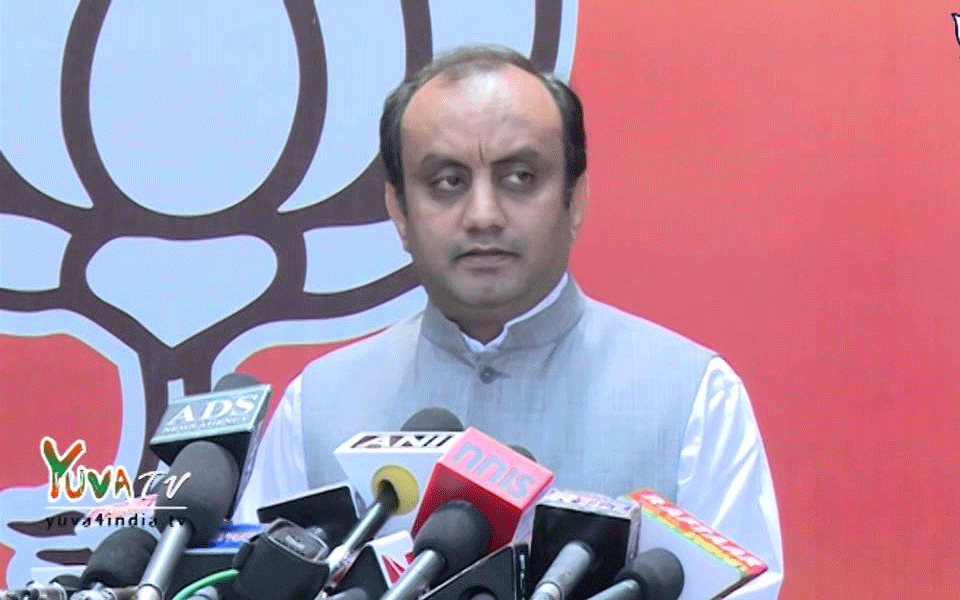
Earlier, BJP spokesperson Sudhanshu Trivedi rejected the fresh allegations as "baseless" , saying the opposition party is repeating same claims in "frustration" which has already been rebutted by Union Ministers and the French government.
"The BJP never levelled allegations in defence deals. It was members of Congress government or foreign countries which first alleged corruption in cases like Bofors deal or AgustaWestland chopper purchase," Trivedi said at a press conference.
He said those levelling allegations should first hear defence experts and refrain from politicising such deals.
The BJP leader said the Congress-led governments never allowed defence production in the country so that it could strike "deals" with foreign suppliers.
"Now, they are levelling baseless allegations after the Modi government has started working towards domestic production," he said.
Earlier in the day, the Congress accused Defence Minister Nirmala Sitharaman of "lying" on Reliance Defence Limited, which it said didn't have the experience in manufacturing fighter jets, having secured an offset contract from Dassault Aviation for Rs.30,000 crore and a consequent ‘Lifecycle Cost Contract of Rs. 1 lakh crore in the Rafale deal.
Stressing that national interest was being compromised by the Prime Minister and the Defence Minister, Congress demanded that Modi must "break his silence over whether he represented the interest of private companies and industrial houses."
Let the Truth be known. If you read VB and like VB, please be a VB Supporter and Help us deliver the Truth to one and all.
Fire breaks out in residential building in east Delhi, nine killed
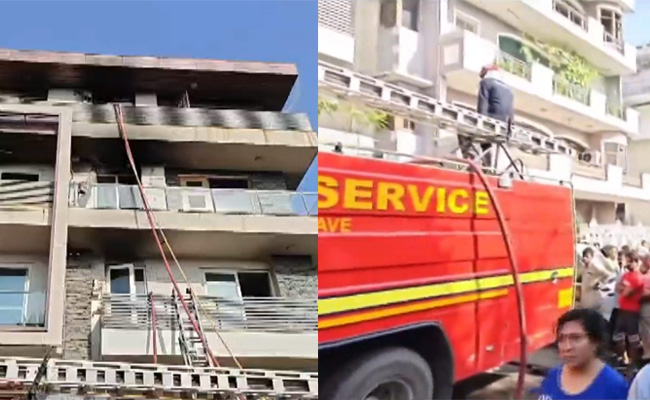
New Delhi (PTI): At least nine people were killed after a fire broke out in a residential building in east Delhi's Vivek Vihar early Sunday, officials said.
The incident was reported around 3.48 am at a four-storey building in Vivek Vihar Phase-I, following which police, fire and disaster management teams rushed to the spot.
According to the police, the blaze engulfed flats on the second, third and fourth floors of the building, prompting a large-scale rescue operation.
The cause of the fire is yet to be ascertained.
"Around 10 to 15 people were rescued from the premises during the firefighting operation. Two of them, who sustained minor injuries, were shifted to the Guru Teg Bahadur Hospital," a senior police officer said.
A total of 12 fire tenders were pressed into service to douse the flames, while teams from the Delhi Disaster Management Authority (DDMA), traffic police and local police assisted in the rescue and evacuation efforts.
Police said the fire was brought under control after several hours.
The identities of the deceased are yet to be ascertained, and efforts are underway to determine the cause of the fire, police said.
Further investigation and proceedings are underway.