BJP, Modi trying to end Gandhi-Nehru ideology: Congress leader Chennithala
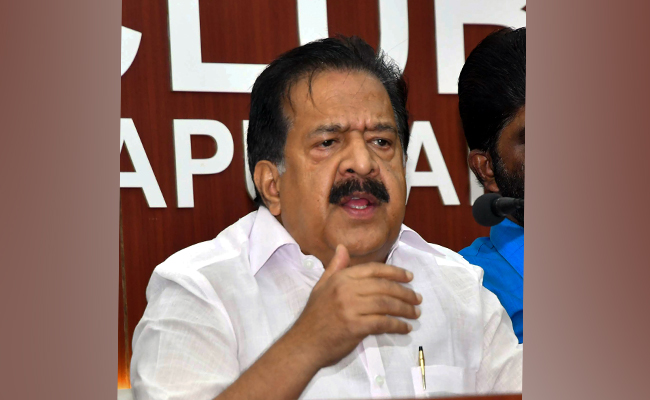
Mumbai (PTI): The Congress' Maharashtra in charge Ramesh Chennithala has said the Bharatiya Janata Party and Prime Minister Narendra Modi were trying to the end the Gandhi-Nehru ideology.
He was speaking on Saturday after a two-day state level training camp concluded in Lonavala in Pune, which was attended by all top leaders, including state unit chief Nana Patole, former chief minister Prithviraj Chavan and former minister Balasaheb Thorat.
"Narendra Modi and the BJP are working to end democracy. If Modi comes back to power, many people will have to go to jail. Because he doesn't believe in democracy or the Constitution. In this election, we face a do-or-die situation," Chennithala said.
"Modi constantly criticises Pandit Jawaharlal Nehru as he wants to end the Gandhi-Nehru ideology," the Kerala MLA added.
Speaking about the state level camp, he said there was very little time for the Lok Sabha polls, which will have to be fought in a scientific manner with proper booth management.
The INDIA alliance must work unitedly to ensure its wins 48 seats in Maharashtra, he said, adding that there must be discipline within the Congress.
It will not work if anyone starts speaking out of line, Chennithala added.
The NSUI, Youth Congress, frontal cells should also have regional level meetings, he added.
Patole said comprehensive discussions took place at the camp.
"We must work with the pride that we are Congress workers. The Congress should be united in the entire state. All cells, frontal organizations should be together. We don't have time to waste and must work on war footing," he said.
"The atmosphere is in favour of the Congress and MVA. The BJP is lying and cheating people. Remember, Maharashtra can stop Modi from retaining power," Patole claimed.
Thorat, the Congress Legislature Party leader, said his party had not regressed but people's principles were regressing.
At present politics doesn't have any ideology and those who have left the Congress will come back when the party regains power, he said.
"Don't let commercial politics continue. We should not allow such people within the Congress party. People should teach such commercial politicians a lesson," he said.
The Rahul Gandhi-led Bharat Jodo Nyay Yatra was generating positive energy among masses and with requisite efforts the Maha Vikas Aghadi can win more than 38 Lok Sabha seats in Maharashtra, Thorat said.
"The Congress party has a tradition, philosophy and work to show. The Congress has sacrificed for the country. We should be proud that we belong to the Congress. Elections are going to be fought as an alliance. No matter who the candidate is, the goal is that BJP and Narendra Modi should not stay in power. It is not in the interest of the country," Thorat said.
Speaking on the occasion, former CM Prithviraj Chavan said PM Modi constantly talks about India becoming the fifth largest economy in his leadership and that the country would be a developed one by 2047.
"But the pace of the country's economy is much slower under Modi than what it was under the UPA government of Dr Manmohan Singh. If the pace was similar now, we would have been the third largest economy by now," Chavan claimed.
During the UPA period (2004-14), the economy expanded by 183 per cent, while during the Modi era, it is 103 per cent, he pointed out.
"Demonetisation, implementation of GST, sudden lockdown, war waged against farmers and corruption have slowed down the pace of the economy. A dream is being shown that India will become a developed nation by 2047 but for that the per capita income should increase," he said.
"A country with high per capita income is a prosperous country. For that the per capita income should be USD 13,845. Currently, India's per capita income is USD 2800 dollars. The economy needs to grow at 10 per cent but under Modi it is only growing at 6-6.25 per cent. He is misleading people," Chavan claimed.
Meanwhile, Patole said the law for Maratha quota should be passed in the special session of the Maharashtra Legislature in such a way that it stands legal scrutiny.
The law enacted by the Devendra Fadnavis government (2014-19) was struck down by court, he said.
The Maharashtra government has cheated the Maratha community and quota activist Manoj Jarange, he asserted.
Let the Truth be known. If you read VB and like VB, please be a VB Supporter and Help us deliver the Truth to one and all.
12-year-old boy sexually assaulted by two classmates, class 10 student in Faridabad

Faridabad (PTI): A student of class 8 here was allegedly sexually assaulted for several days by two of his classmates and a student of class 10, police said on Saturday.
Based on a complaint of the victim's father, police have registered a case against the three juveniles under the Protection of Children from Sexual Offences (POCSO) Act at Saran Police Station.
According to police, the 12-year-old boy, studying in a government school, was leaving the premises to go home when he was lured by two of his classmates and another student of class 10 to the school bathroom, where they sexually assaulted him.
Following this, the accused students allegedly assaulted him for several days.
The boy's father noticed changes in his son's behaviour and asked him about it. He narrated his ordeal to the father who then approached the police.
Two of the accused students live in the same village as the victim, police said.
A senior police officer said, "We have initiated the necessary legal procedures. Counselling is being provided to the victim, and the entire matter is being investigated seriously. Further action will be taken based on the investigation."