'Blatantly undemocratic', CM Omar Abdullah slams 'house arrests'
NC leaders call it attempt to undermine elected govt
Srinagar, Jul 13 (PTI): Prominent leaders, including from ruling and opposition parties, were placed under "house arrest" in Srinagar on Sunday to prevent them from visiting the martyrs' graveyard to pay tributes to the 22 people killed by the Dogra army in 1931, a move termed by Chief Minister Omar Abdullah as "blatantly undemocratic".
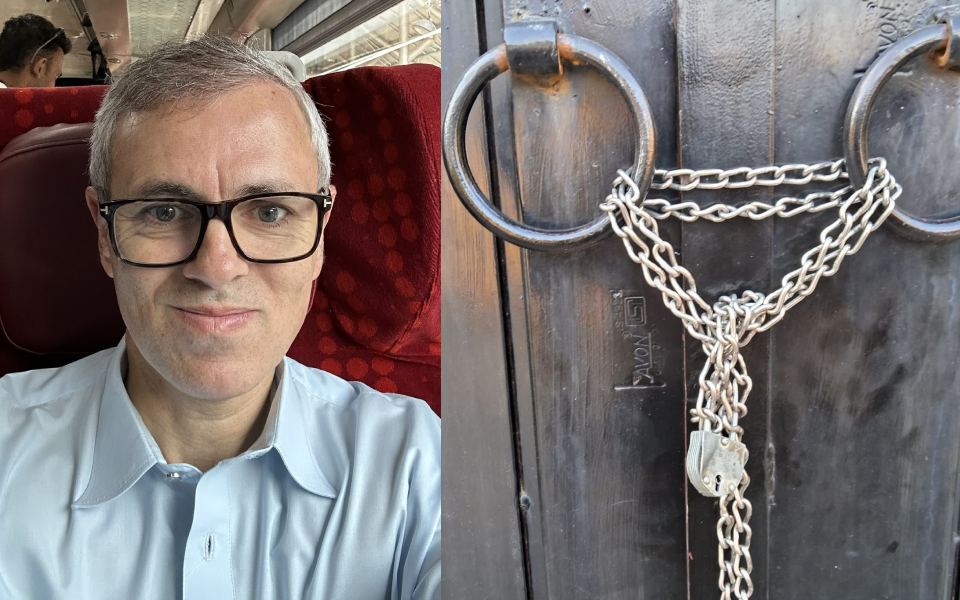
The detentions, which were not officially confirmed by police or the administration, were widely reported by leaders who posted videos and pictures showing their gates locked or blocked by security personnel to stop them from going to the Naqshband Sahib Martyrs graveyard near Nowhatta in the old city.
The Srinagar district administration had denied permission to all applicants, including the ruling National Conference leaders, to visit the graveyard. All roads leading to the area located in downtown were barricaded with a heavy presence of police personnel on Sunday.
In a post on X, the Jammu and Kashmir chief minister likened the July 13, 1931 incident to the Jallianwala Bagh massacre, saying, "the people who laid down their lives did so against the British... What a shame that true heroes who fought against British rule... are today projected as villains."
Abdullah criticised the house detentions, and said "in a blatantly undemocratic move, homes have been locked from the outside, police and central forces deployed as jailers... All to stop people from visiting a historically important graveyard."
The National Conference leader said, "We may be denied the opportunity to visit their graves today, but we will not forget their sacrifices".
Senior National Conference leader and advisor to the chief minister, Nasir Wani, termed the detentions as a "misuse" of power, specifically highlighting what he called a conflict between the "nominated system" of the central administration and the "elected government".
This sentiment was echoed by others who saw the move as an attempt to undermine the authority of the newly elected government.
Srinagar Police had issued a public advisory and posted on its handle on X on Saturday that the "District Administration Srinagar has denied permission to all applicants intending to proceed towards Khawaja Bazar, Nowhatta on 13th July 2025 (Sunday)". The district magistrate had also rejected the ruling National Conference's plea seeking permission for NC president Farooq Abdullah and other senior functionaries to visit the graveyard.
PDP President Mehbooba Mufti posted pictures of her main door locked and said, "When you lay siege to the Martyrs' Graveyard, lock people in their homes... it speaks volumes."
She argued that a genuine end to mistrust between Delhi and Kashmir would only happen when India accepts Kashmiri "martyrs" as their own.
"The day you accept our heroes as your own just as Kashmiris have embraced yours, from Mahatma Gandhi to Bhagat Singh, that day, as Prime Minister Modi once said, the 'dil ki doori' (distance of hearts) will truly end," she said in a post on X.
Deputy Chief Minister Surinder Chaudhary, who was in Jammu, said that his official residence in Kashmir was also locked by the administration.
"This is our condition. Locking a deputy chief minister, ministers and MLAs is a threat to democracy," he said.
“The nation that forgets its martyrs does not last long. Those who laid down their lives in 1931 were unarmed civilians fighting for their rights. They were not driven by religion or fighting against any community,” the deputy chief minister told reporters at the ruling National Conference headquarters.
July 13 used to be a public holiday in Jammu and Kashmir before the reorganisation of the erstwhile state into two Union territories in August 2019. The administration dropped the day from the list of gazetted holidays in 2020.
On the day, mainstream political leaders used to visit the "martyrs' graveyard" to pay homage to the Kashmiris who fell to the bullets of the forces during a protest against the then Dogra ruler, Maharaja Hari Singh, in 1931.
Leader of Opposition in J-K Assembly Sunil Sharma dubbed the slain protesters as “traitors” and said the ruling party is trying to indulge in “provocative politics” and revive a separatist sentiment which was long buried following abrogation of Article 370 in 2019.
"We consider them as traitors as I have made it clear on the floor of the assembly," the BJP leader said.
"National Conference is trying to indulge in provocative politics in the name of these traitors, terrorists, separatists and so-called political prisoners to revive the sentiment (of separatism). They are having a misconception but this will never happen again,” he told reporters.
Panun Kashmir and All State Kashmiri Pandit Conference held separate programmes in Jammu to protest "communal attacks" faced by the community in 1931.
Jammu and Kashmir Apni Party chief Altaf Bukhari said he has been confined to his home, with police reportedly locking his party's headquarters to prevent a planned prayer event.
He described the actions as "clear and blatant examples of highhandedness and authoritarian behaviour."
CPM leader and MLA M Y Tarigami posted on X that his gate has been locked and he has been placed under house arrest and denied the right to pay homage to the July 13 martyrs.
"This day is etched in our collective memory — a reminder of those who laid down their lives for the restoration of democracy and a better future for us all," he said.
Peoples Conference president Sajad Gani Lone also claimed that he has been stopped from leaving his residence.
"Not allowed to move out of home. Detained. I don't know why the union government is so keen to redefine what is sacred for the people of Kashmir. The sacrifices rendered on July 13 are sacred for all of us," he said.
Under house arrest since Friday, Hurriyat Conference chairman Mirwaiz Umar Farooq marked the day by posting a message on X saying Kashmir "bears witness to the painful saga of the sacrifices made by its sons and daughters," with the martyrs of July 13, 1931 having "led this quest by standing up to the tyranny of the rulers of the day".
"We may be put in jails or under house arrest and threatened with dire consequences, and the martyrs' graveyards may be sealed and blocked, but they live in our hearts and in our memory and will continue to, generation after generation," he said.
In a blatantly undemocratic move homes have been locked from the outside, police & central forces deployed as jailers & major bridges in Srinagar blocked. All to stop people from visiting a historically important grave yard containing the graves of people who laid down their… https://t.co/yTC2V53VAy
— Omar Abdullah (@OmarAbdullah) July 13, 2025
13th July massacre is our Jallianwala Bagh. The people who laid down their lives did so against the British. Kashmir was being ruled under the British Paramountcy. What a shame that true heroes who fought against British rule in all its forms are today projected as villains only…
— Omar Abdullah (@OmarAbdullah) July 13, 2025
Let the Truth be known. If you read VB and like VB, please be a VB Supporter and Help us deliver the Truth to one and all.
Compromised PM didn't sign trade deal with US, but a bargain for Adani's release: Rahul
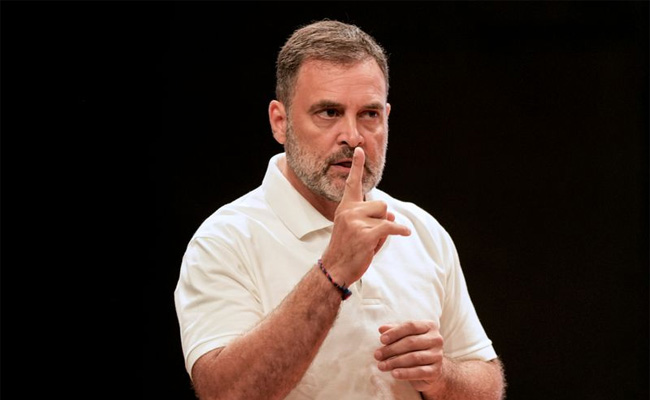
New Delhi (PTI): Congress leader Rahul Gandhi on Friday accused Prime Minister Narendra Modi of signing a trade deal with the US only to secure the "release" of billionaire businessman Gautam Adani.
"Compromised PM did not strike a trade deal, but a bargain for Adani's release," Gandhi said in a post in Hindi on X, after reports that the US has agreed to settle the lawsuit that accused Adani of hiding alleged bribery.
The US government has agreed to settle the lawsuit filed against Adani, who is accused of duping investors by concealing that his company's huge solar energy project in India was being facilitated by an alleged bribery scheme, according to court filings published Thursday.
Reacting to the reports, Congress general secretary in-charge communications Jairam Ramesh said it was now clear why the PM agreed to the "hopelessly one-sided Indo-US trade deal that was really a steal by the US".
"And it is also clear why he abruptly halted Operation Sindoor on May 10, 2025, acting on President Trump's threats rather than on our national interest. Reportedly, the Trump Administration is about to drop all charges of corruption against Modani," he said on X.
"How much more compromised can the PM get?" Ramesh asked.
In the lawsuit filed in late 2024, the Securities and Exchange Commission accused Adani Group Chairman Gautam Adani and his nephew Sagar Adani, who is a director at the group's renewable energy unit Adani Green Energy Ltd, of agreeing to pay about USD 265 million in bribes to Indian government officials between approximately 2020 and 2024 to obtain lucrative solar energy supply contracts on terms that expected to yield USD 2 billion of profit over 20 years.
It was alleged in the lawsuit that Adani Group raised USD 2 billion in loans and bonds, including from US firms, on the backs of false and misleading statements related to the firm's anti-bribery practices and policies.
The ports-to-energy conglomerate had denied the allegations.