Blow to India: Moody's cuts India's credit rating outlook to negative; Govt rebuts
New Delhi: In a blow to India, Moody's Investors Service has cut country's credit rating outlook to negative - the first step towards a downgrade, saying the government has been partly ineffective in addressing economic weakness, leading to rising risks that growth will remain lower.
While foreign currency rating was retained at Baa2 - the second-lowest investment grade score, Moody's projected fiscal deficit of 3.7 per cent of gross domestic product in the year through March 2020, a breach of the government's target of 3.3 per cent, as slower growth and a surprise corporate-tax cut curbs revenue.
In a statement, Moody's said the outlook partly reflects government and policy ineffectiveness in addressing economic weakness, which led to an increase in debt burden which is already at high levels, the rating agency said.
India's economy grew by 5 per cent between April and June, its weakest pace since 2013, as consumer demand and government spending slowed amid global trade frictions.
The government reacted strongly, saying the fundamentals of the economy remain quite robust and series of reforms undertaken recently would stimulate investments.
India's growth outlook has deteriorated sharply this year, with a crunch that started out in the non-banking financial institutions (NBFIs) spreading to retail businesses, car makers, home sales and heavy industries.
"Moody's decision to change the outlook to negative reflects increasing risks that economic growth will remain materially lower than in the past, partly reflecting lower government and policy effectiveness at addressing long-standing economic and institutional weaknesses than Moody's had previously estimated, leading to a gradual rise in the debt burden from already high levels," the rating agency said.
While government measures to support the economy should help to reduce the depth and duration of India's growth slowdown, prolonged financial stress among rural households, weak job creation, and, more recently, a credit crunch among NBFIs, have increased the probability of a more entrenched slowdown, it said.
"Moreover, the prospects of further reforms that would support business investment and growth at high levels, and significantly broaden the narrow tax base, have diminished," it said.
"A prolonged period of slower economic growth would dampen income growth and the pace of improvements in living standards, and potentially constrain the policy options to drive sustained high investment growth over the medium to long term," it added.
Fitch Ratings and S&P Global Ratings -- the other two international rating agencies -- still hold India's outlook at stable.
Finance Ministry in a statement sought to counter the lowering of the outlook by Moody's saying, "India's relative standing remains unaffected."
It said the Government has undertaken series of financial sector and other reforms to strengthen the economy as a whole.
"Government of India has also proactively taken policy decisions in response to the global slowdown. These measures would lead to a positive outlook on India and would attract capital flows and stimulate investments," it said.
"The fundamentals of the economy remain quite robust with inflation under check and bond yields low. India continues to offer strong prospects of growth in the near and medium-term," the Finance Ministry statement added.
The lowering of outlook will put additional pressure on Finance Minister Nirmala Sitharaman to take more measures to kickstart the economy.
With her maiden Budget for 2019-20 seemingly failing to address the widening problems in the economy, she took to announcing measures aimed at reversing the slowdown within a month of Parliament approving her Budget.
The measures include a package for the real estate and the automobile sector as also slashing of corporate income taxes for domestic companies to 22 per cent from 30 per cent previously. Also, the Reserve Bank of India has already cut interest rates five times this year, though lenders have not passed on that easing to customers.
Moody's said it doesn't expect the credit crunch among non-bank financial institutions, which were the main source of consumer loans in recent years, to be resolved quickly.
It said the negative outlook indicates that an upgrade is unlikely in the near term. "Moody's would likely change the rating outlook to stable if the likelihood that fiscal metrics would stabilise and improve over time..."
The rating agency said although the measures announced recently including policy rate cuts by the RBI, which will provide support to the economy, they are unlikely to restore productivity and real GDP growth to previous rates.
"In turn, a prolonged period of slower economic growth would dampen income growth and the pace of improvements in living standards, and potentially constrain the policy options to drive sustained high investment growth over the medium to long term," it added.
Moody's said its Baa2 rating balances the country's credit strengths including its large and diverse economy and stable domestic financing base for government debt, against its principal challenges including high government debt, weak social and physical infrastructure and a fragile financial sector.
Let the Truth be known. If you read VB and like VB, please be a VB Supporter and Help us deliver the Truth to one and all.
Ayush signs off with silver at Badminton Asia Championships
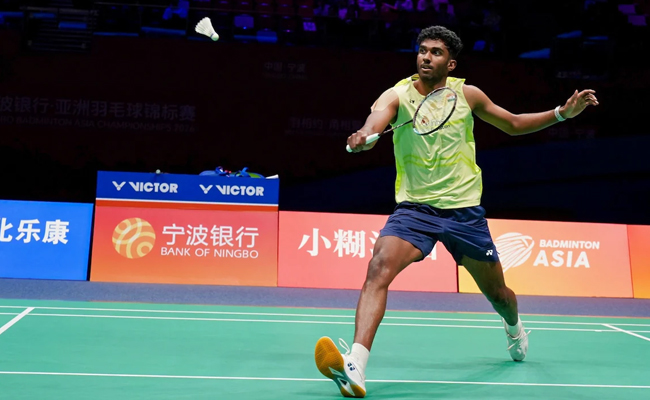
Ningbo (China) (PTI): India's Ayush Shetty signed off with a silver medal after his giant-killing run ended in a straight-game loss to world No. 2 Shi Yu Qi in the final of the Badminton Asia Championships here on Sunday.
The 20-year-old from Mangalore struggled to find his rhythm, going down 8-21, 10-21 to the reigning world champion from China, as India's 61-year wait for a men's singles gold at the event continued.
Despite the loss, it was a creditable campaign from the unseeded youngster, who became only the second Indian men's singles player after Dinesh Khanna to reach the final of the continental showpiece.
Khanna remains the only Indian singles champion at the event, having won the title in 1965. Since then, only the men's doubles pair of Satwiksairaj Rankireddy and Chirag Shetty have lifted the trophy, winning it in 2023.
World No. 25 Ayush entered the contest on the back of defeats to Shi at the Malaysia Super 1000 earlier this year and the Indonesia Masters last season. However, he had played with far greater control and attacking clarity this week, toppling world No. 1 Kunlavut Vitidsarn, world No. 4 Jonatan Christie and world No. 7 Li Shi Feng en route to the final.
However, the Indian, a product of the Padukone-Dravid Centre for Sports Excellence in Bengaluru, failed to counter the tactical discipline of Shi, who used his repertoire of strokes and deception to deny Ayush the opportunity to play his natural attacking game.
Shi dictated the geometry of the court from the outset, controlling the net exchanges and forcing Ayush into the forecourt battle early. The variation in the Chinese player’s game blunted the Indian’s attack, as his smashes lacked precision and he succumbed to scoreboard pressure, leading to rushed shot-making.
Shi Yu Qi logged the opening points with two fine net dribbles to race to a 4-0 lead, as Ayush’s smashes lacked precision early on and he trailed 2-6. A long rally ended with the Chinese player going wide, offering the Indian some respite. A deceptive net shot helped Shi move to 7-4, and he extended the lead to 11-6 as Ayush struggled for control, committing a string of unforced errors.
Shi mixed it up effectively, producing a lovely drop shot and repeatedly drawing the Indian to the forecourt with cross returns like a metronome, forcing errors. Two down-the-line smashes gave Shi a massive cushion of game points, and he sealed the opening game when Ayush sprayed a return wide.
The Indian needed a complete reset to stay alive, and he responded with a thunderous straight smash before diving on both flanks to keep the shuttle in play and move to 3-1 in the second game. Shi continued to test Ayush with backhand deceptive net strokes and pushes to the deep, but the Indian managed to retrieve everything and even found his precision in time, with an on-the-line smash confirmed by Hawk-Eye and a well-constructed rally taking him to 7-2.
However, he couldn't hold on to the momentum as the Chinese clawed back to 7-7 after two long shots and a smash into the net from Ayush. A return that kissed the backline from Shi, followed by another error from Ayush at the net and a return into the net, handed the Chinese the advantage once again at the interval, as he led 11-8.
Shi’s ability to place the shuttle into empty spaces with his repertoire of strokes, often punctuated by a fierce smash, made life difficult for the Indian as he stretched the lead to 13-8. Soon, the Chinese was up 15-9 with another powerful smash.
A body return followed by a straight smash took him to 17-9, and another long shot from Ayush further dented his chances. A perfectly angled smash into the forehand corner brought Shi within two points of victory. He then unleashed a cross-court smash to earn 10 match points and sealed the contest with a return that cramped the Indian, targeting his hip.