Bollywood-drugs nexus: NCB questions Deepika Padukone for five hours
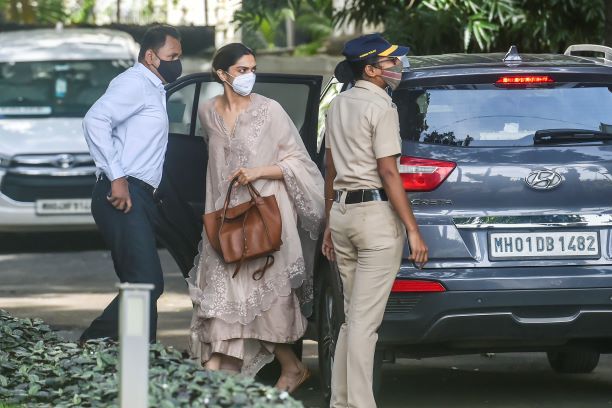
Mumbai: Actress Deepika Padukone was on Saturday questioned here for five hours by the Narcotics Control Bureau (NCB) probing the alleged Bollywood-drug nexus linked to film star Sushant Singh Rajput's death case, an official said.
Padukone was confronted with her manager Karishma Prakash during questioning, sources said.
Prakash's WhatsApp chats, including purported conversations about drugs with one 'D', are on the radar of the anti-drugs agency, sources had said.
Padukone, who reached the NCB guest house in Colaba in south Mumbai around 9.50 am, left around 3:50 pm, a police official deployed outside the guest house said.
After questioning, both Padukone and Praksh were allowed to go home around 3.40 pm, NCB sources said.
Prakash first came out of the guest house, followed by Padukone.
They left in their cars separately, the police official said.
Media personnel were present in large numbers outside the barricaded area near the guest house.
There were reports that Padukone's husband and actor Ranveer Singh had asked the NCB if he could also remain present during her questioning. However, the NCB had on Friday clarified that it did not receive any such request.
The NCB is also questioning actresses Shraddha Kapoor and Sara Ali Khan at its office separately in connection with the alleged drug nexus.
The federal agency had arrested actress Rhea Chakraborty, her brother Showik, and some suspected drug peddlers, earlier.
Rajput (34) was found hanging in his apartment in suburban Bandra on June 14
Let the Truth be known. If you read VB and like VB, please be a VB Supporter and Help us deliver the Truth to one and all.
Trump administration says its war in Iran has been 'terminated' before 60-day deadline
Washington (AP): The Trump administration is arguing that the war in Iran has already ended because of the ceasefire that began in early April, an interpretation that would allow the White House to avoid the need to seek congressional approval.
The statement furthers an argument laid out by Defense Secretary Pete Hegseth during testimony in the Senate earlier Thursday, when he said the ceasefire effectively paused the war. Under that rationale, the administration has not yet met the requirement mandated by a 1973 law to seek formal approval from Congress for military action that extends beyond 60 days.
A senior administration official, who spoke on condition of anonymity to discuss the administration's position, said for purposes of that law, “the hostilities that began on Saturday, Feb 28 have terminated.” The official said the US military and Iran have not exchanged fire since the two-week ceasefire that began April 7.
While the ceasefire has since been extended, Iran maintains its chokehold on the Strait of Hormuz, and the US Navy is maintaining a blockade to prevent Iran's oil tankers from getting out to sea.
Under the War Powers Resolution, the law that sought to constrain a president's military powers, President Donald Trump had until Friday to seek congressional authorisation or cease fighting. The law also allows an administration to extend that deadline by 30 days.
Democrats have pushed the administration for formal approval of the Iran war, and the 60-day mark would likely have been a turning point for a swath of Republican lawmakers who backed temporary action against Tehran but insisted on congressional input for something longer.
“That deadline is not a suggestion; it is a requirement,” said Sen Susan Collins, R-Maine, who voted Thursday in favour of a measure that would end military action in Iran since Congress hadn't given its approval. She added that “further military action against Iran must have a clear mission, achievable goals, and a defined strategy for bringing the conflict to a close."
Richard Goldberg, who served as director for countering Iranian weapons of mass destruction for the National Security Council during Trump's first term, said he has recommended to administration officials to simply transition to a new operation, which he suggested could be called “Epic Passage,” a sequel to Operation Epic Fury.
That new mission, he said, “would inherently be a mission of self-defence focused on reopening the strait while reserving the right to offensive action in support of restoring freedom of navigation.”
“That to me solves it all,” added Goldberg, who is now a senior adviser at the Foundation for Defense of Democracies, a hawkish Washington think tank.
During testimony before the Senate Armed Services Committee on Thursday, Hegseth said it was the administration's “understanding” that the 60-day clock was on pause while the two countries were in a ceasefire.
Katherine Yon Ebright, counsel at the Brennan Center's Liberty and National Security Program and an expert on war powers, said that interpretation would be a “sizeable extension of previous legal gamesmanship” related to the 1973 law.
“To be very, very clear and unambiguous, nothing in the text or design of the War Powers Resolution suggests that the 60-day clock can be paused or terminated,” she said.
Other presidents have argued that the military action they've taken was not intense enough or was too intermittent to qualify under the War Powers Resolution. But Trump's war in Iran would certainly not be such a case, Ebright said, adding that lawmakers need to push back against the administration on that kind of argument.