Bomb threat: Aeroflot flight from Moscow makes emergency landing at Delhi airport
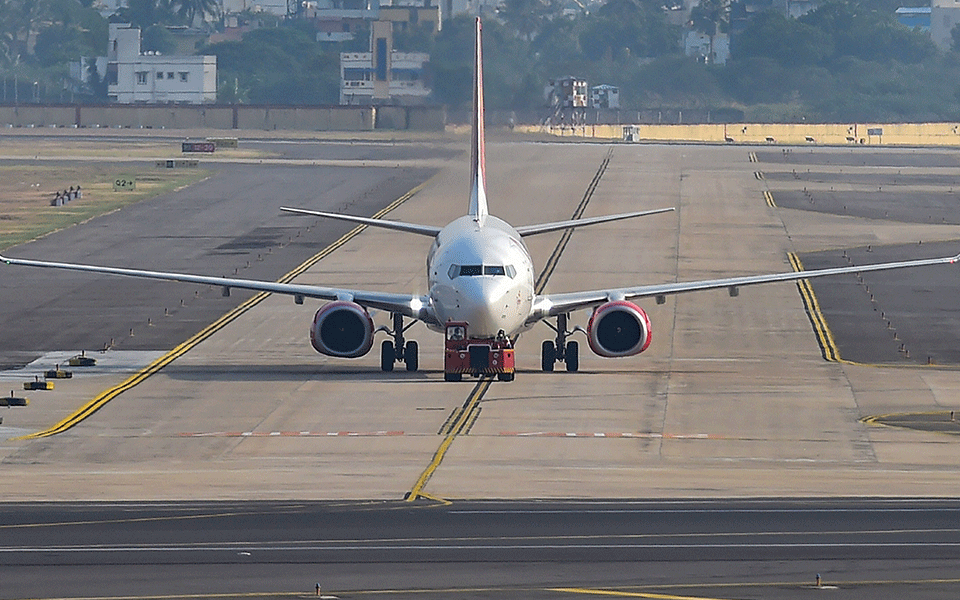
New Delhi (PTI): A plane from Moscow carrying 400 people made an emergency landing in the national capital on Friday following a bomb threat, according to officials.
The Aeroflot aircraft operating flight SU 232 landed at the Indira Gandhi International Airport here at 2.48 am. The passengers and crew were evacuated safely, they said.
According to the police, the Central Industrial Security Force (CISF) received an e-mail warning of bombs on the flight on Thursday night.
As the flight landed, its 386 passengers and 14 crew members were immediately evacuated, a senior police official said.
The flight was checked and nothing has been found so far, the official said, adding that the aircraft has been isolated.
"On Thursday around 11 pm, a threat message was received at IGI Control Room social media site regarding bombs planted on board Russian flight no SU-272 arriving at IGI Airport. The flight landed at 2.48 am safely," one of the officials said.
Full emergency was declared for the landing of the Boeing 777 aircraft that was being operated by Russian carrier Aeroflot, the official added.
There have been at least two incidents of alleged bomb threat on flights in the last few weeks.
On October 3, the Indian Air Force had scrambled its fighter jets after receiving information of a bomb scare on a China-bound Iranian civilian plane that was flying over the Indian airspace. The aircraft did not land in India and later landed safely in China.
Earlier, on September 30, a Malaysia-bound flight was delayed over a false bomb alarm after a fight between two passengers onboard the plane at the IGIA. Four passengers allegedly involved in the incident were handed over to the local police.
Among other incidents, on August 12, 2019, IGIA received a hoax bomb call for Terminal-2 that affected its operations for around 70 minutes.
Let the Truth be known. If you read VB and like VB, please be a VB Supporter and Help us deliver the Truth to one and all.
NEET student hangs self in Rajasthan's Sikar

Jaipur (PTI): A student preparing for the NEET examination allegedly committed suicide by hanging himself in a rented room in Rajasthan's Sikar on Friday, police said.
According to the police, the student allegedly hanged himself from a ceiling fan using his sister's scarf while one sister was attending coaching classes and the other was in the bathroom.
He had appeared in the NEET UG exam 2026, which was cancelled due to paper leak, they said.
Udyog Nagar SHO Rajesh Kumar said that the deceased, identified as Pradeep Meghwal, was a resident of Kanika ki Dhani village in Jhunjhunu's Gudha Gaudji area.
He had been living in a rented room in Sikar's Jaldhari Nagar area with his two sisters while preparing for NEET over the last three years.
His elder sister later found him hanging and informed the landlord and police after bringing him down, officials said.
The SHO said the body was kept at SK Hospital mortuary, and a postmortem had not been conducted.
The student's father, Rajesh Kumar Meghwal, told police that Pradeep's NEET examination had gone well and the family was expecting him to score around 650 marks.
Former Rajasthan deputy chief minister Sachin Pilot expressed grief over the incident and linked it to anxiety among students after reports of irregularities and paper leaks in NEET 2026.
Pilot said repeated paper leak incidents and cancellation of examinations were affecting students' mental health and demanded a time-bound investigation and strict action against those responsible.