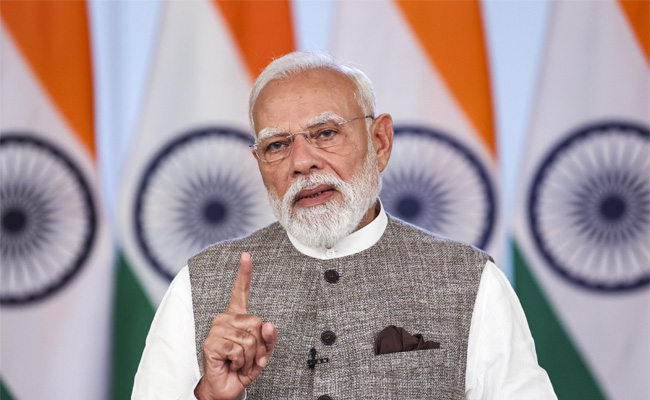
Brinda Karat of CPI(M) questions why Rohingya and Ahmadiyya Muslims were left out of CAA
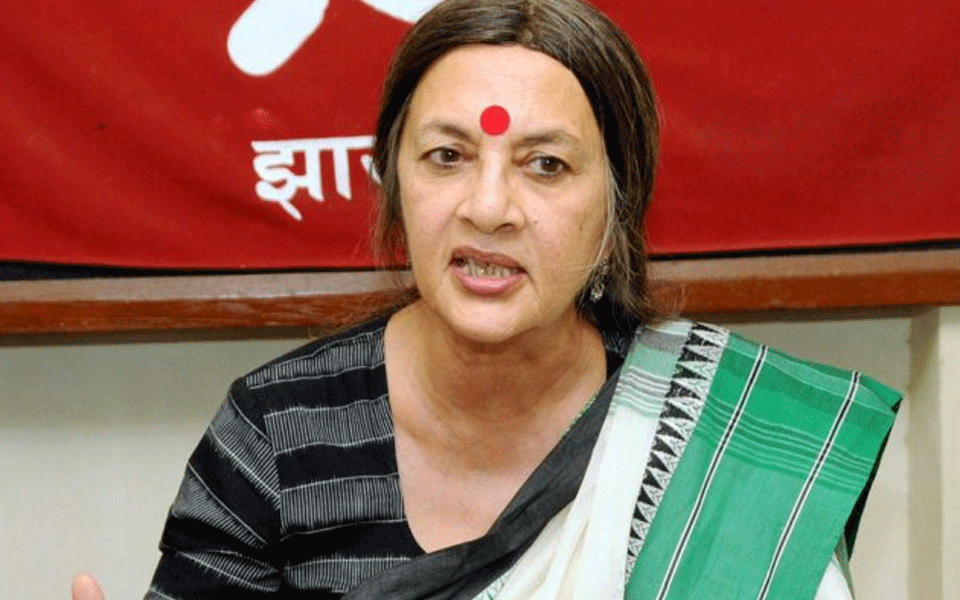
Raipur: CPI(M) leader Brinda Karat has asked why the Rohingya and Ahmadiyya Muslims, facing persecution in Myanmar and Pakistan, are not covered under the new citizenship law if the Centre is so much concerned about people facing atrocities in neighbouring countries.
Terming the Citizenship Amendment Act as "divisive and discriminatory", she said it is India's tragedy that instead of external forces, the central government itself is engaged in "weakening the Constitution and dividing the country".
She also hit out at the Rashtriya Swayamsevak Sangh, alleging that in 1950, when the entire country welcomed the Constitution drafted under the leadership of Dr B R Ambedkar, "the RSS was the one which opposed it".
"They call them 'Rashtriya Swayamsewak Sangh', but it is 'Rashtriya Sarvanash (destroyer) Sangh'," Karat said.
She was addressing a protest against the CAA, the proposed countrywide National Register of Citizens (NRC) and the National Population Register (NPR), largely attended by Muslim women, at Jaistambh Chowk here on Monday night.
The protest site has been dubbed as 'Shaheen Bagh of Raipur' by the protesters. "You (Centre) are saying that you have love and concern for the persecuted people in neighbouring countries.
We agree that such people should be given shelter. But only three countries - Pakistan, Afghanistan and Bangladesh - are our neighbours? Are there no persecuted people in Nepal, Myanmar, Sri Lanka?" Karat asked.
She sought to know why there is no mention of Tamils in CAA, despite over one lakh Tamil refugees living in India.
"Why you (government) don't have feelings for Rohingyas and Ahmadiyya facing atrocities in Myanmar and Pakistan (respectively). Why the two sects were not included in the new law. Is it because they are not Hindus? You are not concerned about persecuted people, rather you are projecting your narrow agenda," she alleged.
Some (religious) communities were "selectively" included in the CAA and it does not cover the persecuted people, she claimed.
Karat said the CAA is "aimed at changing the social fabric and nature of the Constitution" and it will not only affect Muslims but the entire nation.
The implementation of CAA in the entire country will be a great success for the BJP and RSS towards fulfilling their agenda of making India a 'Hindu Rashtra', she said.
"We can understand if external forces try to weaken our country and break it. But the tragedy of the country is that the forces sitting at the Centre are trying to weaken our Constitution and divide the country, not the external forces," Karat charged.
She also accused Prime Minister Narendra Modi and Union Home Minister Amit Shah of making a "mockery" of democracy, and asked why FIR was not registered against two BJP leaders after they made objectionable remarks during campaign for the Delhi Assembly elections.
"In Delhi, a Union minister said 'goli maaro', while a BJP MP said people protesting at Shaheen Bagh will enter homes and rape women. But, so far no FIR has been registered against them...how a heinous crime of rape can be linked with a religion or caste? They tried to give a communal colour to the incident of rape," Karat alleged without taking any names.
Union minister Anurag Thakur made the "goli maaro..." (shoot) remark during a public meeting in Delhi, while the 'rape' comment was made by BJP MP Parvesh Verma.
Karat also rejected the government's claim that the CAA has no link with the NRC and NPR.
Let the Truth be known. If you read VB and like VB, please be a VB Supporter and Help us deliver the Truth to one and all.
Govt comes out with set of FAQs on women's reservation bill
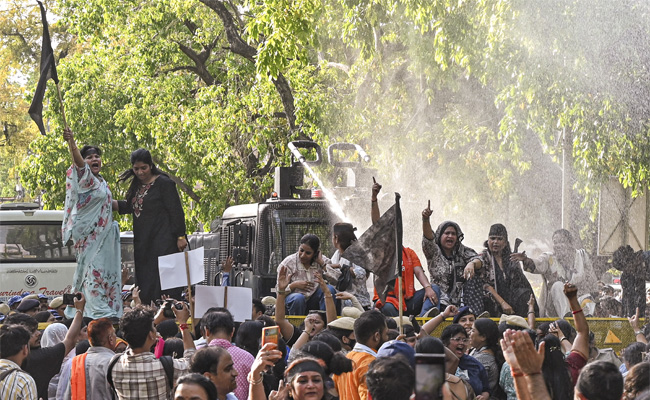
New Delhi (PTI): The government on Sunday came out with a set of Frequently Asked Questions (FAQs) related to the reservation for women in legislatures following the defeat of a Constitution Amendment Bill in the Lok Sabha that seeks to provide 33 per cent quota for women in the Lower House and state assemblies.
The FAQs came amid the Opposition's claim that in the name of women quota, the government was trying to carry out delimitation on its own will based on 2011 census.
Here are the FAQs:-
1. Which Bills were introduced by the central government in the Lok Sabha on April 16, 2026?
A:- On April 16, the central government introduced three key Bills in the Lok Sabha: The Constitution (One Hundred and Thirty-First Amendment) Bill, 2026, The Delimitation Bill, 2026 and The Union Territories Laws (Amendment) Bill, 2026.
2. Why were these three Bills brought at this point in time?
A:- The 'Nari Shakti Vandan Adhiniyam', commonly known as the Women Reservation Act, provides that reservation for women will be implemented based on delimitation after the Census conducted post-2026.
If the government had waited for the Census and subsequent delimitation, women would not have been able to benefit from 33 per cent reservation even in the 2029 general elections as the Census and subsequent delimitation period takes time.
Therefore, to ensure timely benefits to half the population, it was considered necessary to delink implementation of the Act from this condition.
3. What would have been the benefits if these Bills had been passed?
A:- If passed and approved, these Bills would have enabled women to receive 33 per cent reservation in the Lok Sabha as early as the 2029 general elections.
4. Why was delimitation linked with the Nari Shakti Vandan Adhiniyam, and why was there a proposal to increase seats?
A:- Delimitation means finalising the boundary of a constituency. It is essential for implementing women's reservation. The limit on seats in the Lok Sabha was set at 550 in 1976. In 1971, the population of India was 54 crore. Today it is 140 crore. Therefore, it is important to increase seats to 850 in the Lok Sabha. This would enable fair representation of people in Parliament.
5. Was there any attempt to modify the Delimitation Commission Act for political advantage? Would ongoing state elections be affected?
A:- No changes were proposed to the Delimitation Commission Act. The existing legal framework remains intact, and any recommendations of the commission would require parliamentary approval and Presidential assent.
Ongoing elections, including those in states like Tamil Nadu or West Bengal, would not be affected, as elections up to 2029 will be conducted under the current system.
6. What was the rationale behind increasing Lok Sabha seats to 850?
A:- The proposal was based on a proportional expansion approach. A uniform 50 per cent increase in seats would maintain the proportion for all states and UTs. Applying this principle to the current 543 seats would lead to approximately 815 seats. Therefore, the upper limit on seats was increased from current cap of 550 seats in Lok Sabha to 850 seats.
7. Would southern or smaller states have been adversely affected by the new delimitation proposal?
A:- No. All states would see uniform 50 per cent increase in seats. Southern states would not face any reduction in representation; rather, their overall share would remain stable. For example, Tamil Nadu's seats would increase proportionally, ensuring no disadvantage. The southern states currently have 23.76 per cent seats in Lok Sabha. This would have become 23.87 per cent after the passage of the Bills.
Lok Sabha seats in Karnataka would have increased to 42 from present 28; in Andhra Pradesh, the seats would have been 38 from the present 25; in Telangana, the total seats would have been 26 from the present 17; in Tamil Nadu, it would have been 59 seats from the present 39 and in Keralam, it would have been 30 from the present 20 seats.
Total seats in the five southern states would have been increased to 195 from the present 129.
This is 543 seats to 816 seats - 50 per cent increase model.
8. Would states that have controlled population growth face any disadvantage?
A:- No, as the increase in seats was proposed uniformly across states, their proportional representation would remain unchanged or slightly improve.
9. Would the representation of Scheduled Castes and Scheduled Tribes be affected?
A:- No, the process of delimitation ensures proportional reservation for Scheduled Castes and Scheduled Tribes. With an expanded House, the number of reserved seats would increase significantly, thereby strengthening their representation.
10. Was this Constitutional Amendment Bill introduced to delay caste census?
A:- No, the government has already started a time-bound programme for caste census. The process includes detailed enumeration, and caste-related data will be recorded during the population count phase.
11. Why was there no separate quota for Muslim women within the reservation framework?
A:- The Constitution of India does not provide for reservation based on religion. Reservation policies are based on social and economic backwardness, as laid out in the Constitution.
12. Why was women's reservation not implemented in the 2024 general elections itself?
A:- Implementing reservation requires delimitation of seats. Delimitation is an extensive consultative process. It takes about two years to complete delimitation. Therefore, these Bills (including Delimitation Bill) were brought in Parliament for implementing women's reservation.
13. Why was the Women's Reservation Bill introduced in 2023 if it was not to be implemented immediately?
A:- The Bill was introduced and passed in 2023 to establish the legal and constitutional framework for women's reservation. Its unanimous passage reflected broad political support at the time, enabling the enactment of the Nari Shakti Vandan Adhiniyam.
14. Why was a separate Union Territories Bill required?
A:- Legislative Assemblies in Union Territories such as Jammu and Kashmir, Delhi and Puducherry are governed by separate legal provisions. Therefore, specific amendments were required to implement women's reservation in these regions, necessitating a separate Bill.