Broadband internet services restored after week-long suspension in J-K’s Doda

Doda/Jammu, Sep 14 (PTI): Authorities on Sunday restored broadband internet services in Jammu and Kashmir’s Doda district where the situation started returning to normal after nearly one-week long restrictions following detention of sitting AAP MLA Mehraj Malik under the Public Safety Act, officials said.
Malik, who is also president of AAP's J-K unit, was detained on September 8 for allegedly disturbing public order in the district. His detention sparked violent protests, following which authorities imposed prohibitory restrictions and snapped mobile internet and broadband services.
The restrictions on the movement of people were eased for six hours from Saturday noon after Deputy Inspector General of Police, Doda-Kishtwar-Ramban Range Shridhar Patil, along with Deputy Commissioner Doda Harvinder Singh and Senior Superintendent of Police Sandeep Kumar Mehta held a meeting with civil society members, including representatives of traders and transporters.
The representatives were assured that restrictions would be progressively eased out starting immediately, the officials said.
The reopening of shops in the market, resumption of transport services, restoration of broadband and mobile internet services and the reopening of schools will be carried out in a phased manner after assessing the ground situation, the officers had said.
Broadband internet services were restored, while additional forces were removed from the markets which opened this morning, the officials said.
At the meeting, the representatives of Beopar Mandal, Transport Association and others assured their active support and cooperation to the district administration in maintaining public order and requested for phase-wise lifting of restrictions imposed under section 163 BNSS, so that government and private business may run smoothly and the general public feels relieved.
The representatives highlighted that the general public suffered significant losses in the recent flood-like situation in the district and people have high hopes from the government in this time of distress. They pushed for immediate restoration of services including Internet, transport, while stressing on the opening of schools and the market, the officials said.
The officials said the civil society representatives assured their active support and cooperation to the administration in bringing the situation back on track.
The DIG commended the role and support of the general public of Doda and other stakeholders in maintaining peace and order in the district by foiling the attempts of disturbing public order.
However, he stressed upon the participants, particularly the business community, to activate the CCTV cameras and ensure their functionality so that activities of trouble creators could be monitored.
He sought cooperation and responsibility of the transport association, shopkeepers to keep an eye on miscreants and trouble creators which includes sensitization of drivers, labourers and workers connected with the business activities.
The deputy commissioner assured the meeting that the issues of the public related to supply of essential commodities shall be addressed in 24 hours.
Let the Truth be known. If you read VB and like VB, please be a VB Supporter and Help us deliver the Truth to one and all.
Karnataka rolls out climate action plan to tackle global warming: Minister Khandre
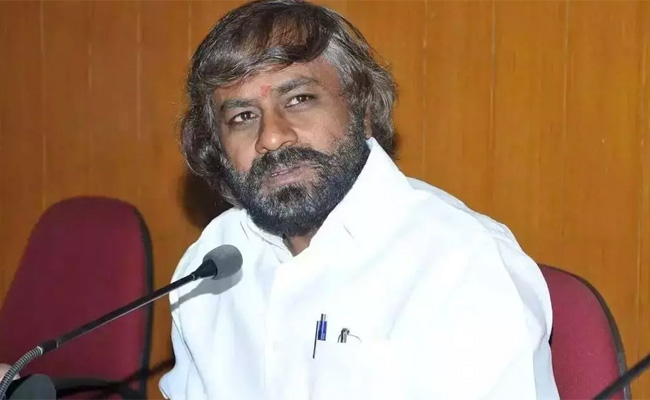
Bengaluru (PTI): Minister Eshwar Khandre on Tuesday said that a Karnataka state action plan on climate change has been formulated to mitigate the impact of global warming and climate change, and directions have been issued to ensure its proper implementation.
Speaking after presiding over a seminar on extreme heat and its impact on Bengaluru, organised by the Karnataka Media Academy, he said the Environmental Management and Policy Research Institute (EMPRI), which comes under the environment department, has taken steps to implement the action plan in coordination with various state government departments.
He said training programmes are being organised in cooperation with zilla panchayat offices for district officials and other related institutions regarding the implementation and progress of the Karnataka state action plan on climate change.
The Forest, Ecology and Environment minister said such programmes will be conducted in all 31 districts of Karnataka.
According to a statement issued by the minister’s office, in terms of climate resilience, Khandre said a dedicated radio programme, “Havamaana Mitra” (weather friend), was launched in April 2025 to share information on best practices, and 24 programmes have so far been broadcast on Akashvani.
ALSO READ: Passenger held at BLR airport with hydroponic ganja worth Rs 1.28 crore
He said these efforts aim to create public awareness.
Khandre emphasised that due to global warming and climate change, even seasons are changing today.
“Keeping this in mind, after becoming Forest Minister, I have been making every effort to increase green cover, especially in Bengaluru city,” he said.
He noted that during the last three years, about 11 crore saplings have been planted in the state, and information on their survival rate has been made available on the Forest Department website.
According to him, encroachments on about 250 acres of forest land worth around Rs 10,000 crore in several parts of Bengaluru, including Kothanur, Kadugodi, B M Kaval, and Turahalli, have been cleared.
Thousands of saplings have been planted and groves created on the cleared land, thereby preserving lung spaces essential for Bengaluru city.
The minister also recalled that more than 400 acres of forest land in Peenya plantation had earlier been allotted to the central government-owned HMT for industrial purposes.
He said HMT had sold 160 acres of this land, while 280 acres remain, and a decision has been taken to reclaim it for the department to preserve an essential lung space for Bengaluru. A legal battle is underway, and the case is currently in the Supreme Court.
In addition, he said 444 acres in the Jarakabande area had been allotted to the Indian Air Force. Under the Forest (Conservation) Act, 1980, forest land cannot be diverted without due process. Hence, in 2017, the then Deputy Commissioner cancelled the land allotment.
“Steps are now being taken to reclaim this forest land and preserve the green space,” he said.
Khandre also highlighted that the Yelahanka Air Force Station in Gantiganahalli, where the international air show is held once every two years in Bengaluru, is on forest land.
He said 159 acres in Gantiganahalli village is classified as a reserved forest area.
“If the Air Force submits a proposal for diversion and provides alternative land, this area may be considered for transfer; otherwise, steps will be taken to reclaim it for the forest department,” he said.
“The Indian Air Force is presently using this area as a runway. However, the RTC and mutation records are in the name of the Forest Department, and the land has not been legally converted. Hence, this forest land will be reclaimed,” he said.
He added that the government has resolved to construct a major biological park on 153 acres at Madappanahalli in Bengaluru North taluk, and cabinet approval has been obtained.
“The CM will lay the foundation stone next month. This will be the largest park after Lalbagh and Cubbon Park. It would not be incorrect to call this an achievement of the century,” he said.