BSF jawan shoots himself dead with service weapon in Chhattisgarh
Raipur: A Border Security Force (BSF) jawan allegedly committed suicide by shooting himself with his service weapon in Kanker district of Chhattisgarh on Saturday, police said.
The incident took place in the early hours at a forest in Pankhanjore police station area, police said.
"The deceased jawan, identified as Head Constable Suresh Kumar, was returning along with his colleagues after an anti-Naxal operation," a senior police official told PTI.
A team of BSF's 157th battalion had launched the operation on Friday from its camp in Sangam village, he said.
On the way back, Kumar allegedly shot himself with his AK-47 rifle between Ghoda and Dotameta villages, around 200 meters ahead of the camp, and died on the spot, he said.
What prompted him to take the extreme step is being ascertained, he added.
On Friday, an Assistant Sub Inspector (ASI) of the same 157th battalion had tested positive for COVID-19 in Bhilai town of Durg district. The ASI was kept in a quarantine centre set up by the paramilitary forces in Bhilai after he returned from his hometown in Uttar Pradesh following his leave.
The Frontier Headquarters of the BSF, which is extensively deployed in Kanker for anti-Maoist operations, is located in Bhilai. Security forces who are returning from other states are being quarantined before being allowed to join the duty.
Let the Truth be known. If you read VB and like VB, please be a VB Supporter and Help us deliver the Truth to one and all.
Strictest action promised after students forced to remove sacred thread at Bengaluru CET exam centre
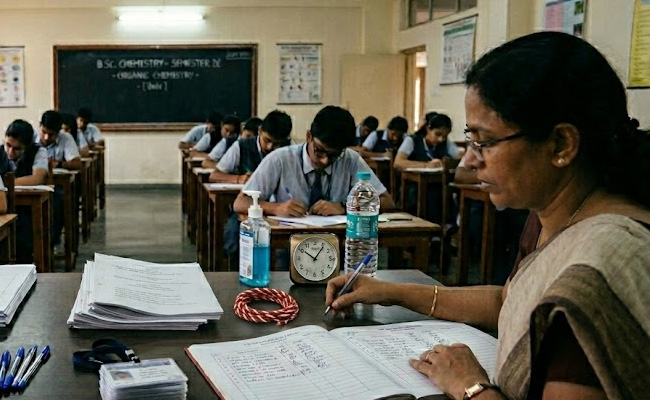
Bengaluru (PTI): Bengaluru Urban Deputy Commissioner Jagadeesha G on Monday said the government has decided to take the “strictest possible action” against those responsible for allegedly forcing some students to remove their ‘janivara’ (sacred thread) before entering the venue of the CET exam last week.
He said a committee of senior officials constituted to inquire into the incident reported that, prima facie, it appears the students were “intentionally” made to remove the ‘janivara’.
The city police have already booked three staff members of a private college in Bengaluru for allegedly forcing some students to remove their ‘janivara’ before entering the venue of the Common Entrance Test (CET-2026) last week.
Similar incidents last year in Shivamogga and Bidar had triggered controversy, following which the Karnataka Examinations Authority (KEA) issued clear directions not to force students to remove any religious identification or symbol during exams.
“Despite KEA taking measures such as appointing dress code officials and providing training on dos and don’ts to prevent such incidents from recurring after last year’s cases, there has been a dereliction of duty this time,” Jagadeesha told reporters here.
“To take strict action against those responsible, an FIR has been registered, and arrests have been made. An inquiry has been conducted by senior officials, and those responsible have been suspended,” he added.
Stating that the inquiry report has been submitted at the district level, he said it will be forwarded to the government.
Based on the findings, it has also been decided that KEA will not conduct CET exams at the institution where the incident occurred, he added.
“The strictest possible action is being taken by the district administration and the government,” he added.
The deputy commissioner had constituted a committee headed by the additional deputy commissioner to investigate the incident and submit a report within two days.
“Exams have been held at several centres across the state, and nowhere else has this issue occurred. If students were forced to remove ‘janivara’ at this centre, it appears that it was intentional. We have taken it seriously,” he said, adding that strict action has been recommended to ensure such incidents do not recur.
Noting that senior officials were appointed for the inquiry, the DC said that after a thorough investigation and verification—which included statements from students, the school principal, exam observers, CCTV footage, and documents—it prima facie appears that students were intentionally made to remove the ‘janivara’.
“We are recommending strict action. The government has also ordered a detailed police investigation, and an FIR has been registered in connection with the incident,” he added.