BSNL Q3 profit at Rs 262 cr, first profit since 2007
Scindia says return to profitability a turning point for telco

New Delhi: BSNL Limited has posted a net profit of Rs 262 crore for December quarter, marking its return to profitability after almost 17 years, Union Minister Jyotiraditya Scindia said on Friday terming it a "significant turning point" for the state-owned telco that has been focused on expansion of service offerings and subscriber base.
BSNL scripted an improvement on several counts, clinching 14-18 percent growth across mobility, FTTH and leased line service offering, Scindia, Minister for Communications said adding that the subscriber base too has risen to about 9 crore in December, from 8.4 crore in June.
"Today is an important day for BSNL, and for the journey of the telecom sector in India...BSNL has, in third quarter of FY2024-25, for the first time in 17 years, posted a profit on a quarterly basis. The last time that BSNL posted a quarterly profit was in the year 2007," he said on BSNL's earnings.
The net profit came in at about Rs 262 crore in the third quarter of the financial year. Mobility services revenue grew by 15 percent, Fiber-to-the-Home (FTTH) revenue increased by 18 percent and leased line services revenue rose by 14 percent over Q3 of the previous year.
The Q3 scorecard underlined the telco's focus on innovation, network expansion, cost optimisation, and customer-centric service improvements.
Additionally, BSNL has cut its finance cost and overall expenditure, leading to a decline in losses by over Rs 1,800 crore compared to last year.
With a view to enhancing customer experience, BSNL has introduced offerings such as National WiFi Roaming, BiTV – Free Entertainment for All Mobile Customers, and IFTV for All FTTH Customers, and first private 5G connectivity for mining.
"We certainly hope that this year will not just see an increase in revenues at the end of fourth quarter for the full financial year, but will also (see BSNL) keep expenditure and costs under control and significantly reduce losses from the figures of last year," the minister said.
In the last four years, BSNL's EBITDA doubled from Rs 1,100 crore to almost Rs 2,100 crore as of FY23-24.
"...And this quarter's return to profitability is a significant turning point for BSNL as it now embarks on providing 4G services to all its subscribers across the length and breadth of the country. Out of 100,000 towers, almost 75,000 have been installed, close to about 60,000 have been commissioned. And we hope that by June of this year all 100,000 towers will be operational," Scindia said.
Let the Truth be known. If you read VB and like VB, please be a VB Supporter and Help us deliver the Truth to one and all.
Mumbai family deaths: Rat poison ingredient zinc phosphide found in viscera, watermelon sample
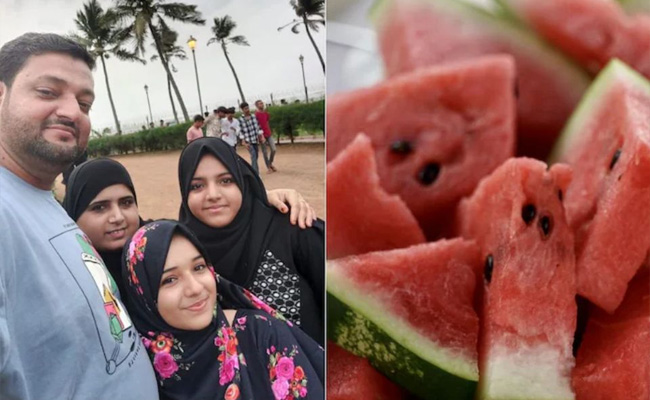
Mumbai (PTI): Four members of a family in Pydhonie area of south Mumbai died last month due to rat poison, police officials said on Thursday.
The Forensic Science Laboratory (FSL) report has confirmed the presence of zinc phosphide in viscera (liver, kidney, spleen), stomach contents, bile, and abdominal fat samples of the deceased identified as Abdulla Dokadia (44), his wife Nasrin (35) and their daughters Aayesha (16) and Zaineb (13), said Deputy Commissioner of Police Pravin Mundhe.
"The watermelon sample also tested positive for zinc phosphide, while all other food items were negative. The report will be studied in depth. We will consult forensic doctors. Further probe in the case is underway," the DCP said.
ALSO READ: Man dragged into river by crocodile in Vadodara; search ops underway
Zinc phosphide is used primarily as a highly toxic acute rodenticide to control rats and mice.
"The forensic experts who examined the viscera of deceased Abdulla Dokadia, Nasrin (35), Aayesha (16) and Zaineb (13) found traces of zinc phosphide. It is, however, unclear whether the rat poison was consumed accidentally (or on purpose). So far, we have found no strong reason why the whole family would take such an extreme step," another official said.
Further probe is being conducted by the JJ Marg police station, which has recorded statements of kin and neighbours, he added.
The Dokadia family, residents of Ghari Mohalla on Ismail Kurte Road, had hosted a get-together of relatives on the night of April 25. At around 1 am, hours after the guests had left, Abdullah Dokadia, his wife Nasreen, and daughters Ayesha and Zaineb ate pieces of a watermelon.
They suffered severe bouts of vomiting and diarrhoea in the early hours of April 26 and were rushed to a local hospital before being referred to the government-run J J Hospital where all four died during treatment.