Budget session set for 'EPIC' showdown; budget, Waqf bill top priority for govt
_vb_72.jpeg)
New Delhi (PTI): Parliament's Budget session resumes on Monday amid indications of an 'EPIC' showdown between the government and the opposition which is planning to raise issues such as the alleged manipulation of electoral rolls, the fresh bout of violence in Manipur and India's handling of the Trump administration.
The focus of the government will be on getting Parliament nod for the demands for grants, completion of the budgetary process, seeking approval for the Manipur budget and passage of the Waqf Amendment Bill.
Home Minister Amit Shah is expected to move a statutory resolution seeking Parliament approval for the proclamation of President's Rule in Manipur.
Finance Minister Nirmala Sitharaman is also scheduled to table the budget for Manipur on Monday. Manipur has been under President's Rule since February 13 after the resignation of Chief Minister N Biren Singh.
The opposition said it is set to corner the government over the issue of duplicate Electoral Photo Identity Card (EPIC) numbers.
The Trinamool Congress has taken the lead in flagging the issue, following which the Election Commission declared that it would take corrective measures within the next three months.
The Election Commission had rejected the Trinamool Congress claim that the voter lists were manipulated to allow voters from other states to exercise their franchise in West Bengal.
The poll body also made it clear that while the EPIC numbers of some voters "may be identical", other details such as demographic information, Assembly constituency and polling booth are different.
Trinamool Congress leaders are meeting the Election Commission on Monday and have also rallied other opposition parties, including the Congress, DMK, Shiv Sena-UBT, to raise the issue in both Houses of Parliament during the second part of the Budget session.
For the government, the early passage of the Waqf Amendment Bill is a priority.
Parliamentary Affairs Minister Kiren Rijiju said at the India Today Conclave last week that the government is keen on the early passage of the Waqf Amendment Bill as it will solve many issues of the Muslim community.
A Joint Committee of Parliament submitted its report on the bill in the Lok Sabha amid vociferous protests by the opposition.
Issues such as the fresh violence in Manipur, the threat of reciprocal tariffs by US President Donald Trump, the political furore over the delimitation of parliamentary constituencies are also expected to find an echo in Parliament.
Congress leader Jairam Ramesh has said the opposition INDIA bloc leaders will hold "extensive consultation" to jointly oppose the Waqf bill.
Ramesh also said the Congress will also keep raising the issue of irregularities in the election process, alleging that elections are "no longer free and fair" and are being "masterminded and orchestrated".
He said the Congress will raise the issue of Trump's reciprocal-tariff threats during the second half of the Budget session and called for a bipartisan collective resolve to deal with the threats.
The first part of the Budget session of Parliament was from January 31 to February 13. The second part will commence on March 10 and continue till April 4.
Let the Truth be known. If you read VB and like VB, please be a VB Supporter and Help us deliver the Truth to one and all.
Sujit Nair raises concerns over speculation of DMK-AIADMK understanding to block TVK
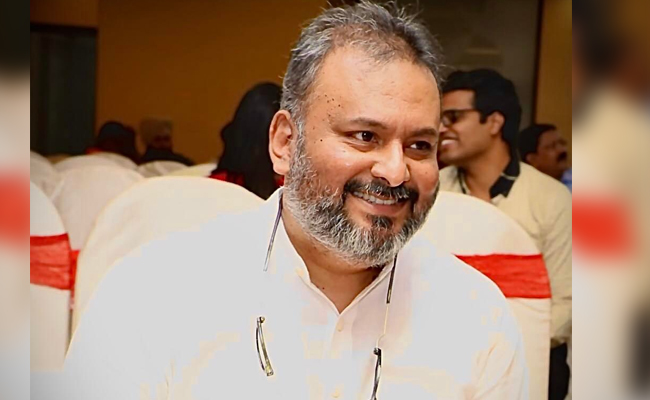
Chennai: Journalist and political commentator Sujit Nair has expressed concern over speculation that the Dravida Munnetra Kazhagam and the All India Anna Dravida Munnetra Kazhagam could explore a post-poll understanding to prevent Vijay-led Tamilaga Vettri Kazhagam from forming the government in Tamil Nadu.
In a social media post, Sujit Nair said the election verdict in Tamil Nadu reflected a clear public demand for political change and argued that the mandate should be respected irrespective of political preferences.
Referring to reports and political discussions surrounding a possible understanding between the DMK and AIADMK, he said he hoped such developments remained only speculative conversations and did not turn into reality.
Nair stated that if such an alliance were to take shape, it would raise serious questions about ideological politics in the country. He said TVK had emerged through a democratic electoral process and that the legitimacy to govern in a parliamentary democracy comes from the people’s verdict.
According to him, attempts to prevent an electoral winner from forming the government through unexpected political arrangements may be constitutionally valid, but many people could view them as politically opportunistic.
He further said that such a move could particularly affect the political image of the DMK, which has historically projected itself around ideology, social justice and opposition politics. Nair said that in ideological terms, the DMK appeared closer to TVK than to the AIADMK, and joining hands with its long-time political rival only to remain in power could weaken its broader political narrative.
He added that the same questions would apply to the AIADMK as well, as the party had spent decades positioning itself against the DMK and such an arrangement could create discomfort among its cadre and supporters.
Drawing a comparison with Maharashtra politics in 2019, Nair said he had expressed similar views when the Shiv Sena formed an alliance with the Indian National Congress and the Nationalist Congress Party after the Assembly elections.
He said post-poll alliances between long-standing political rivals often create a public perception that ideology and electoral mandates become secondary when political power equations come into play.
Nair also said such developments increase public cynicism towards politics and reinforce the belief among voters that ideology is often sidelined after elections.
He maintained that the Tamil Nadu verdict was emphatic and said respecting both the spirit and substance of the mandate was important for the credibility of democratic politics.