Budget shunned populism, bets on capex to power jobs and growth: PM Modi
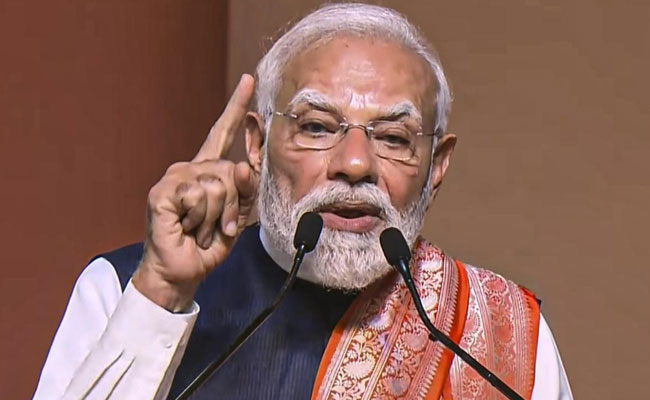
New Delhi (PTI): Calling productive spending a hallmark of his government, Prime Minister Narendra Modi on Sunday said the just unveiled Union Budget deliberately avoided short-term populism and instead channelled record capital outlays into infrastructure to drive jobs and sustainable growth.
In an exclusive interview with PTI, Modi said his government has used its years in office to plug "structural gaps left behind by earlier administrations", pursued bold reforms and laid the foundations for a developed India. He asserted that the latest Budget marks the "next level" of that journey.
Describing the Budget for fiscal year starting April 1 as reflective of his governance approach, Modi said the document "is a good reflection of our governance style and priorities".
"This Budget represents the next level in this journey, imparting momentum to our 'Reform Express.' It is designed to accelerate momentum and prepare our youth for the opportunities of a rapidly changing world," the prime minister told PTI.
He cited the pre-Budget Economic Survey to state that capital accumulation, labour formalisation, and digital public infrastructure together have elevated India' potential growth rate to 7 per cent.
"Productive spending has been a hallmark of our government. The high capital expenditure reflects our focus on infrastructure and capital investment, which are strong engines for long-term growth," he said in the written interview to PTI.
The FY27 Budget sharply scales up capital expenditure to Rs 12.2 lakh crore - a 5-times increase compared to 2013 - as the Modi government reinforces its strategy of prioritising infrastructure creation, logistics expansion and investment in sunrise sectors to drive long-term growth. It lays emphasis on spending on rail, roads, digital and energy infrastructure, alongside measures to ease compliance and improve credit flow as the central lever for job creation and economic momentum.
"This reflects a conscious strategic choice to invest in assets that create productivity, jobs, and future economic capacity rather than short-term populism. This shows that our focus is on improving the quality of life for the people, creating jobs for our youth and advancing the nation's progress towards Viksit Bharat," Modi said.
For a long time, the prime minister said, high-quality infrastructure had been neglected, posing a challenge for the people and Indian businesses.
"Broken and outdated infrastructure has no place in a nation that aspires to create a Viksit Bharat," he said.
"Therefore, we revolutionised the sector with our speed, scale and focus on creating next-gen infrastructure, while upgrading the existing infrastructure. In the last decade or so, India has seen perhaps the most expansive infrastructure-building effort in our history, an unprecedented emphasis on quality! The most important aspect of this has been the way we have created infrastructure with the future in mind."
Highlighting the scale of expansion, he said the number of airports has doubled as orders for thousands of aircraft are placed, number of cities with metro services has more than quadrupled, rural roads and internet connectivity are expanding rapidly, and investments made in the transformational expansion of freight corridors, ports, and coastal connectivity.
On sectoral allocations, he said a capital outlay of almost Rs 3 lakh crore has been made for Indian Railways, with a priority on high-speed connectivity, freight capacity, and passenger safety. Seven new high-speed rail corridors are proposed to be developed to connect major Indian cities, including the South High-Speed Diamond corridor, which will significantly benefit Karnataka, Telangana, Andhra Pradesh, Tamil Nadu, Kerala, and Puducherry.
At the same time, Dedicated Freight Corridors are being expanded to decongest passenger routes and reduce logistics costs for industry.
Allocations for national highways have increased nearly 500 per cent compared to a decade ago.
Highlighting investments in emerging sectors, Modi said investments are being made in sunrise sectors, including biopharma, semiconductors, electronics component manufacturing, rare earth corridors, and chemical parks. "These will provide a new impetus to jobs and investment while strengthening India’s future."
Emphasising governance reforms, the prime minister said, "An important feature of this budget has been our continued stress on trust-based governance. Across sectors, ministries, and processes, we are massively reducing paperwork, decriminalising offences, and reducing compliance requirements. This is because we envisage the state as an enabler, and we trust the citizens. This will have a far deeper impact on people’s lives than the numbers in typical budgets."
Modi said his government had built "an inclusive, tech-driven yet human-centric welfare architecture that reaches the last mile and leaves no one behind," with nation-building and economic strengthening as its guiding principles.
Recalling his call from the Red Fort - 'Yahi Samay Hai, Sahi Samay Hai' (now is the time, the right time) - Modi said the sense of urgency had now become a "national conviction".
"The 'now is the time' sense of purpose that you are alluding to has always been there within us. But today, that sense of urgency has become a national conviction, a whole-of-society resolve," he said.
Describing India's positioning in a changing global order, Modi said, "We are living in a post-pandemic world order that is opening new doors for India; countries eager to partner with us in trade and innovation, we have a young and increasingly skilled population; and we are focusing on strong growth accompanied by low inflation and macroeconomic stability."
Framing the Budget in long-term terms, he said the document should not be seen just as Budget 2026. "This is the first budget in the second quarter of the 21st century. This budget consolidates the gains made since 2014 and builds upon them to impart momentum for the next quarter-century."
"Just as the decisions and initiatives taken in the 1920s laid the foundation for independence in 1947, the decisions we are taking now are laying the foundation for Viksit Bharat by 2047," he added.
Let the Truth be known. If you read VB and like VB, please be a VB Supporter and Help us deliver the Truth to one and all.
Two killed as college tour bus crashes into parked tanker, lorry near Maravanthe
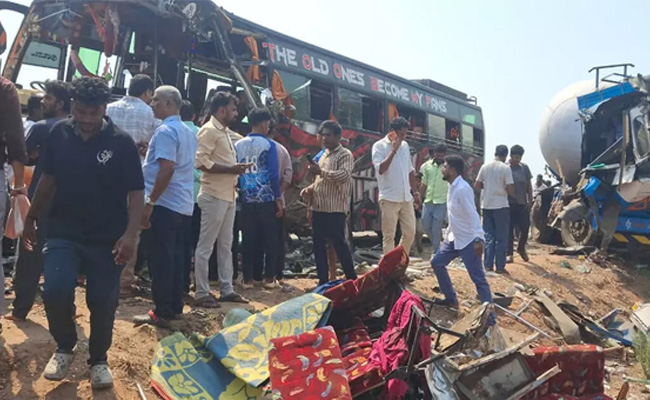
Kundapur: Two persons died and several students were injured after a college tour bus rammed into a tanker and a goods lorry parked by the roadside near Maravanthe Beach in Trasi on Wednesday afternoon.
The bus was carrying final-year B.Com students of Rambhapuri College from Shivamogga district. According to sources, the group had left for the tour two days ago.
There were around 50 persons in the bus, including 24 male students and 23 female students.
The students had visited Murdeshwar and were travelling towards Udupi on Wednesday when the accident occurred.
Police said the bus driver reportedly lost control of the vehicle, following which the bus first hit a parked gas tanker and then crashed into a goods lorry stationed ahead.
The front portion of the bus was badly mangled in the impact. Preliminary information said the bus cleaner and a cooking assistant travelling with the group died in the accident. Several injured students were shifted to different hospitals in Kundapur for treatment.