Bulandshahr violence attempt to instill fear among Muslims, claim human rights bodies
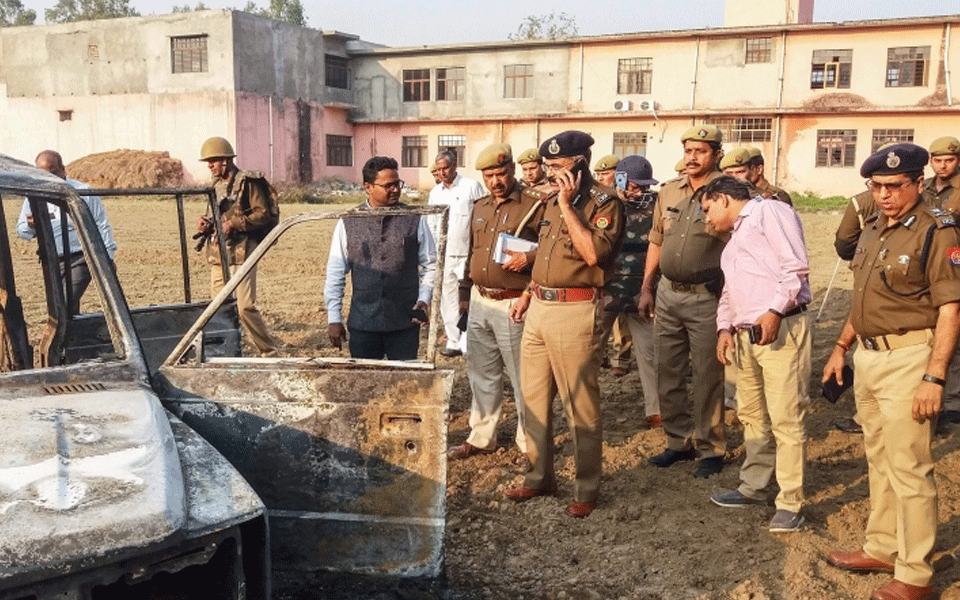
New Delhi, Dec 30: The recent Bulandshahr violence that claimed the lives of a policeman and a 20-year-old man was a "targeted attempt" to "instill fear" in the Muslim community, an umbrella organisation of human rights bodies claimed Sunday and demanded a Supreme Court-monitored probe into it.
Inspector Subodh Kumar Singh and civilian Sumit Kumar of Chingrawathi village were killed on December 3 in the mob violence that broke out in Bulandshahr's Siyana area after cattle carcasses were found strewn outside a village.
The incident happened when the election process in five states -- Madhya Pradesh, Rajasthan, Chhattisgarh, Mizoram, Telangana -- was underway.
"Hindutva Wadi forces masterminded" the incident to "polarise" the voters because of the "ongoing elections in five states", the organisation claimed, whose members visited Bulandshahr and presented a "fact-finding" committee's report here, and demanded a new law to check hate crimes.
The National Confederation of Human Rights Organisation (NCHRO) sought an immediate ban on all groups and 'senas' which use weapons "in the name of cow protection".
Addressing the media at the Press Club here, members of the NCHRO claimed that the violence was a "planted incident" to create unrest in the area and elsewhere "in the name of cow".
"The mob, at the instigation of local Bajrang Dal and BJP Yuva Morcha leaders Yogesh Raj and Shikhar Agrawal, gathered at the Chingrawathi police post and burnt down many vehicles, staged a shootout and pelted stones on the police force," it said in a statement.
The "fact-finding" team member Manoj Singh, of the All India People's Forum, claimed the way a purported video of the inspector's killing was shot "clearly indicates" the mob received political protection.
"In a peaceful area like Bulandshahr, the December 3 incident was a targeted attempt by Sangh-BJP organisations to instill fear in the Muslim community," said Singh.
He claimed that small skirmishes between local groups were used as an excuse to start communal clashes.
"There are clear signs of political conspiracies at play to discourage honest members of the administration, like Inspector Subodh, through intimidation and fear of life," he said.
He said there were also no signs of cow slaughtering at the fields outside Mahaw village, where the carcasses were found on December 3 morning, "which makes it clear that the mob violence...was executed through meticulous planning".
The NCHRO also highlighted that several innocent people, including two minors, were put behind bars while the key suspect, Bajrang Dal local leader Yogesh Raj, was still at large.
"A law should be made to contain mob violence and an immediate ban on all organisations and 'senas' which use weapons and have led the country to a civil war-like situation in the name of cow protection," the NCHRO said.
"Also another law be made and strictly implemented to ensure a state government's responsibility to check hate crimes and elements spreading hate crimes," it said.
The Home Ministry should review it on regular basis and share details in every parliamentary session on what steps it has taken to check riots and hate crimes, said Singh.
Another team member, Ansar Indori, claimed that the incident was a "planned affair".
"The occurrence of such a big incident in the presence of the administration proves that it was planned affair. Police presence deterred the violence from spreading further. The murder of a police officer at the hands of the mob occurred as he was executing his duties," Indori, an advocate by profession, told reporters.
Meanwhile, Sarfuddin, a resident of Nayabans village, who was initially arrested by the police following a complaint by Raj, told reporters that he would move court against his arrest.
He was arrested under Indian penal Code sections 358 (assault or criminal force on grave provocation) and 295 (injuring or defiling place of worship with intent to insult the religion of any class) but released after 16 days.
"I was put in jail for 16 days when I had done nothing. I am the president of the village's mosque committee and I was named under a conspiracy," he said.
Sarfuddin, who runs a clothes shop in Siyana town, also alleged that he was being threatened by a leader of a local right wing group who was opposed to the loudspeaker being installed on the mosque in 2017.
Seven people -- two children aged 11 and 12, a non-existent man, a man living in Faridabad for over a decade, besides Sarfuddin -- were named in the FIR for cow slaughter on a complaint by Raj.
The police recently arrested three men who were not named in the FIR for their role in the alleged cow slaughter on December 3.
Let the Truth be known. If you read VB and like VB, please be a VB Supporter and Help us deliver the Truth to one and all.
AIITA welcomes Karnataka’s ban on obscene songs in school events
Bhatkal: The Karnataka unit of the All India Ideal Teachers Association (AIITA) has welcomed the Karnataka government’s decision to strictly ban school children from dancing to obscene songs during educational and cultural programmes in government, aided, and private schools across the state.
AIITA Karnataka State President M. R. Manvi congratulated the government for taking what he termed an important step to preserve the sanctity of education.
“Such decisions to safeguard the dignity of school children and uphold the values of education are the need of the hour. This rule should not be limited to government schools alone but must be strictly implemented in all private educational institutions as well,” he said.
He further urged the government to address other concerns within school programmes.
“The government should not only prohibit obscene dances in the name of school anniversaries, but also ensure that plays and dialogues that incite religious hatred are avoided. Schools should be centres of harmony, not platforms for spreading hatred,” he added.
According to a recent circular issued by the Department of School Education and Literacy, obscene dances are adversely affecting the mental health and moral values of students.
In this regard, schools have been advised to use songs that promote nationalism, positive thinking, the greatness of Kannada culture, and value-based traditions instead of inappropriate content during programmes.
The circular also emphasises that students should be dressed in decent attire.
AIITA also backed the department’s warning that disciplinary action would be taken against head teachers if such guidelines are violated. The association has further demanded that district Deputy Directors of Public Instruction strictly monitor the implementation of these rules.