Bullet train’s inaugural run to cover 100 km between Surat and Vapi in August 2027: Vaishnaw
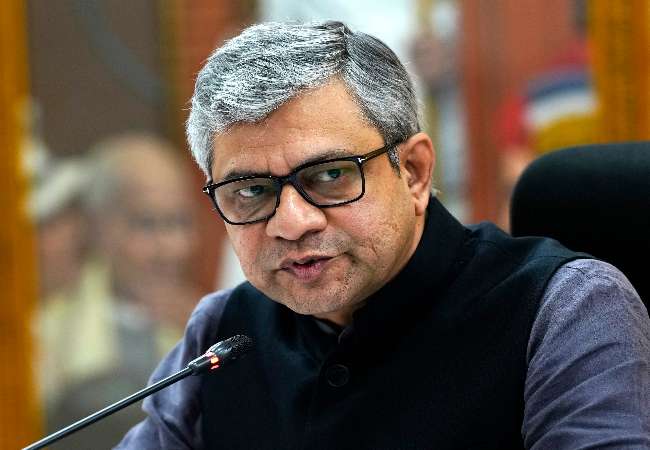
New Delhi (PTI): India’s first bullet train will now cover a 100 km distance between Surat and Vapi in Gujarat during its inaugural run in August 2027, Railway Minister Ashwini Vaishnaw said on Tuesday.
Earlier, Vaishnaw had said that the inaugural run would happen on a 50 km stretch between Surat and Billimore.
The country’s first 508-km long high-speed rail corridor is being constructed between Sabarmati (Ahmedabad) and Mumbai to operate a bullet train at 320 kmph, covering the entire distance in 2 hours and 17 minutes.
Its foundation stone was laid in 2017 and the entire project was initially proposed to be ready by December 2023. However, land acquisition and other issues delayed the ambitious project.
“The bullet train, in its inaugural run, will now cover 100 km between Surat and Vapi in August 2027. Earlier, the inaugural run was planned on a 50 km stretch between Surat and Billimora within the same deadline,” Vaishnaw told reporters at the Rail Bhawan here.
“The bullet train will cover the distance between Mumbai and Ahmedabad in 1 hour 58 minutes while stopping at four stations. However, if it stops at all 12 stations, the entire distance will be covered in 2 hours and 17 minutes,” he added.
Speaking about Prime Minister Narendra Modi’s recent visit to upcoming Surat station, Vaishnaw said that the PM was very happy with the pace of construction.
“PM Modi said that whatever we have learnt from the project must be used elsewhere, not only in Railways and other high speed projects, but in other different sectors as well. We have done one innovation after the other in this project,” Vaishnaw said.
“It is a complex project and the biggest challenge was its design,” He added, emphasising that the entire project will be operational by the end of 2029.
Despite Vaishnaw’s new commitment to the bullet train’s inaugural run, there remains a lack of clarity on the type of train which will operate on its first run.
While the Railway Ministry has awarded a contract to a Siemens-led consortium to install the signalling system on the corridor, industry experts say that this system might not support the Japanese Shinkansen bullet train.
The ministry has also asked Bharat Earth Movers Limited to indigenously develop a high speed train capable of running up to 250 kmph.
When asked whether the Japanese or the indigenously developed train would operate the inaugural run in August 2027,, Vaishnaw reiterated his commitment to the deadline, saying, “We will cover the first 100 km in August 2027.”
Let the Truth be known. If you read VB and like VB, please be a VB Supporter and Help us deliver the Truth to one and all.
Banned tobacco products seized in Ulhasnagar, one arrested

Thane (PTI): Police have arrested a 26-year-old man and seized banned tobacco products valued at more than Rs 5 lakh following a raid in the Ulhasnagar area of Thane district, an official said on Saturday.
The operation was conducted on the premises late Wednesday night near Shahad gate, based on a complaint filed by officials from the Food and Drug Administration (FDA), a police officer said, adding that a police team found a large consignment of contraband from different brands, stocked for illegal sale.
The arrested accused has been identified as Arbaz Nasir Khan (26). Two other suspects have been named as wanted in the case, and a hunt has been launched to nab them.
The seized tobacco products are valued at approximately Rs 5,05,658.
An FIR has been registered at the Ulhasnagar police station under various sections of the Bharatiya Nyaya Sanhita (BNS), along with relevant provisions of FDA regulations.