Burqa clad students in Telangana denied entry into examination hall: Students allege
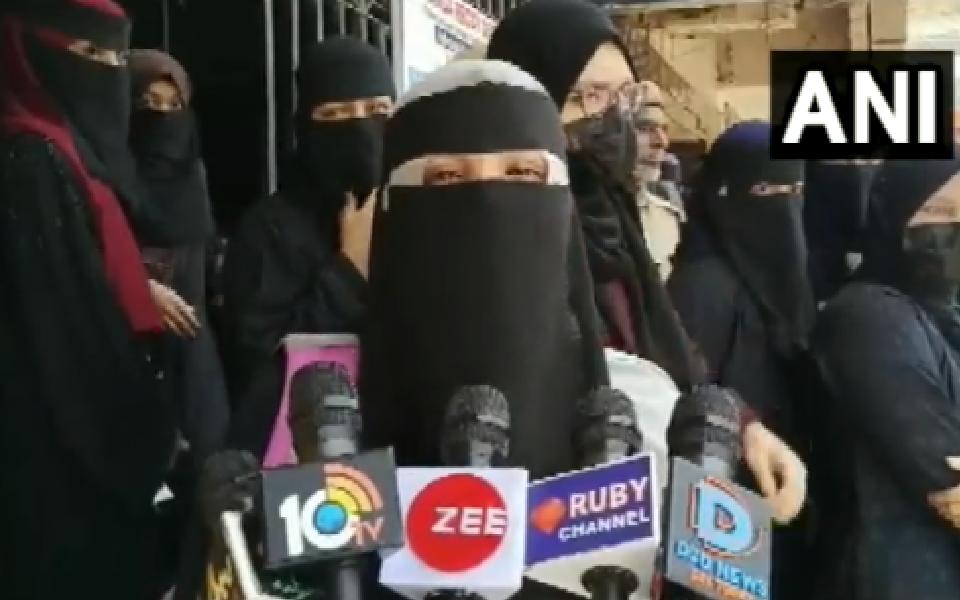
Hyderabad: A private college in Hyderabad allegedly denied entry of Burqa clad women into the college premises and did not permit the women to write examinations unless and until they removed them.
The incident allegedly took place at the KV Ranga Reddy college in Hyderabad on Friday, reported the IANS.
The students alleged that the management asked them to remove their burqas and when they refused, they did not allow them to sit their exams.
After 30 minutes, the management allowed them into the examination hall after they removed their burqas, according to the news agency IANS.
In response to the incident, the Home Minister Mohammed Mahmood Ali, speaking to the IANS, stated that while it is possible that some headmasters or principals may be involved, the government's policy remains entirely secular. He emphasized that people are free to wear whatever they choose, but he expressed his view that wearing European dress would not be appropriate, and it is important to dress modestly.
The Home Minister further mentioned that women should aim to remain covered as much as possible and avoid wearing short dresses. However, he clarified that there is no explicit prohibition on wearing a burqa, and the government will take appropriate action based on the situation, as reported by the IANS.
Several media reports also suggest that the school management allowed students to enter the examination hall after a delay of 30 minutes, as some of them voluntarily removed their burqas.
A student of the college reportedly speaking to the Asian News International, stated, “corresponding to the law we are not supposed to remove the burqa but here we have been asked and forced to remove our burqa, and they have asked us to wear the attire outside the premises.” The student in the clad further confirmed that the alleged incident happened in KV Ranga Reddy college in the state capital.” The student further alleged that their college was the only college that didn’t allow students to enter the hall with Burqa clad, other colleges allowed, “ the student claimed.
#WATCH | Telangana | Girl students who appeared for examination at KV Ranga Reddy College in Santosh Nagar, Hyderabad allege that they were "forced" to take off their burqa before sitting for the exam. (16.06.2023) pic.twitter.com/JHzWP1agsR
— ANI (@ANI) June 17, 2023
Let the Truth be known. If you read VB and like VB, please be a VB Supporter and Help us deliver the Truth to one and all.
Bhojshala case: Disputed structure built from remains of pre-existing temples, claims ASI
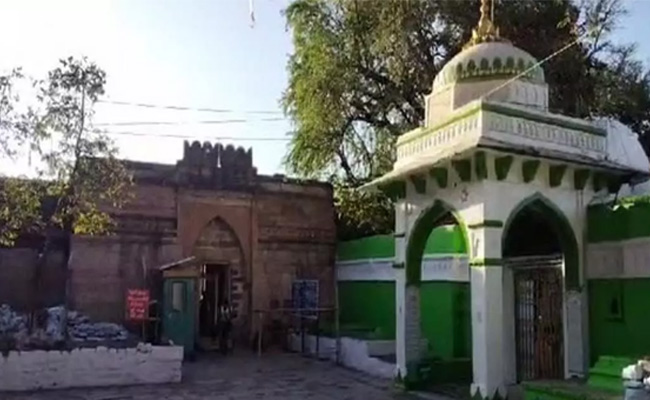
Indore (PTI): The ASI has told the Madhya Pradesh High Court that a massive structure dating back to the Paramara kings' rule existed at the disputed Bhojshala temple-Kamal Maula mosque complex, and the current structure was built from the remains of temples.
The Archaeological Survey of India (ASI) made the claim on Tuesday based on its 98-day scientific survey and over 2,000-page report.
The Hindu community considers Bhojshala a temple dedicated to Vagdevi (Goddess Saraswati), while the Muslim side claims the monument as the Kamal Maula Mosque. The disputed complex is protected by the ASI.
During the hearing before Justices Vijay Kumar Shukla and Alok Awasthi of the HC's Indore bench, Additional Solicitor General Sunil Kumar Jain, representing the ASI, presented a detailed account of the scientific survey conducted two years ago at the complex.
Referring to the ASI's survey report, he said, "Retrieved architectural remains, sculptural fragments, large slabs of inscriptions with literary texts, Nagakarnika inscriptions on pillars, etc, suggest that a large structure associated with literary and educational activities existed at the site. Based on scientific investigations and archaeological remains recovered during the investigations, this pre-existing structure can be dated to the Paramara period."
It can be said that the existing structure was made from the parts of earlier temples, based on scientific investigations, survey and archaeological excavations conducted, study and analysis of retrieved finds, study of architectural remains, sculptures, and inscriptions, art and sculptures, Jain said quoting the report.
Summarising the report, he also drew the court's attention to the fact that the archaeological study identifies that many architectural components, such as pillars and beams, were originally part of temple structures before being repurposed for a mosque.
"The evidence of this transition includes Sanskrit and Prakrit inscriptions that were damaged or hidden, alongside sculptures of deities and animals that were often mutilated or defaced," Jain contended.
The report also states that "all Sanskrit and Prakrit inscriptions are older than the Arabic and Persian inscriptions, indicating that users or engravers of the Sanskrit and Prakrit inscriptions occupied the place earlier".
In light of the Muslim side's earlier objections, the bench wanted to know why there were some discrepancies in the ASI's responses regarding the status of the disputed complex in the cases filed over the years.
The Additional Solicitor General argued that earlier studies of the complex involved only officials, while the current survey involved scientists and the use of advanced technologies such as Ground Penetrating Radar (GPR).
The hearing in the Bhojshala case will continue on Wednesday.
The high court has been regularly hearing four petitions and one writ appeal regarding the religious nature of the Bhojshala temple-Kamal Maula mosque complex since April 6.