Canara Bank employees in Kochi protest alleged beef ban by serving beef outside office
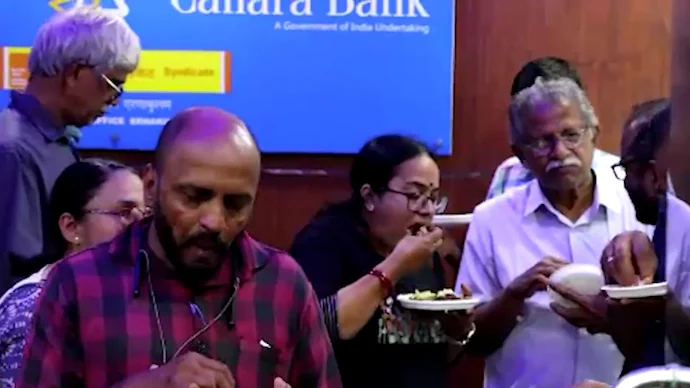
Kochi: Employees of Canara Bank in Kochi staged an unusual protest on Friday by serving beef and parotta outside their office, opposing what they alleged was a beef ban imposed by the regional manager.
According to members of the Bank Employees Federation of India (BEFI), the regional manager, a native of Bihar who recently assumed charge in Kerala, had instructed the canteen staff to stop serving beef. The protest, initially planned against alleged mental harassment and insulting behaviour by the manager, turned into a demonstration of food choice rights.
“A small canteen operates here, and beef is served on select days. The manager informed the canteen staff that beef should no longer be served. This bank functions according to the Constitution. Food is a personal choice. In India, every individual has the right to choose their food. We are not forcing anyone to eat beef. This is simply our form of protest,” said BEFI leader S.S. Anil.
The protest drew political support as well. Left-backed independent MLA K.T. Jaleel endorsed the demonstration, declaring that “no Sangh Parivar agendas would be allowed in Kerala.” Writing on Facebook, he said that questions of what to eat, wear, or think should not be dictated by superiors and hailed Kerala’s history of resistance to communal agendas.
Kerala has witnessed several such beef protests in the past, particularly in 2017, when the central government issued restrictions on cattle sales for slaughter.
Authorities have not issued an official response regarding the employees’ allegations or the protest.
Let the Truth be known. If you read VB and like VB, please be a VB Supporter and Help us deliver the Truth to one and all.
Rahul Gandhi calls Great Nicobar Island project a ‘major threat’ to environment, tribal heritage
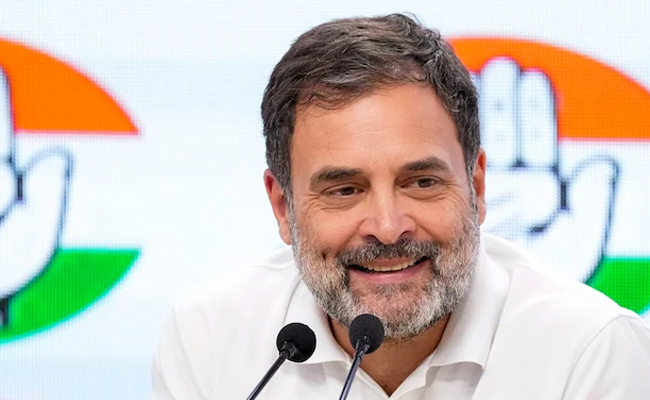
Sri Vijaypuram (Port Blair)/ Nicobar: Congress leader Rahul Gandhi criticised the Centre’s development initiative in Great Nicobar Island on Wednesday, On his maiden visit to the Andaman and Nicobar Islands, Gandhi alleged that the project will lad to large-scale environmental degradation and displacement of local communities.
The Rae Bareli MP, in a post on X after visiting the island, said the project would lead to extensive deforestation and adversely impact indigenous populations.
“So I will say it plainly, and I will keep saying it: what is being done in Great Nicobar is one of the biggest scams and gravest crimes against this country’s natural and tribal heritage in our lifetime,” Gandhi added.
“The government calls what it is doing here a ‘Project’. What I have seen is not a project. It is millions of trees marked for the axe… It is communities that have been ignored while their homes have been snatched away,” Gandhi said.
Describing the initiative as “destruction dressed in development’s language”, he termed it one of the “biggest scams” against the country’s natural and tribal heritage and called for it to be stopped.
Gandhi also claimed that nearly 160 square kilometres of rainforest could be affected, raising concerns over ecological damage.