Can't force ashram inmates to live with parents but no institution can violate fundamental rights:HC

New Delhi, Apr 21: The Delhi High Court Thursday said that while it cannot force the women living in a Rohini ashram under shocking conditions to live with their parents, no institution has the licence to conduct its affairs in a manner that violates the fundamental rights of the inmates.
A bench headed by Acting Chief Justice Vipin Sanghi, which was hearing pleas concerning the state of affairs at Adhyatmik Vidhyalaya founded by self-styled spiritual guru Virender Dev Dixit, said that it was inclined to direct the Delhi government to take over the institution's management and asked the government counsel to seek instructions.
The bench, also comprising Justice Navin Chawla, observed that the ashram was run by a baba who has been charge-sheeted by the CBI for the offence of rape and is now absconding.
The bench recollected an earlier report on the matter which revealed a shocking state of affairs at the institution and claimed that the women inmates were living in jail-like conditions , without any doors on toilet cubicles.
The court also asked the counsel for CBI to file a status report on the state of the investigation in the matter.
There is very thorough indoctrination... How can we accept that any sane person would live in these conditions? Can we shut our eyes to it? Who is funding it? Who is managing? This is shocking that this is going on in the capital We don't want (that) in the garb of spirituality, the inhumane situation continues, observed that court.
The court stated that it is not proposing that the ashram should be shut down but that it has to run in a manner which is consistent with the inmates' rights to privacy and bodily integrity and it falls on the State to ensure that infraction of individuals' fundamental rights is prevented and remedied.
We can't force anybody to live with their parents but they can't insist that the institute be run in a covert way. We are not saying shut the institution (but) there has to be a supervising eye, the court said.
We are not for a moment suggesting that the respondent institution and its inmates should not profess their spiritual and religious beliefs ..so long as they do not contravene any law or constitutional provision, it stated.
The counsel for the institution vehemently opposed the takeover by the Delhi government and submitted that their rights were protected under the Constitution.
No minority institution gets a licence by being such an institution to conduct its affairs so as to violate the fundamental rights of the individuals, particularly right to life and personal liberty Even if GNCTD were to take over and appoint an administrator the freedom of the inmates to exercise their religious and spiritual rights would not be infracted, stated the court.
The lawyer also stated that there has never been a single complaint from the inmates concerning the commission of any sexual misconduct.
Earlier this week, the court had asked the ashram to show cause as to why it should not be taken over by the Delhi government and said that it was difficult to accept that the inmates were living there of their free will.
In December 2017, on a petition by NGO Foundation for Social Empowerment, the high court had asked the CBI to trace the founder of the ashram Virender Dev Dixit after raising doubts over the ashram's claims that women inmates there were not illegally confined.
Earlier, the court had directed the CBI to probe the alleged illegal confinement of girls and women in the ashram where it was claimed they were kept in "animal-like" conditions behind metal doors in a "fortress" surrounded by barbed wire.
The petitioner NGO had claimed that several minors and women were allegedly being illegally confined at the "spiritual university" and were not allowed to meet their parents.
Taking note, the high court had immediately set up a committee, comprising lawyers and Delhi Commission for Women chief Swati Maliwal, to inspect the premises of the institute.
The committee, comprising lawyers Ajay Verma and Nandita Rao, then gave a report detailing the "horrible" living conditions of the over 100 girls and women who were housed in "animal-like conditions with no privacy even for bathing."
The matter would be heard next on April 25.
Let the Truth be known. If you read VB and like VB, please be a VB Supporter and Help us deliver the Truth to one and all.
Bengal govt directs schools to mandatorily include singing of Vande Mataram in morning assemblies
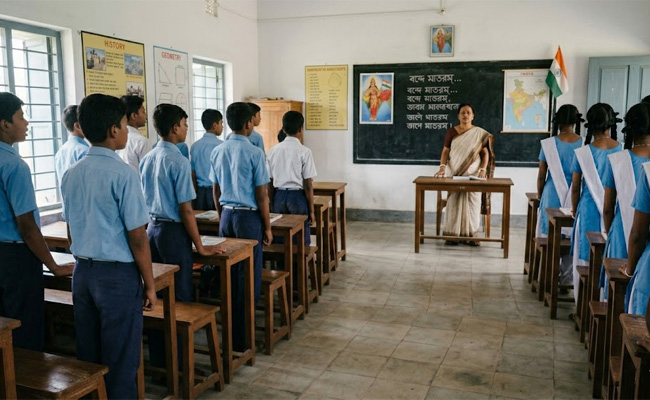
Kolkata (PTI): The West Bengal government has directed all state-run and aided schools to mandatorily include the singing of Vande Mataram during morning assemblies with immediate effect, according to an official communication issued by the School Education department.
The directive states that every student must participate in the singing the national song at the start of the school day. Heads of institutions have been instructed to ensure strict compliance.
"The singing of Vande Mataram during morning assembly prayers prior to the start of classes should be made mandatory so that Vande Mataram should be sung by all students in all schools in the state with immediate effect," the Director of Education specified in a communication to state-run and state-aided school heads on May 13.
The move comes shortly after the Union government initiated steps to strengthen provisions related to respect for national symbols, including a proposed amendment to the Prevention of Insults to National Honour Act, 1971, making obstruction to the singing of Vande Mataram a punishable offence.
A school education department official indicated on Thursday that the song is to be performed at the beginning of the assembly session.
School authorities have also been asked to document the proceedings, including video recordings, as proof of implementation, he said.
Earlier, schools in the state traditionally sang only the national anthem, Jana Gana Mana, composed by Rabindranath Tagore.
In recent years, the previous TMC government had introduced 'Banglar Mati Banglar Jol', also penned by Tagore in 1905 during protests against the partition of Bengal, as the state song.
The national song Vande Mataram, written by Bankim Chandra Chattopadhyay, now adds to the list, raising questions among sections of teachers about the duration and sequencing of both the national anthem and the national song within the limited assembly time.
Headmaster of Hindu School Subhrojit Dutta told PTI, "Once our students attend classes after summer vacation, they will sing Vande Mataram along with the National anthem Jana Gana Mana during the assembly before classes."
"Our students had already been told about the historical significance of Vande Mataram on the occasion of its 150th year, and they had been asked to recite the lines and memorise it at home before this notice was issued. So once they join school, they will sing the national song along with the national anthem," he added.
A left-run teacher representative body spokesperson said further clarity is awaited regarding whether all songs are to be sung daily and how they are to be accommodated within the existing schedule.