Can't stay neutral on such issues: Varun Dhawan on JNU attack
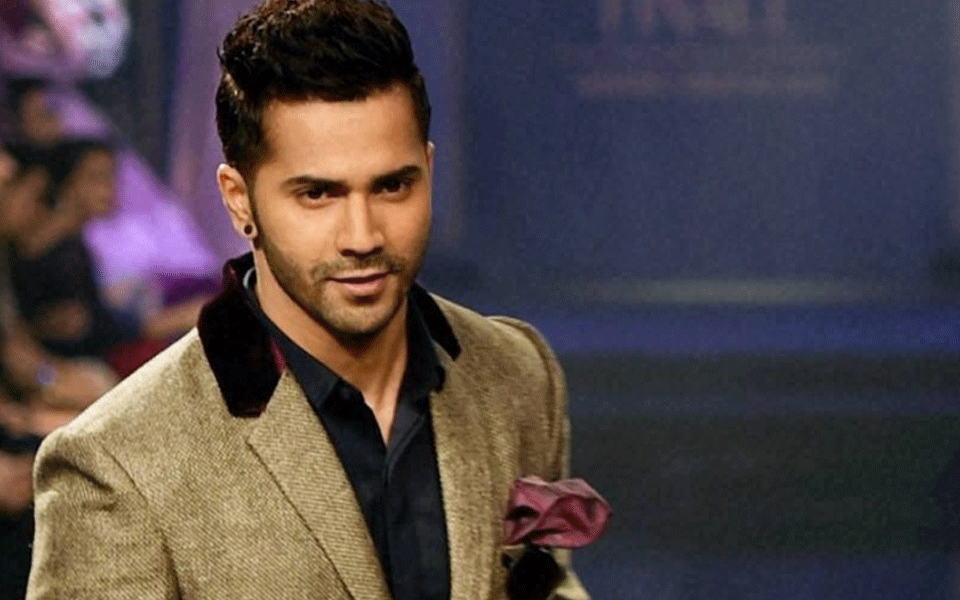
Indore: Actor Varun Dhawan on Tuesday condemned the violence in Delhi's Jawaharlal Nehru University (JNU) and said one cannot stay neutral during such incidents, joining a section of Bollywood personalities who have denounced the campus mayhem.
Violence had broken out inside the university campus on Sunday night as masked men armed with sticks and rods attacked students and teachers and damaged property. At least 34 people, including JNU Students' Union president Aishe Ghosh, were injured.
Speaking to reporters here in Madhya Pradesh while promoting his upcoming film, Dhawan said, "I think we cannot stay neutral in such issues. You have to condemn such attacks.
"It is dangerous and sad if masked people enter an educational institution and all this (assault, vandalism) happens."
Queried on whether there was a "divide" in the Hindi film industry on the incident going by the vast number of tweets and posts on social media from the fraternity, the 32- year-old actor evaded a direct reply and said, "I am not going to get into what people are saying on Twitter on this issue."
He feigned ignorance when asked about tweets against the Centre on the JNU violence by producer-director Anurag Kashyap, and said "I have been promoting my film for the past three days and have not read statements of these people".
The 'Badlapur' actor said it was not known, right now, who was behind Sunday's violence inside the premier central varsity.
"But the police will investigate it. As an Indian, I have full faith in the police and judiciary. I hope those involved in this incident get severe punishment as soon as possible," he said.
Dhawan said everybody, especially parents, wanted students to remain safe in campuses, adding that the need now was for peace and stability and for all people to act unitedly.
"It is easy to sit here and say whether this or that man is wrong," he added.
"Horrifying", "heartbreaking" and "barbaric" is how voices emerging from Bollywood such as director Zoya Akhtar, actors Anil Kapoor and Alia Bhatt on Monday described the JNU violence and demanded that the perpetrators be brought to justice.
Let the Truth be known. If you read VB and like VB, please be a VB Supporter and Help us deliver the Truth to one and all.
Representative of Iran's Supreme Leader in India calls current situation 'no war, no peace'
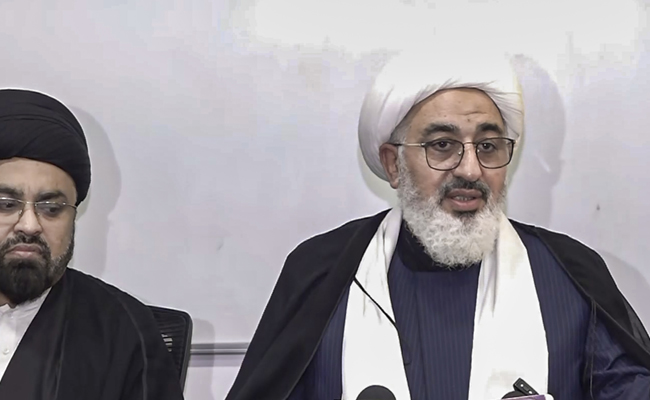
Bengaluru (PTI): Representative of Iran's Supreme Leader in India, Abdul Majeed Hakeem Ilahi on Saturday characterised the ongoing tensions between his country and the Israel-US alliance as a state of “no war, no peace”.
Calling for an immediate halt to the conflict, he said the global stability hinges on those who initiated the war.
He questioned why countries affected by the war and suffering from the energy crisis are not pressuring the US and Israel to stop the aggression.
Addressing a press conference here, Ilahi said Iran did not want the conflict, but was compelled to respond amid continued attacks, even as negotiations were expected to continue.
"Iran didn't want this war, but Iran was forced by the war and several times Iran tried to avoid this war... I don't know what is the condition of these people and these countries (US-Israel)... they want to impose on other countries what they want, and who gave them this authority?" he questioned.
Recalling the negotiations Iran held in Oman, he said talks later moved to Geneva and made progress before being disrupted by sudden attacks.
Ilahi claimed that airstrikes and missile attacks led to the deaths of Iran’s supreme leader Ayatollah Ali Khamenei, ministers, commanders and civilians.
"They killed a lot of civilians… They attacked a primary school, and they killed 175 innocent girls," he said, claiming over 4,000 deaths, more than 40,000 injuries, and widespread damage to houses, hospitals, universities and public infrastructure.
Despite these losses, he said Iran resisted calls for “unconditional surrender” and stood firm and defended itself.
"They wanted unconditional surrender. Which no one—no one can accept it. Iran said, 'Okay, we are ready to be sacrificed,' but we are not ready to submit ourselves," he added.
He argued that they (US-Israel) proposed the current ceasefire only after realising that they could not achieve any of their objectives after 40 days of conflict.
The envoy further claimed that the ceasefire is not an actual ceasefire, but a “no war, no peace” situation.
Explaining the current situation in Iran, he said conditions remain stable and people are going about their daily lives.
"They are working ....(leading) their ordinary life. They are working—they're going farming and they do everything....and they aren't scared of anything. And they are ready to defend themselves," he added.
Addressing the crisis in the Strait of Hormuz, he said the situation was stable before February 28 and all countries benefited from it.
"(For) 10,000 years, the Strait of Hormuz was open...and Iran daily yearly spent a lot for providing security in the Strait of Hormuz... so no one even complained anything about the Strait of Hormuz. Everyone was free...and even our enemies their warship was passing through the Strait of Hormuz," he said.
However, he linked the current maritime instability to the actions of the US and Israel.
"So Iran cannot do anything. Those people who initiated, created and started this war, they have to stop it. And everything will go back to normal," he said.
Criticising the mentality of the "great powerful country", Ilahi said, "they think they have the right to do whatever they want. It should change."
He sought to know why the countries affected by the conflict are not exerting pressure on the US and the "Zionist" regime to halt the war.
"Why are they not asking them? This crisis and problem by which a lot of countries are affected was created by them. A lot of factories are closed and even working days in some countries reduced... A lot of restaurants are closed," he said.
Seeking fairness and justice, Ilahi said instead of asking Iran, all those nations should ask those who initiated this war to stop it, by telling them, "we are suffering."
To a query on international mediation, Ilahi, referring to the US, asked, "Is it acceptable and reasonable that one country orders all countries -- you should not deal with this country, You should not purchase from this country. You should not have business with this country. You should not buy from this country."
Ilahi also highlighted Iran's long-standing ties with India and said, "It is a great country and we respect India and Indians."
"We have 5,000 years relationship and friendship. We are connected to India by education, by philosophy, by culture, by civilisation and by the economy," he said.
According to him, the bilateral cooperation remains strong, citing diplomatic engagement.
"At the moment also, our relationship, collaboration, cooperation with India is very good," he said, adding Iran allowing Indian ships to pass through Strait of Hormuz reflects the ties.
"Iran allowed Indian ships to pass through the Strait of Hormuz. Why? A lot of countries couldn't get this permission?... The relationship between Iran and India is very good," he added.
He expressed confidence that in future too, the ties between Iran and India will be strong.