Carbon tax remains intact in India-EU FTA; technical talks to address concerns: German official
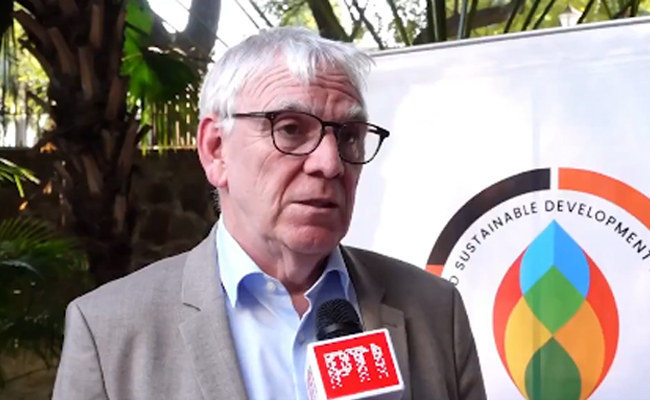
New Delhi (PTI): The European Union's Carbon Border Adjustment Mechanism (CBAM) will not see any exceptions despite the concluded India-EU Free Trade Agreement (FTA), but both sides have committed to technical discussions to find the best way forward, a senior German environment ministry official said here.
Jochen Flasbarth, State Secretary in the German Federal Ministry for the Environment, Nature Conservation, Nuclear Safety and Consumer Protection, emphasised that the CBAM is not targeted against any specific country but serves as a necessary protective measure once carbon pricing is introduced domestically in the EU.
"CBAM is not against anyone. Once you introduce carbon pricing, you need to have some kind of protection," Flasbarth told PTI Videos on Wednesday during his ongoing visit to India, where he held discussions with officials from the Ministries of New and Renewable Energy, Power, and Environment, Forest and Climate Change.
"With the carbon pricing, we need to do something, and that is something we want to discuss. It is written in the free trade agreement that there will be technical discussions on how to do it in the best possible way. And of course, it's very clear we will not make exceptions for any other countries in the world. We would not follow the pressure of the US, for example, or others, so India can be sure there will be no exceptions," the secretary emphasised.
The EU's CBAM, which entered its definitive financial phase in January 2026, imposes charges on embedded carbon emissions in imports of key sectors such as iron and steel, aluminium, and cement, among others. This has raised concerns in India, particularly for carbon-intensive exports like steel, which could face additional costs, potentially offsetting some tariff benefits from the FTA.
Flasbarth described the FTA as enormously important amid rising global trade barriers and a difficult geopolitical situation. He noted that while environment and climate issues are not the core of the agreement text, they remain central given the EU's commitment to climate neutrality.
"The Free Trade Agreement that was agreed...will have to be ratified soon. We also agreed to collaborate more in the field of carbon pricing and emission trading systems," Flasbarth said.
Flasbarth also stated that India and Germany will ratify a pact on critical minerals during the upcoming inter-governmental commission meeting.
"Critical minerals are extremely important for both countries. At the moment, both countries are dependent on one source, basically from China. And of course, it's in the interest of the two countries to get less dependent on one source," he said.
Sources indicate that the IGC between the two countries is likely to be held in June 2026.
VIDEO | Delhi: Jochen Flasbarth, State Secretary, Germany's Federal Ministry of the Environment, Climate Action, Nature Conservation and Nuclear Safety, says, "Critical minerals are extremely important for both countries... Both countries are dependent on just one source, which… pic.twitter.com/D4NcnnhUFv
— Press Trust of India (@PTI_News) February 26, 2026
Let the Truth be known. If you read VB and like VB, please be a VB Supporter and Help us deliver the Truth to one and all.
CM Siddaramaiah ready to "sacrifice power" or continue, as per Rahul's directions: Rajanna
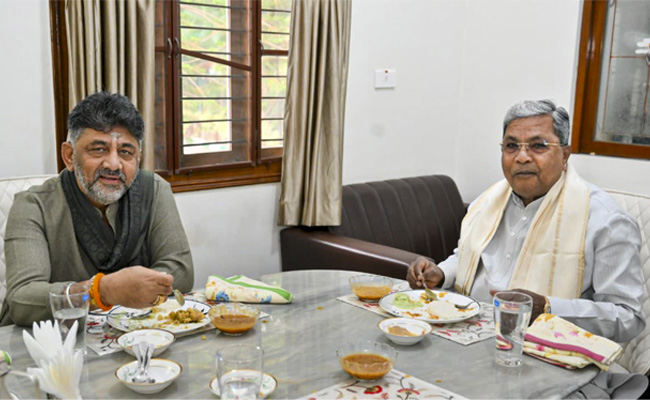
Bengaluru (PTI): As the speculation about leadership change in Karnataka rages yet again, a senior party leader and close aide of Siddaramaiah on Tuesday said the Chief Minister was ready to "sacrifice power" or continue in the top post, based on the directions of Congress leader Rahul Gandhi.
KN Rajanna also seemed to support the idea of a change in the party leadership as well, an apparent reference to deputy CM and Karnataka Congress president D K Shivakumar, whose supporters want him to be made CM.
Urging the Congress high command to clear the confusion on the leadership issue, Rajanna, a former minister who is considered close to Siddaramaiah, warned that continued uncertainty would be detrimental for the party and governance.
He also insisted that if the chief minister is changed, there should be a "Dalit CM" in Karnataka.
The development comes amid speculations within the party and political circles about a possible decision on leadership change and cabinet reshuffle after May 4, once the results for assembly elections in four states and one union territory, along with bypolls to two assembly segments in Karnataka, are announced.
"The Chief Minister has an open mind and has said he will abide by the directions of the high command and Rahul Gandhi, and that everyone should cooperate. The CM has repeatedly reiterated that he will abide by Rahul Gandhi's directives and suggested that everyone follow the decision. All ministers have agreed to it," Rajanna said in response to a question about the CM's recent discussion with his close cabinet colleagues and MLAs.
Speaking to reporters here, he said, "power is not permanent for any politician, those who lose it will try to gain it and those who have gained it will try to maintain it. The CM's mindset is that he is ready to sacrifice power or continue in power as per Rahul Gandhi's directions. He will abide by Rahul Gandhi's decision."
When asked whether supporters of Siddaramaiah demanded that he continue as CM, and if he steps down, that an AHINDA leader should take over, the MLA said the matter is for the high command to decide.
"We have told the high command what we had to. Ultimately it is left to high command and Rahul Gandhi," he said.
AHINDA (Kannada acronym for minorities, backward classes, and Dalits) is considered as the strong support base of Siddaramaiah and also the Congress party.
When asked about his past statement that there should be a Dalit CM after Siddaramaiah, Rajanna said, "What's wrong with it. I am committed to the statement that there should be a Dalit CM."
MLAs and leaders who want Shivakumar to be elevated have recently claimed they expect some "sweet news" by May 15, which is their leader's birthday.
When asked whether the party president should also be changed, the former minister said that everything has to change.
"If the ministers have to change, why shouldn't the party president. Everything will be decided by high command," he said.
Shivakumar is the state Congress President and has completed six years in the post.
For the government to function more actively towards the welfare of the people it is important that the high command clears the existing confusion in the Congress party at the earliest, Rajanna said, adding, the ministers have gone to discuss the same with the leadership.
"I too urge that the high command should not allow the confusion to continue; as long as the confusion continues, it is detrimental for the party and governance. I will also go to Delhi after May 4," he said.
"The high command is at it (resolving the confusion), but because of elections, the leaders are busy. The matter cannot be decided hastily, it must be decided with a clear state of mind, as it involves the future of the people of Karnataka and the party," he said, expressing confidence that the party will take appropriate decisions after examining all aspects.
PWD Minister Satish Jarkiholi on Monday met Congress President Mallikarjun Kharge and General Secretary (in charge of Karnataka) Randeep Surjewala in New Delhi and requested them to address the speculation regarding the change of leadership in the state.
Subsequently Social Welfare Minister H C Mahadevappa too met the party leadership in Delhi.
Both Jarkiholi and Mahadevappa are considered close to Siddaramaiah.
Regarding the demand for cabinet reshuffle, Rajanna said there is an expectation within both the party and the public that the administration should be sensitised more, and there is nothing wrong in new people getting opportunities.
Responding to a question, Rajanna said, there is a feeling among AHINDA communities that their expectations from the current government have not been fulfilled. "I too agree with it," he said.
Rajanna, who recently alleged that the Chief Minister is "helpless" and under some "compulsion," reiterated his statement by saying, "compare Siddaramaiah as CM during 2013-18 and 2023 to now, there is a huge difference, people are saying it."
The leadership issue is being hotly debated as Shivakumar's supporters have been demanding his elevation since late 2025, in lines with a rumoured power-sharing agreement involving Siddaramaiah when the party won the 2023 Assembly elections.