Cat stranded on Kochi Metro Rail pillar rescued
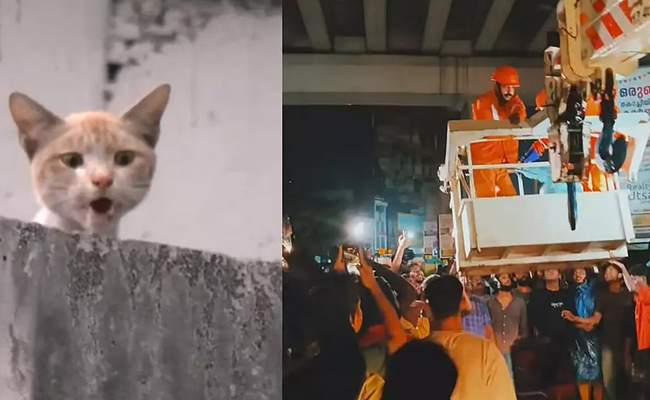
Kochi (PTI): A cat that was stranded on a pillar of the Kochi Metro Rail was rescued after several attempts by animal lovers and Fire and Rescue Service officials here on Sunday, officials said.
According to Fire and Rescue Service officials, the cat’s presence on a pillar near the Jawaharlal Nehru Stadium Metro Station at Kaloor was first noticed by auto rickshaw drivers operating in the area.
Officials said an attempt was made on Thursday to rescue the cat, but the animal could not be spotted.
On Saturday, following news reports about the stranded cat, the Society for the Prevention of Cruelty to Animals (SPCA) began efforts to rescue it.
However, the animal moved into gaps in the girder, and a technical issue with the hydraulic crane forced them to suspend the operation.
Later, Fire and Rescue Service personnel made another attempt in the evening, and Kochi Metro Rail Limited (KMRL) authorities provided support by shutting off the electrical connection for over 15 minutes. However, that attempt also failed as the feline could not be spotted.
Officials left food atop the pillar for the cat to survive. By then, animal lovers had reached the spot and had requested that authorities continue the rescue operation.
Interestingly, auto rickshaw drivers named the cat "Subash" after a character in the Malayalam movie 'Manjummel Boys' who was trapped in the Guna Caves in Tamil Nadu.
Later, after KMRL’s daily operations ended on Saturday night, a fresh attempt was launched around midnight to trace and rescue the cat.
Officials said two personnel, equipped with a rescue box and nets, reached the top of the pillar at around 1 am on Sunday, spotted the cat, and rescued it.
As the cat was brought down, a large crowd gathered at the spot and raised slogans in support of the authorities.
The feline was later shifted to an animal rehabilitation centre, officials said.
An officer with the Fire and Rescue Service at the Gandhi Nagar station said this was the third time a cat had been rescued after being stranded on a Metro pillar.
"It might have entered from the station, as we don’t see any other possibility, considering the height of the pillar. To save a life, we continued the operation, in which Metro authorities also cooperated," he said.
Let the Truth be known. If you read VB and like VB, please be a VB Supporter and Help us deliver the Truth to one and all.
4 held for sexually assaulting woman, girl on moving bus after social media alert in UP's Agra

Agra (UP) (PTI): Four people were arrested, after a prompt response by police following a social media alert, for allegedly sexually assaulting a woman and a girl inside a moving bus here, officials said on Tuesday.
According to an official police statement, at 12:27 am on April 27, information was received on the social media platform X about an incident of sexual assault on a bus travelling from Kanpur to Ahmedabad, which was approaching Namner crossing in Agra.
Acting under the direction of Police Commissioner Deepak Kumar, the Agra Police social media team immediately alerted the Rakabganj police station within minutes and coordinated with the victims to confirm the incident and obtain the exact location, it stated.
Police teams launched intensive checking at Namner crossing and intercepted the bus as it reached the spot. The four accused involved in the incident were apprehended on the spot, and legal action was initiated against them, the statement said.
The police said the swift response and coordination between the social media team and field units ensured timely action, bringing relief to the victims and other passengers, who expressed gratitude towards the police, it added.