CBI books its own Deputy Legal Advisor for alleged Forging Signature of her Boss
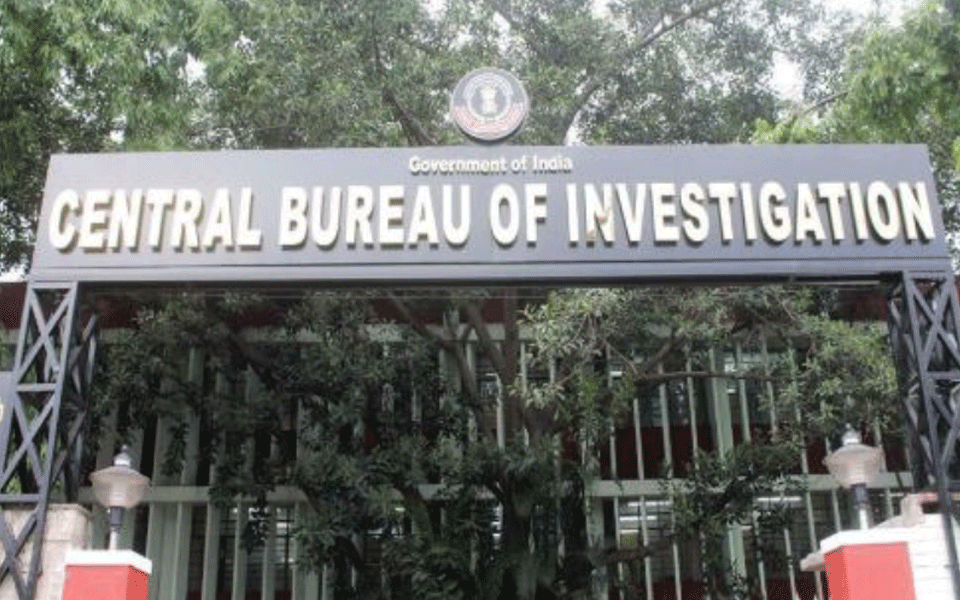
New Delhi, Nov 13: The Central Bureau of Investigation (CBI) has booked its own Deputy Legal Advisor (DLA) attached to an anti-corruption unit for alleged forgery of her Annual Performance Appraisal Reports (APARs) for three consecutive years.
The accused Beena Raizada is currently with the agency’s Anti Corruption-VI (Delhi) which is handling the Vyapam scam cases.
The FIR has been registered following an inquiry into allegations that Ms. Raizada that forged signatures on her work appraisal reports. She had joined the Patna’s Anti-Corruption Branch as Senior Public Prosecutor in May 2014 and on promotion, she became a DLA in November 2014.
Ms. Raizada was relieved from there in January 2017 and transferred to the AC-VI unit.
In the office of Department of Prosecution at Delhi headquarters of the CBI, the accused personally submitted her three appraisal reports for 2014, 2015 and 2016, along with the assessment notes for the same period, purportedly bearing the signatures of V.K Singh, the then Deputy Inspector-General (DIG) and head of the Patna’s anti-corruption branch.
All the said assessment notes certified the performance of Ms. Raizada as “excellent.” However, during the inquiry, Mr. Singh — who is now the Inspector-General of Police of the Jaipur Range in Rajasthan — said the signatures on the assessment notes resembled his, but he had not signed those documents.
Mr. Singh said Ms. Raizada was not on duty for 90 days during 2014 and 2015 and therefore, there was no question of writing an assessment report in her favour. He stated that similarly, there was no question of writing an assessment report in her favour for 2016 as he was repatriated in 2015 to his parent department.
“It is also found that as per procedure, the assessment notes for the Law officers of the level of Assistant Public Prosecutor, Public Prosecutor and Senior Public Prosecutor posted in the Branch are issued by the DIG/Head of Branch towards Annual Appraisal,” said the agency.
However, during the relevant period, Ms. Raizada, as the then DLA, was working under Joint Director in Patna and therefore, the DIG could not have issued the said assessment notes. “This prima facie establishes that the signatures of Mr. Singh were forged with the intention to get her APARs processed favourably,” the agency said.
Courtesy: theworldnews.net
Let the Truth be known. If you read VB and like VB, please be a VB Supporter and Help us deliver the Truth to one and all.
EAM Jaishankar meets Jamaican PM, gifts over 10 BHISHM Cubes
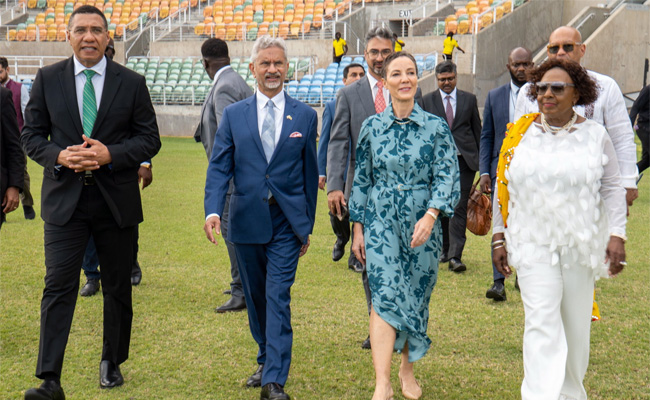
Kingston (PTI): External Affairs Minister S Jaishankar on Monday met Jamaican Prime Minister Andrew Holness and discussed ways to further deepen "political, economic and people-to-people cooperation."
Jaishankar also conveyed greetings from Prime Minister Narendra Modi to Holness.
"Pleased to call on Prime Minister @AndrewHolnessJM in Kingston. Conveyed the greetings of PM @narendramodi," Jaishankar posted on X.
"Discussed deepening our political, economic and people-to-people cooperation. Value his commitment towards further strengthening India-Jamaica relations," the post further read.
Also, the external affairs minister handed over 10 BHISHM (Bharat Health Initiative for Sahyog Hita & Maitri) Cubes as a gift to Jamaica.
"Formally handed over 10 BHISHM Cubes as a gift from India to Jamaica, in the presence of PM @AndrewHolnessJM, Health Minister @christufton and FM @kaminajsmith," Jaishankar posted on X.
"The BHISHM Cube mobile hospital system, designed for rapid deployment, will help Jamaica during disasters and emergencies. The gift of these cubes is a statement of friendship, a commitment to disaster preparedness, and an outcome of innovation," the post said.
Jaishankar arrived in Kingston on Saturday evening, marking the first leg of his nine-day tour of Jamaica, Suriname, and Trinidad and Tobago, aimed at further strengthening India's strategic and cultural ties with the Caribbean nations.
Earlier in the day, he interacted with the Indian diaspora and discussed India's ongoing transformation in infrastructure, human development and technology-driven governance and entrepreneurship with them.
He also highlighted the cricket bond between both countries as India gifted a scoreboard to Jamaica.
A scoreboard was dedicated at Sabina Park in Kingston. It is the home of the Jamaica cricket team and is the only Test cricket ground in the Caribbean island nation.
The minister expressed hope that the new scoreboard would witness many memorable innings, including those symbolising the enduring friendship between the two countries.
Cricket has long been a strong cultural bridge between India and Jamaica, which is part of the West Indies cricket team.
Jamaican players, including Chris Gayle, Courtney Walsh and Michael Holding, have played a major role in shaping the legacy of West Indies cricket in the international arena, contributing to its dominance in earlier decades and its continued global appeal.