'CBI can't be faulted': Delhi court closes JNU student Najeeb Ahmed missing case
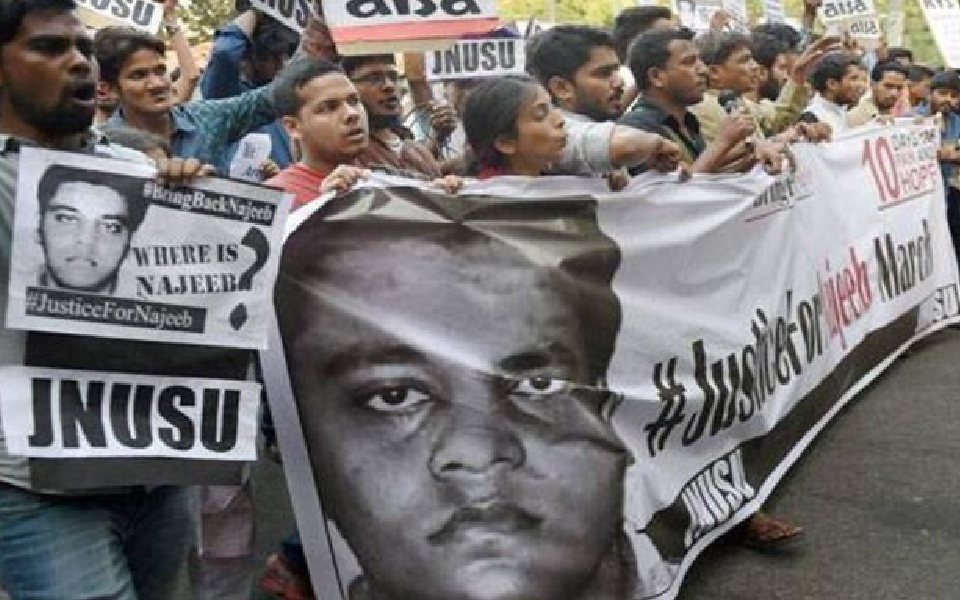
New Delhi, Jun 30 (PTI): A Delhi court on Monday allowed the CBI to close the case of first year JNU student Najeeb Ahmed, who went missing on October 15, 2016, saying the agency "exhausted all options".
Additional chief judicial magistrate Jyoti Maheshwari also "earnestly hoped" Najeeb was traced soon.
"This court expresses its regret that while the proceedings in the present case end with this closure report, a closure for Najeeb’s mother and other loved ones, still eludes us," the order said.
While it accepted the agency's closure report, the court granted liberty to the CBI to re-open the investigation on the receipt of any credible information on Ahmed's whereabouts and intimate the court accordingly.
The judge said there was no evidence of any scuffle or exchange of Najeeb with any person on the day of his disappearance once he returned to the hostel to show his disappearance was caused by any suspect or any other person at JNU.
"An analysis of the discussion shows that CBI has undertaken a holistic investigation and exhausted all options," the court said.
She also noted that when Najeeb left the hostel room, his cell phone and laptop were lying in the room only.
"It is evident that all conceivable aspects which could have been investigated upon, have been thoroughly covered by CBI, but no credible information could be received regarding the whereabouts of Najeeb Ahmed. An analysis of the above discussion shows that CBI has undertaken a holistic investigation and exhausted all options," the court said.
Further, the grounds raised by the protest petitioner by Ahmed's mother, in alleging lapses in the investigation by CBI, was examined at length and stood rejected, the judge added.
The order continued, "This court is cognisant of the plight of an anxious mother, who has been on a quest to find out about her missing son since 2016, but the investigating agency in the present case, i.e., CBI cannot be faulted for the investigation carried out. The quest for truth is the foundation of every criminal investigation, yet there are cases where the investigation conducted cannot achieve its logical conclusion, despite the best efforts of the investigating machinery."
The CBI in October 2018 closed its investigation into the case as the agency's efforts to trace Ahmed, a first year master's student at JNU, yielded no results.
The agency filed its closure report before the court in the case after getting permission from the Delhi High Court.
Ahmed went missing from the Mahi-Mandvi hostel of JNU on October 15, 2016, following a scuffle with some students allegedly affiliated to the Akhil Bharatiya Vidyarthi Parishad the previous night.
Nafees' counsel had previously said it was a "political case" in which the "CBI has succumbed to the pressure of its masters".
The case was initially probed by Delhi Police but later transferred to the CBI.
Let the Truth be known. If you read VB and like VB, please be a VB Supporter and Help us deliver the Truth to one and all.
BJP, TMC hail SC directions on counting of votes for West Bengal polls
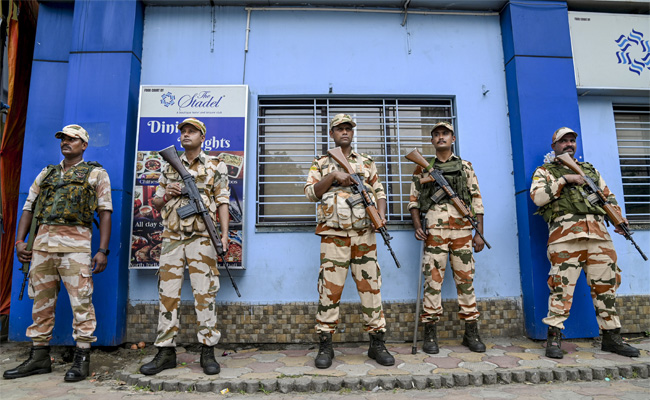
Kolkata (PTI): The BJP and TMC on Saturday both hailed the SC directions on the Election Commission's circular over the deployment of central government personnel for vote counting in West Bengal.
The apex court on Saturday said no further order was necessary on the TMC's plea challenging the Calcutta High Court's dismissal of its petition against the April 13 circular.
In a social media post, BJP leader Amit Malviya said, "In yet another legal setback, the Supreme Court has refused to intervene. The Trinamool Congress had approached the court challenging the exclusion of state government employees from vote-counting supervisor duties, and had sought an urgent hearing."
"The refusal to entertain this plea underscores a clear message -- attempts to influence or cast doubt over the integrity of the counting process will not find easy validation. Another day, another judicial rebuff for Mamata Banerjee," he added.
The TMC, however, claimed that the SC directions vindicated its stand.
"The issue raised before the Hon'ble Supreme Court pertained to the implementation of the said communication in a manner whereby only Central Government/Central PSU employees were being appointed as Counting Supervisors and Counting Assistants for counting of votes," the party said in a statement.
The TMC said it was highlighted that such an interpretation and implementation of the communication would be contrary to the framework of a fair and balanced counting process.
"After hearing the parties, the Hon'ble Supreme Court directed that Clause 1 of the communication dated 13.04.2026, relating to the appointment of Counting Supervisors and Counting Assistants, must be read along with the salient feature contained in the second page of the said communication, which provides for random selection of both State Government and Central Government employees," it said.
"The Hon'ble Supreme Court has further recorded the undertaking of Mr Dama Seshadri Naidu, learned Senior Advocate appearing for the Election Commission of India that the said communication shall be followed in its letter and spirit," it added.
The TMC said that in view of the directions, it is expected that the counting of votes shall be conducted in a fair, transparent, and balanced manner.
A special bench of Justices P S Narasimha and Joymalya Bagchi said the EC can choose the counting personnel, and its April 13 circular, which provides for deployment of state government employees as well, cannot be said to be incorrect.
The poll body said the apprehensions of TMC of any wrongdoing are misplaced, as the circular very clearly states that there will be a mix of central and state government employees.
The EC assured the court that the circular would be implemented in letter and spirit, and there would be state government employees also during the counting of votes on May 4.
Polling for the 294-member West Bengal assembly was held in two phases -- April 23 and April 29. The counting of votes will be taken up on May 4.
On April 30, the Calcutta High Court dismissed the TMC's petition against the Election Commission circular, saying there was no illegality in the poll panel's decision to appoint counting supervisors and assistants from Central government and Public Sector Undertaking (PSU) employees, instead of the state government staff.