CBI closes case against DHFL, its directors in 'fake' home loan accounts case

New Delhi, Jan 23 (PTI): The CBI has closed the case against the DHFL and its directors pertaining to 2.60 lakh allegedly fictitious home loan accounts, some of which were used to claim interest subsidies under the Pradhan Mantri Awas Yojna, officials said.
After over three years of probe, the agency could not find evidence suggesting a criminal conspiracy which could have led to the creation of such accounts, they said.
The irregularities were pointed out in the report of auditor Grant Thornton, appointed by the new board of the scam-hit Dewan Housing Finance Limited (DHFL), they said.
The agency has now submitted its final report before a special court in Delhi, which would take a call on whether to accept the closure report or order further investigation into the matter.
The CBI had booked promoters Kapil and Dheeraj Wadhawan along with the company.
It was alleged that DHFL had opened a fictitious branch in Bandra and fake accounts worth Rs 14,046 crore of home-loan borrowers, who had already repaid their loans, were entered in the database, they said.
A total of 2.60 lakh "fake and fictitious" home loan accounts were created in the non-existent branch from 2007-19 for a total loan worth Rs 14,046 crore, out of which Rs 11,755.79 crore were deposited or routed to several fictitious firms known as Bandra Book firms, the CBI had alleged in the FIR.
Several of these bogus loan accounts were linked in the Pradhan Mantri Awas (PMAY) to claim interest subsidies from the National Housing Bank in connivance with its officials, the CBI had alleged.
The DHFL had allegedly processed 88,651 cases under the PMAY till December 2018, and it received an interest subsidy of Rs 539.40 crore, while it has to receive Rs 1,347.80 crore from the government, it had said.
PMAY is a central scheme to ensure housing for all.
Let the Truth be known. If you read VB and like VB, please be a VB Supporter and Help us deliver the Truth to one and all.
Vartha Bharati-Sankalp exit poll sees close fight in Davanagere South; Congress lead narrows sharply

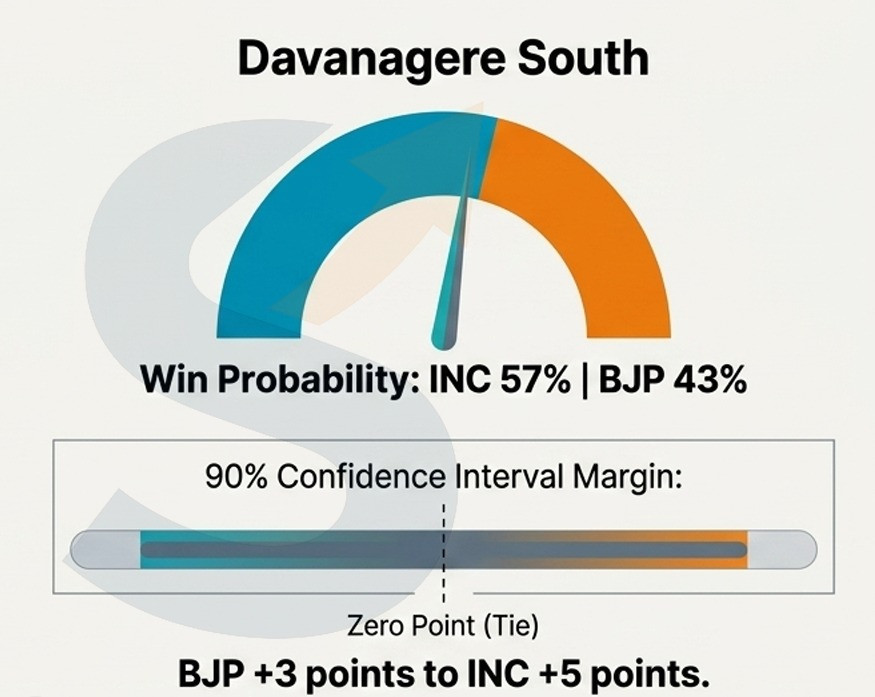
Bengaluru: A post-poll survey conducted by Vartha Bharati and Bengaluru-based political research organisation Sankalp has projected a tight contest in the Davanagere South Assembly by-election, with Congress still ahead of BJP but with a sharply reduced margin compared to the 2023 Assembly election.
According to the survey, Congress may retain the seat, but it is likely to lose around 25 per cent of the votes it had secured in the 2023 election. As a result, its lead is expected to shrink considerably. In contrast, BJP is projected to have retained 95 per cent of the votes it secured in 2023.
The survey also noted widespread anger among Muslim voters against Congress, making the by-election far from easy for the ruling party.
Vote share projection
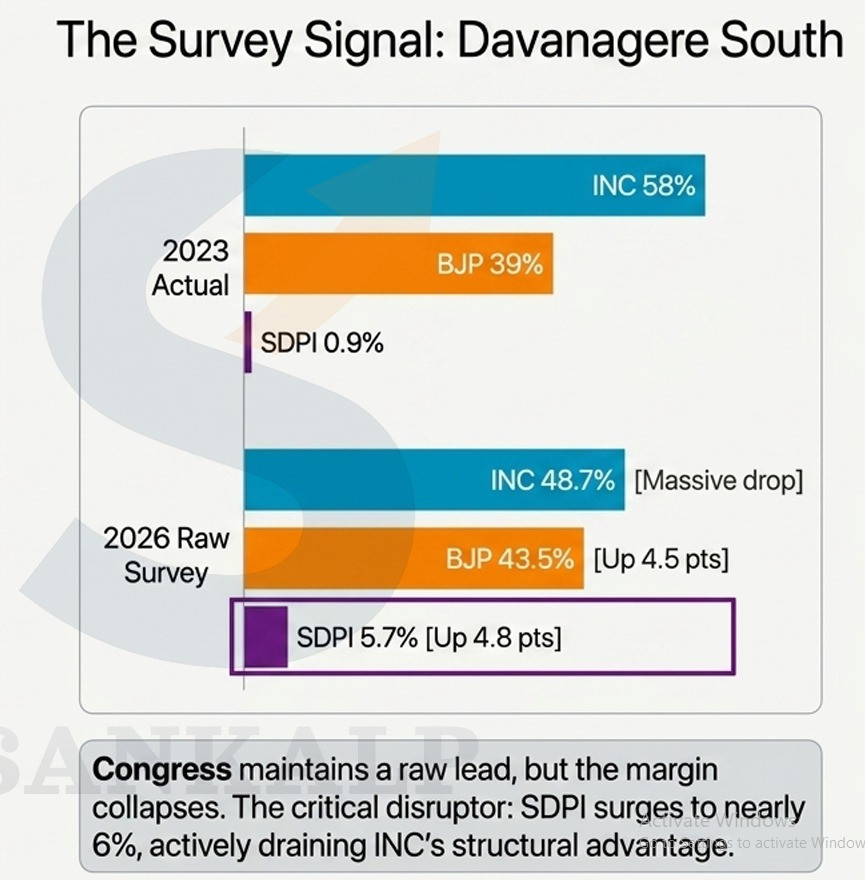
The survey estimates that of the total votes polled in 2023, Congress had secured 58 per cent. In the present by-election, its vote share may decline to 48.7 per cent.
BJP, which had received 39 per cent votes in 2023, may rise to 43.5 per cent this time.
SDPI, which had polled only 0.9 per cent in 2023, is projected to rise sharply to 5.7 per cent.
Independents and NOTA together may account for 2.1 per cent votes.
The survey stated that dissatisfaction among Muslims over ticket distribution and the manner in which Congress handled the community may hurt Congress and benefit SDPI.
Where Congress votes are shifting
Of the votes Congress may lose, a major share is projected to move to BJP.
The survey says:
- 17 per cent of Congress’s lost votes may shift to BJP
- 7 per cent may move to SDPI
- Around 1 per cent may go to others
This means that out of every 100 voters who supported Congress in 2023, nearly 25 may have shifted elsewhere in the by-election.
BJP vote retention strong
The survey estimates BJP has retained 95 per cent of its 2023 voters.
Only 5 per cent of BJP’s earlier votes may have moved to Congress.
Of that 5 per cent shift:
- 25 per cent are Dalits
- 33 per cent Lingayats
- 25 per cent Kurubas
- 17 per cent others
The survey says no BJP votes appear to have shifted to SDPI.
Social group movement from Congress to BJP
Among the 17 per cent votes shifting from Congress to BJP:
- 50 per cent Dalits
- 27 per cent others
- 11 per cent Lingayats
- 12 per cent Kurubas
The 7 per cent shift from Congress to SDPI is attributed clearly to Muslim voter dissatisfaction.
Gender-wise voting pattern
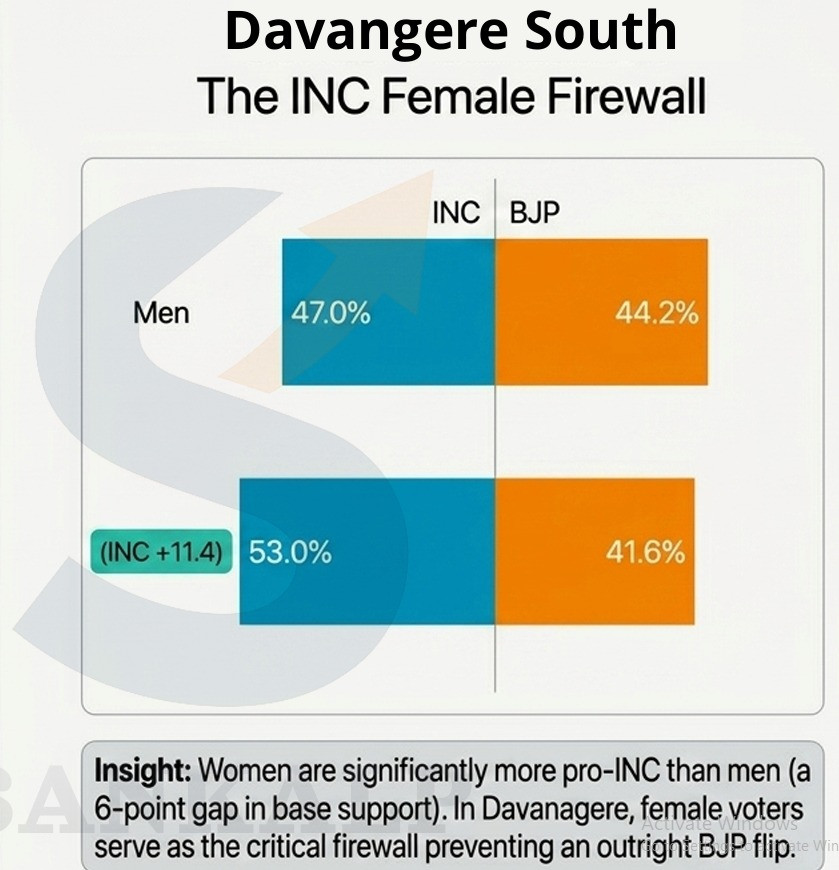
Among male voters:
- Congress: 47.0 per cent
- BJP: 44.2 per cent
- SDPI: 6.4 per cent
- Others: 2.4 per cent
Among female voters:
- Congress: 53.0 per cent
- BJP: 41.6 per cent
- SDPI: 3.9 per cent
Age-wise voting trend
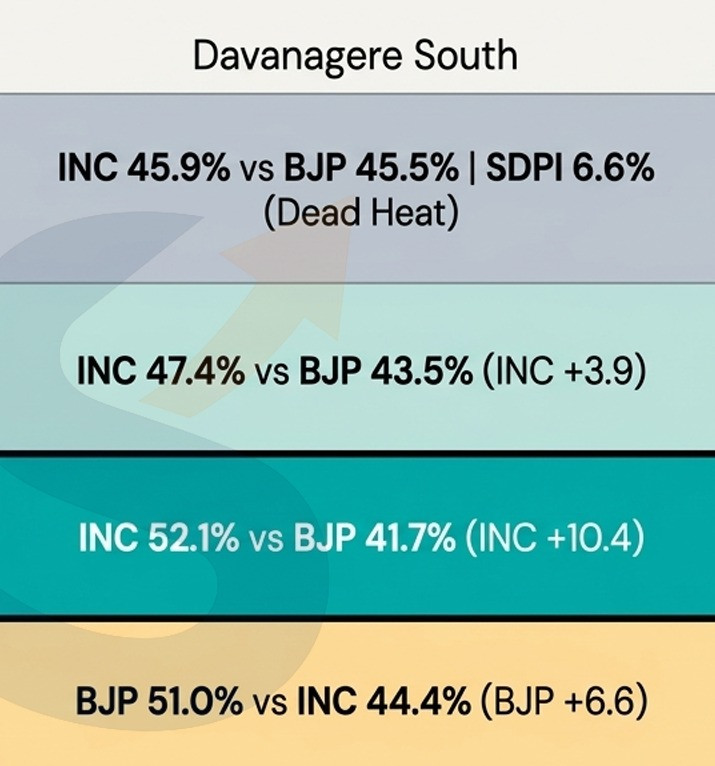
18 to 25 years
A close fight is seen among younger voters.
- Congress: 45.9 per cent
- BJP: 45.5 per cent
- SDPI: 6.6 per cent
The survey says this suggests young Muslim voters may have moved from Congress to SDPI.
26 to 40 years
This is the largest voter group.
- Congress: 47.4 per cent
- BJP: 43.5 per cent
- SDPI: 6.4 per cent
41 to 60 years
Congress is believed to have benefited from sympathy votes linked to Shamanur.
- Congress: 52.1 per cent
- BJP: 41.7 per cent
- SDPI: 4.7 per cent
Above 60 years
BJP appears stronger among senior voters.
- BJP: 51.0 per cent
- Congress: 44.4 per cent
- SDPI: 3.7 per cent
Factors helping Congress
The survey listed the following advantages for Congress:
- Sympathy factor after Shamanur’s death
- Voter preference towards ruling party
- Influence of Mallikarjun-Prabha couple
- Congress victory in Lok Sabha election
Factors helping BJP
The survey listed the following advantages for BJP:
- Anti-incumbency against Congress government
- Anger among Muslims hurting Congress
- BJP fielding a Dalit candidate
The survey observed that while SDPI gained directly from Muslim anger, BJP gained indirectly because Congress lost votes.
Candidate-wise estimate
The survey projects:
- Congress candidate Samarth Mallikarjun: 43% to 51%
- BJP candidate Srinivas T. Dasakariyappa: 42% to 50%
- SDPI candidate Afsar Kodlipete: around 6%
- Others: around 1%
Margin expected to shrink sharply
Congress had won the 2023 election by a huge margin of 27,888 votes.
This time, the survey projects Congress may be ahead by only 1,500 to 2600 votes.
It added that since the margin appears extremely narrow, the possibility of a surprise result cannot be ruled out.