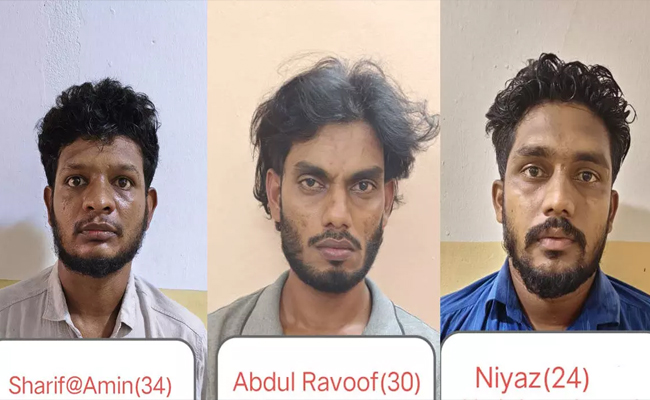
CBI leads major crackdown against drug cartels; 127 cases registered, 175 arrested

New Delhi(PTI): The CBI has led a massive countrywide crackdown on narcotics networks in coordination with the NCB, Interpol and police in multiple states, leading to the arrest of 175 alleged drug peddlers, officials said Thursday.
As many as 127 FIRs have been filed by the agencies involved in 'Operation Garuda' which started earlier this week to "disrupt, degrade and dismantle" drug networks with international linkages, CBI said in a statement.
The global operation was planned through a "rapid exchange" of intelligence on narco-trafficking and coordinated actions with enforcement agencies across international jurisdictions through Interpol, officials said.
Police of eight states and Union Territories, including Punjab, Delhi, Himachal Pradesh, Manipur, Maharashtra, and the Narcotics Control Bureau (NCB) tracked around 6,600 suspects during the operation following which 127 cases were registered and around 175 people, including six absconders and proclaimed offenders, were arrested, they said.
The agencies targeted smuggling of illicit drugs and psychotropic substances, with a special focus on the Indian Ocean Region, the statement said.
"Drug trafficking networks with international linkages require law enforcement cooperation across international jurisdiction. Operation GARUDA, CBI-led global operation, seeks to target drug networks with international footprints for action against handlers, operatives, production zones and support elements," it said.
The CBI and NCB worked with intelligence agencies and police of different states for information exchange, analysis and operational information, they said.
"Illicit drugs and psychotropic substances, including 5.125 kg heroin; 33.936 kg ganja; 3.29 kg charas; 1,365 gm Mephedrone; 33.80 gm of smack; around 87 tablets, 122 injections and 87 syringes of Buprenorphine; 946 Alpazolam tablets; 105.997 kg Tramadol; 10 gm hash oil; 0.9 gm Ecstacy pills, 1.150 kg opium, 30 kg poppy husk; 1.437 kg intoxicant powder and 1,1039 pills/capsules were recovered," the CBI spokesperson said
Let the Truth be known. If you read VB and like VB, please be a VB Supporter and Help us deliver the Truth to one and all.
13,989 pilots employed by 6 major domestic airlines: Govt

Mumbai (PTI): Six major domestic airlines have employed 13,989 pilots, with Air India and its low-cost arm, Air India Express, having 6,350 and 1,592 pilots respectively and IndiGo having 5,085 cockpit crew, Parliament was informed on Monday.
The number of pilots at Akasa is 466 and at SpiceJet, it is 385, Minister of State for Civil Aviation Murlidhar Mohol said in a written reply to a question in the Rajya Sabha.
The government-run Alliance Air has employed 111 pilots, he added.
The minister said the rate of employment among qualified pilots is dependent on market forces.
ALSO READ: Trainer aircraft crashes after hitting power line in MP's Seoni; pilot, instructor injured
He said the rationale behind airlines hiring foreign pilots, inter alia, is the requirement of a specific type-rated pilot in light of fleet expansions and time-bound operational requirements.
Mohol also said the flying training organisations (FTOs) are continuously upgrading their aircraft fleet by regularly inducting training aircraft fleets.
The Directorate General of Civil Aviation (DGCA) has facilitated the induction of 61 training aircraft by FTOs till November, he said, adding that the civil aviation regulator has approved two FTOs in 2025.
As of November 2025, India has 40 FTOs operating across 62 bases, Mohol said.
He said the modernisation of flying-training infrastructure is market dependent and undertaken on the basis of the commercial consideration of the FTOs, adding that the civil aviation ministry currently has no intervention in the same.
"However, India being an ICAO member, DGCA aligns its training and regulatory framework to ICAO's Standards and Recommended Practices (SARPs). DGCA regularly assesses the quality and adequacy of flying training through robust regulatory framework," Mohol said.
A continued review of safety standards is undertaken during the surveillance of these FTOs, in accordance with the published Annual Surveillance Plan of the DGCA, the minister said. Special safety audits and spot checks are also carried out as and when needed, he added.