CBI searches premises of ED officer in Shimla, seizes cash
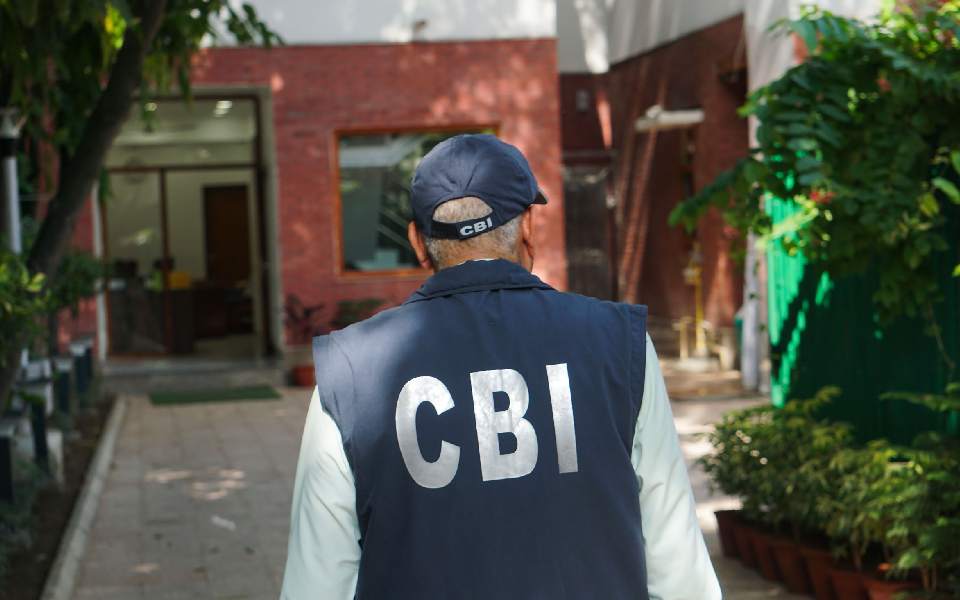
New Delhi, Dec 28: The CBI has searched the premises of an assistant director of the ED in Shimla, who managed to give a slip to the agency during a trap operation on Sunday and escaped, officials said.
The assistant director of the Enforcement Directorate (ED) posted at Shimla and his brother Vikas Deep, a senior manager in the Punjab National Bank in Delhi, had allegedly gone to Chandigarh to receive bribe money from a businessman, who is facing a case lodged under the Prevention of Money Laundering Act (PMLA), they said.
The businessman filed a complaint with the Central Bureau of Investigation (CBI) about alleged extortion, based on which the Chandigarh unit of the agency planned the trap operation where the complainant was asked to give a bribe of Rs 55 lakh in cash to the officer with CBI sleuths keeping an eye, the officials said.
It was planned that the CBI would nab the accused after the bribe was allegedly received by him, they said.
The ED officer, who is on deputation from the Central Board of Indirect Taxes and Customs (CBIC), got alerted during the operation and allegedly fled the spot with the cash, the officials said.
The agency has been trying to locate him for six days. It has even launched technical surveillance to pin-point his location but to no avail.
The CBI conducted searches at his residence on Friday and seized cash amounting to around Rs 56 lakh, the officials said.
So far, cash amounting to around Rs 1 crore, including the bribe amount, has been recovered, they added.
The car used by the absconding officer to escape was also located at the ED office, the officials said.
The CBI has arrested Vikas Deep in connection with the case and produced him before a court, they said.
The agency is questioning him regarding his alleged involvement in the case.
Sources in the ED said the accused assistant director of its Shimla sub-zonal office and his supervisory officers -- a deputy director and the joint director (based in Chandigarh) -- have been transferred to Delhi following the case.
Let the Truth be known. If you read VB and like VB, please be a VB Supporter and Help us deliver the Truth to one and all.
Air India resorts to cost-cutting ways amid 'tough times'; layoffs not anticipated
New Delhi/Mumbai (PTI): Hit hard by Pakistan airspace closure and Iran war, Air India has resorted to cost-cutting measures, including holding back annual increments for staff and asking them to cut discretionary spending as well as non-critical expenditures, warning of "tough times".
On Friday, Air India Chief Executive Officer & Managing Director (CEO & MD) Campbell Wilson told the staff it is going to be a "very, very difficult year" if things don't improve on the Middle East front.
A day after the loss-making airline's board discussed various cost-saving steps, Wilson, along with Chief Financial Officer (CFO) Sanjay Sharma and Chief Human Resources Officer (CHRO) Ravindra Kumar GP, addressed the employees during a townhall on Friday where the emphasis on the need to keep a close watch on costs.
With higher jet fuel prices due to the West Asia conflict and airspace curbs, the loss-making airline's expenses have spiralled in recent times and against this backdrop, Sharma also told staffers that FY26 has seen a softening in revenue amid heightened external uncertainties.
Calling for a relentless focus on costs in these tough times, Wilson urged employees to suspend discretionary spending, renegotiate rates where feasible, and defer non-critical expenditures.
"There must be a laser-sharp focus on eliminating wastage and leakages," he said.
Stressing the need to tighten the belt for a while, Wilson sounded optimistic that travel demand would rebound and the industry would continue on its upward path.
CHRO Ravindra Kumar told staff that the airline will proceed with variable pay for the last financial year and continue with planned promotions while noting that annual increments will be deferred by at least one quarter.
"We don't anticipate layoffs," he said.
At the airline's board meeting on Thursday, various cost-saving steps, including likely furloughs, were discussed. The Tata Group-owned airline has around 24,000 employees.
Generally, furlough refers to sending staff on unpaid leaves by companies during a tough financial situation.
During the townhall, CFO Sanjay Sharma said while strong revenue growth and fleet expansion drove financial momentum through FY25, FY26 has seen a softening in revenue amid heightened external uncertainties.
Air India has seen around 40 per cent CAGR (Compounded Annual Growth Rate) in revenue between 2022 and 2025, he added.
The airline was acquired by the Tata Group from the government in January 2022.
The Air India CEO mentioned the external challenges being facing the aviation industry as a whole, including the continued closure of Pakistan airspace that is expected to persist for the foreseeable future and geopolitical conflicts leading to disruptions and airspace closures across West Asia.
Wilson, who is set to step down later this year, also flagged a sharp depreciation of the rupee and a 2.5-3 times increase in jet fuel prices, and added that these factors have adversely affected travel sentiment and consumer confidence, as per the sources.
If the Strait of Hormuz opens, oil prices fall and consumer as well as business confidence come back, there is a decent chance of a solid recovery, Wilson said, adding that unless those circumstances happen, it was going to be "a very, very difficult year".
"I feel somewhat responsible that we ended up with probably the biggest surprise of the year in the external environment which was a full-scale war in our neighbouring region in the Gulf. That has had a huge impact on airspace," he said.
For Air India, Wilson said the situation is compounded by the fact that the airline cannot fly over the neighbouring country and has to take a much longer routing for any west-bound destination.
"Every airline is reporting that they are under some sort of financial pressure as a result of higher fuel prices and economic uncertainty. So, it is unfortunately not a great environment to be running an airline," the Air India CEO said.
The Air India Group -- Air India and Air India Express -- is projected to have incurred more than Rs 22,000 crore loss in the financial year ended March 2026.
At the townhall, Wilson also highlighted various initiatives, including completion of the retrofit of its legacy narrow-body aircraft and rapid network optimisation to redeploy capacity more efficiently.