CBSE Class-10 board exams twice a year from 2026; first phase mandatory, second optional

New Delhi, June 26 (PTI): From 2026, Class-10 students will be able to take CBSE board exams twice in an academic session but it will be mandatory for them to appear for the first phase in February, officials said on Wednesday.
The second phase scheduled in May will be optional for students who wish to improve their performance. In case a student appears for both the phases, the best score of the two will be retained, they said.
The Central Board of Secondary Education (CBSE) has approved the norms for conducting board exams twice a year for Class-10, a move recommended in the new National Education Policy (NEP).
"The first phase will be conducted in February and second in May. The results for the two phases will be announced in April and June, respectively,” CBSE Examination Controller Sanyam Bhardwaj said.
"It will be mandatory (for students) to appear for the first phase while the second phase will be optional. Students will be allowed to improve their performance in any three subjects out of science, mathematics, social science and languages," he added.
Explaining the rationale behind making the first phase mandatory for the students, CBSE Chairman Rahul Singh said it is being done to ensure that students take the exams seriously and the sanctity of the board exams is maintained.
"If a student does not appeared for three or more subjects in the first examination, he or she will not be allowed to appear for the second exam. Such students will be placed in the 'Essential Repeat' category and can take the examination only next year in the main exam in February," he said.
"Students whose result in the first examination is compartment will be allowed to appear in the second examination under the compartment category. Additional subjects will not be permitted after passing Class-10, students will not be allowed in stand-alone subjects," he added.
According to the approved norms, Class-10 students from winter-bound schools will get an option to appear for the board exams in any of the two phases.
Similarly, sports students will be allowed to appear in the second phase in subjects which coincide with their sports events.
The internal assessment will be conducted only once during the academic session.
The CBSE announced the draft norms in February, which were put in the public domain for stakeholders' feedback, including from schools, teachers, parents, students and the public.
The draft norms said the two phases will be optional and students will get the choice to either appear for both, or any of the two.
The new NEP recommended that to eliminate the "high-stakes" aspect of the board exams, all students will be allowed to take the exams on up to two occasions during any given school year.
Both the examinations will be conducted on the full syllabus meant for the year and the scheme of studies and scheme of examinations will remain the same.
The Board has clarified that no separate supplementary exams will be conducted under this system. Instead, the second session of the Board exam will serve as the supplementary exam for those who wish to improve their scores.
At present also, students have an opportunity to improve their scores in supplementary exams.
"Presently, students can improve scores in two subjects and the improvement exams are conducted in July, the results of which are announced in August.
"So, in the new setup, the second phase of exams will be conducted in May and the results will be declared in June. Also, students can attempt to improve their scores in three subjects instead of two," Bhardwaj said.
Let the Truth be known. If you read VB and like VB, please be a VB Supporter and Help us deliver the Truth to one and all.
India should create strategic buffers to navigate 'most difficult' energy shock: CEA Nageswaran
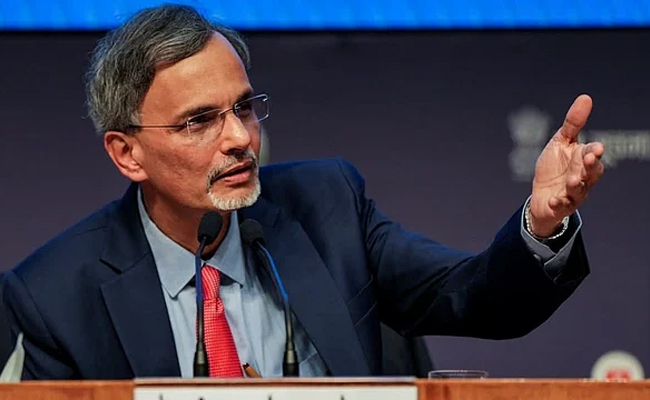
New Delhi (PTI): Chief Economic Advisor V Anantha Nageswaran on Saturday said India needs to create strategic buffers in the face of the "most difficult" energy shock that the country is facing amid the West Asia crisis.
Nageswaran also said the rising prices of fertiliser and petroleum products globally due to the crisis will make it challenging to achieve the 4.3 per cent fiscal deficit target for the current fiscal, while below normal monsoon and pass-through of higher energy prices could lead to "potential inflation spike".
He also said India has employment challenge emanating from AI, and there is a need to ensure that IT sector becomes more competitive and not lose jobs to AI, and instead create jobs that use AI within the IT sector or in other services.
Speaking at the ICPP Growth Conference organised by the Ashoka University, Nageswaran said the current account deficit (CAD) in the current fiscal could rise to over 2 per cent of GDP, from less than 1 per cent in FY'26.
"The ... priority for us is to create strategic buffers. This energy shock is the most difficult one compared to any other previous energy shock in terms of energy lost as a percentage of total global energy supply, not just oil, including gas.
"And we also need to use this occasion to think about other areas where we are vulnerable in terms of import dependence, nickel, tin, and copper. We need to build strategic buffers if we have to make a shot at manufacturing and becoming indispensable," Nageswaran said.
Since the beginning of the war in West Asia on February 28, crude oil prices soared to a four-year high of USD 126 per barrel on Thursday, from about USD 73 level before the war.
Stating that geopolitics will compel policymakers to be nimble and flexible and shed old model of thinking, Nageswaran said India is better prepared than many other countries to deal with the crisis because of the fiscal leeway that the country has due to lowering of fiscal deficit ratio to 4.4 per cent of GDP in FY'26.
Nageswaran said the West Asia conflict is more of a price shock than supply shock for India as the government is managing the supply side deftly.
"This particular conflict, which is going to be on a low simmer or a high flame situation, whatever it is, it is going to be there with us in some form or the other because the military conflict may be over, but the strategic conflict is well and truly alive. It will be so for some time," Nageswaran said.
He said the conflict has four channels of shock: price and supply shock, trade impact, sticky logistics costs and remittance shock.
India imports 60 per cent of its LPG usage and of that, 90 per cent flows through the now closed Strait of Hormuz.
Nageswaran said the pass-through of high global energy prices would have to be a "balancing act". He said some pass-through is already happening in commercial LPG, and the levy of export duty on diesel and ATF.
The government has cut excise duty on petrol and diesel to shield customers from the impact of the rise in petroleum prices. "We are coming around to arriving at a certain modus vivendi with respect to burden-sharing between the fiscal policy side, inflation, households and the oil marketing companies. So it has to be a balancing act," Nageswaran said.