Celebi Aviation denies ownership links to Erdogan’s daughter after security clearance revoked

New Delhi: Celebi Aviation India has vehemently rejected rumors on social media about ownership or affiliation with Sumeyye Erdogan, the daughter of Turkish President Recep Tayyip Erdogan. Celebi Aviation India takes care of the ground and cargo handling activities at key Indian airports like Delhi, Mumbai, and Chennai, which are sensitive from a national security viewpoint.
The clarification follows the Indian government's move to cancel the company's security clearance in the wake of increased scrutiny of Turkish connections, after Ankara's latest diplomatic approach inclining towards Pakistan.
In a formal announcement, the ground-handling and airport services firm declared that Sumeyye Erdogan has no involvement whatsoever and doesn't have any stake in the parent organization. The company clarified that its ownership lies solely with members of the Celebioglu family, Can Celebioglu and Canan Celebioglu, who, it said, have no political associations.
"There is no one named Sumeyye owning any shareholding in the parent organisation,” the statement noted, dismissing online speculation as baseless. Celebi further stated that it is a professionally managed company with a global presence, adhering to corporate governance and neutrality, and having no ties to any foreign government or political individual.
Celebi also detailed the ownership structure of its parent company, explaining that 65 per cent is held by institutional investors across Canada, the United States, the United Kingdom, Singapore, the UAE, and Western Europe. Notably, a Jersey-registered fund, Actera Partners II L.P., holds a 50 per cent stake, while Dutch entity Alpha Airport Services BV owns 15 per cent.
Let the Truth be known. If you read VB and like VB, please be a VB Supporter and Help us deliver the Truth to one and all.
Injured Phil Salt returns home for scans
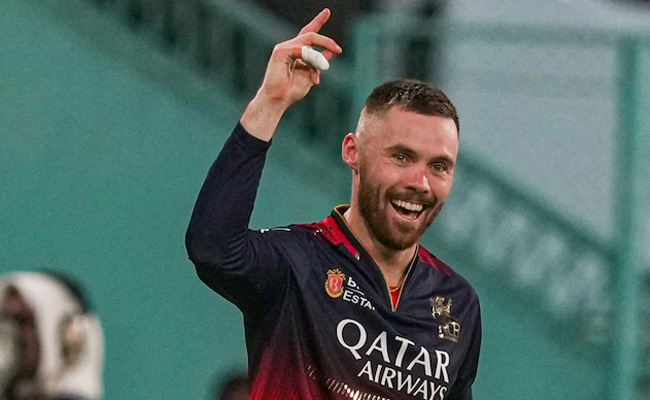
New Delhi (PTI): Royal Challengers Bengaluru opener Phil Salt has returned to England for scans on a finger injury sustained last month.
The injury has kept Salt out of RCB's last three matches, with compatriot Jacob Bethell stepping in at the top of the order.
The 29-year-old is reported to have "damaged a finger on his left hand" while diving to save a boundary at deep backward square leg during RCB's defeat to Delhi Capitals at the M. Chinnaswamy Stadium on April 18.
"Salt, who is centrally contracted by the ECB, has since returned home at the request of England's management and has undergone scans on his finger," ESPNCricinfo reported.
According to the report, both RCB and Salt are hopeful of a speedy recovery and the opener can return to India later this month.
Salt had enjoyed a strong start to the season, amassing 202 runs in six innings at an impressive strike rate of 168.33.
RCB are currently second on the points table behind Punjab Kings. They take on Lucknow Super Giants (LSG) on Thursday next.