Central schemes no longer limited to certain people, reaching all: Modi
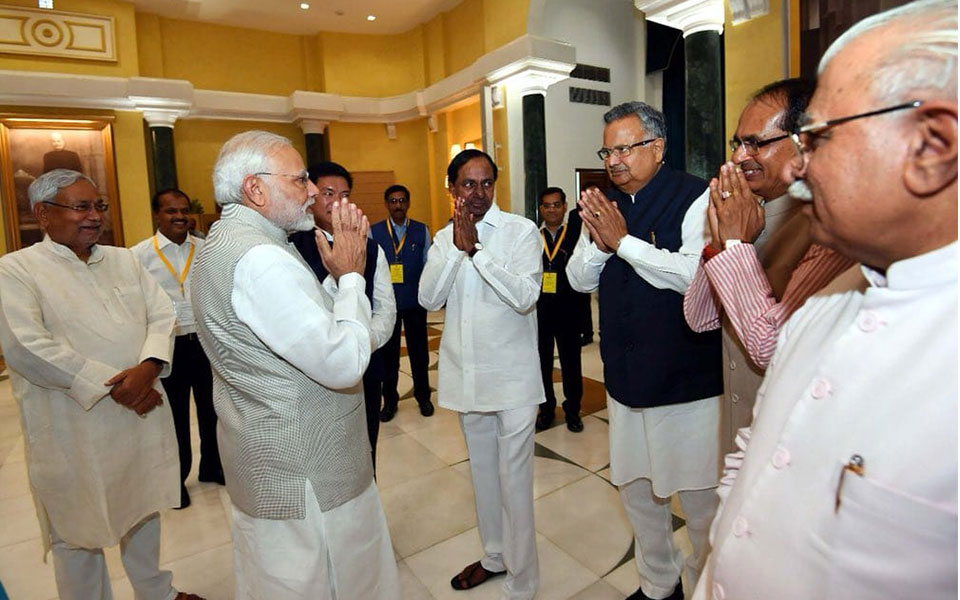
New Delhi, June 17: Prime Minister Narendra Modi on Sunday called upon Chief Ministers to contribute their efforts towards 100 per cent implementation of Central schemes for the poor people's welfare as he said these were no longer limited to certain people and reaching everyone without discrimination.
He encouraged states to give fresh ideas to the Finance Commission on outcome-based allocations and expenditure correction, while calling for a widespread debate and consultations on simultaneous parliamentary and assembly elections, "keeping in view various aspects such as the resulting financial savings and consequent better utilisation of resources".
In his closing remarks at fourth meeting of the NITI Aayog's Governing Council, Modi, welcoming the constructive discussion and suggestions made by various Chief Ministers, assured them that these would be seriously considered during decision-making, an official statement said.
He asked the NITI Aayog to follow up, within three months, on the actionable points suggested by states.
Modi termed it "vital to identify the 'last people in the line' so that benefits of governance can reach them". "Similarly social justice is an important governance objective. These noble causes require close coordination and constant monitoring," he said.
On his government's guiding principle of "Sabka Saath, Sabka Vikas", the Prime Minister said: "The schemes of the Union government are no longer limited to certain people, or to certain regions and are reaching everyone without discrimination, in a balanced way."
Noting that all villages of the country are now electrified, he said that, under Saubhagya Yojana, four crore houses are now being provided with electricity connections.
"Rural sanitation coverage has increased from less than 40 per cent to about 85 per cent in four years. After implementation of the Jan Dhan Yojana, the entire population will be connected to the banking system.
"The Ujjwala Yojana is providing access to cooking gas, and Mission Indradhanush is working towards universal immunization," he said adding that his government is working towards providing housing for all by 2022.
"The implementation of these welfare schemes is also bringing about a behavioural change in the lives of people," he said, holding that the neem coating of urea, Ujjwala Yojana, Jan Dhan Accounts and RuPay debit cards are improving the lives of the people, while the Swachh Bharat Mission is being discussed around the world.
"In the last four years, 7.70 crore toilets have been constructed," he said calling upon the Chief Ministers to work towards 100 per cent sanitation coverage by October 2, 2019, the 150th birth anniversary of Mahatma Gandhi.
He reiterated the his commitment to provide universal coverage of seven key schemes to 45,000 additional villages in 115 Aspirational Districts, by August 15.
On the issue of environment, raised by some Chief Ministers, the Prime Minister urged them to use LED bulbs in government buildings, official residences and streetlights "within a definite timeframe".
Modi appreciated several other suggestions made by various Chief Ministers, on matters such as water conservation, agriculture, rural job scheme etc.
He also called upon Chief Ministers of Madhya Pradesh, Bihar, Sikkim, Gujarat, Uttar Pradesh, West Bengal and Andhra Pradesh, to work together to make recommendations on a coordinated policy approach on the subjects of agriculture and the rural job scheme, including both pre-sowing, and post-harvest phases.
He urged for efforts towards water conservation and water management on a war footing.
Encouraging the states to give fresh ideas to the Finance Commission for incentivizing outcome-based allocations, and expenditure correction, he said, "The world expects India to become a five trillion dollar economy soon."
Asking states to focus on exports, he encouraged them to boost "Ease of Doing Business."
"NITI Aayog should call a meeting with all states to provide a further impetus to ease of doing business. 'Ease of living' for the common man is also the need of the hour, and states should now take initiatives in this regard," he said.
Expressing concern over low corporate investment in agriculture sector, he said states should formulate policies that promote corporate investment in areas such as warehousing, transportation, value addition and food processing etc.
The Prime Minister said that mining blocks which have been successfully auctioned, should start production at the earliest and urged the states to take steps in this regard.
Let the Truth be known. If you read VB and like VB, please be a VB Supporter and Help us deliver the Truth to one and all.
3 held, hunt on for 4 accomplices after they kidnap, assault and urinate on man in Bhopal
Bhopal (PTI): Police have registered a case against seven persons and arrested three of them for allegedly kidnapping, assaulting and urinating on a 22-year-old man in Madhya Pradesh capital Bhopal, officials said on Thursday.
The incident occurred during the intervening night of April 26 and 27 in an area located under the Hanumanganj police station limits, an official said.
One of the accused urinated on the face of the victim and captured a video of the act, which was later circulated on social media to humiliate him, he said.
"A complaint in this connection was lodged by Jaswant Markam (22), a resident of Kamla Nagar, based on which a case was registered against seven persons under sections of Bharatiya Nyaya Sanhita (BNS) and police have arrested three of them, including one Prem Thapa," Bhopal Police Commissioner Sanjay Kumar said.
Three police teams have been formed and the remaining suspects will be apprehended soon, he said.
During the intervening night of Sunday and Monday, Markam was at the local bus stand with a friend when around 4 am, the accused took him away on the pretext of discussing something with him. They asked him about his neighbour and friend Aniket. When he refused to provide any information, they started assaulting him, the police said.
The accused then took him to a forest in Karond area, where he was stripped and severely thrashed, they said.
When the man began to lose consciousness, one of the accused urinated on his face and made a video of the act, which was circulated on social media to humiliate him and spread terror, according to the police.
The accused called Markam's friend around 5 am to inform him about his condition. The victim was subsequently admitted to a hospital, the officials said, adding that the viral video was also being investigated.
Responding to a query, Hanumanganj police station in-charge Awdhesh Bhadoria said if the victim was found to be from the tribal community, then relevant sections will be invoked against the accused.
At present, the police are probing the incident and search is on to arrest the remaining accused, he added.
In 2023, a man had urinated on a tribal youth in Sidhi district of Madhya Pradesh. A video of the incident had gone viral on social media platforms and created a controversy.