Centre asks states to keep strict vigil, take pre-emptive action in any area of concern
Rise in Covid cases
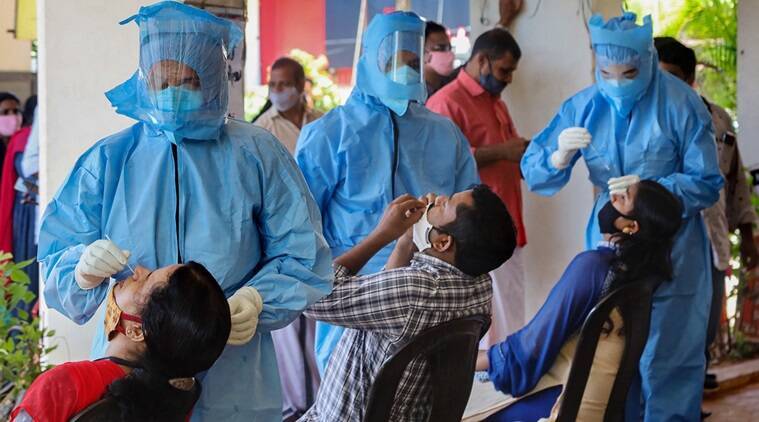
New Delhi, Apr 21: Amid rising cases of Covid, the Centre on Friday asked eight states including Uttar Pradesh, Tamil Nadu and Maharashtra to maintain a strict watch and take preemptive action in any area of concern to control any emerging spread of infection.
Underlining that Covid is still not over, Union Health Secretary Rajesh Bhushan in a letter to Uttar Pradesh, Tamil Nadu, Rajasthan, Maharashtra, Kerala, Karnataka, Haryana and Delhi urged them to remain cautious against laxity at any level saying that may nullify the gains made in pandemic management so far.
The country has been witnessing a consistent rise in COVID-19 cases since March, with 10,262 cases reported in the week ending April 20. A rise in positivity rate has also been noted across the country, with 5.5 per cent positivity reported in the week ending April 19 against 4.7 per cent positivity reported in the previous week, Bhushan said.
"This is a cause of concern," he stated.
While the rates of hospitalization and deaths due to COVID-19 have remained low, states or districts reporting higher number of cases may indicate a possible localized spread of infection thus necessitating a closer look at these states or districts (high daily cases and/or high-test positivity rates) and the need to institute requisite public health measures to control and contain such surges in the initial stages, he said.
"It is also critical to ensure timely and regular updating of data to assist in accurate monitoring of the situation. It is essential that the State must maintain a strict watch and take preemptive action if required in any area of concern to control any emerging spread of infection. Regular monitoring and follow-up action are crucial," Bhushan said.
While the five-fold strategy for control of pandemic - Test-Track-Treat-Vaccination and adherence to Covid appropriate behaviour - remains the time-tested approach, it is critical for the state health departments to institute prompt and effective public health measures with a key focus on the aspects such as strengthening Covid surveillance in all districts and monitoring trends of influenza-like illness (ILI) and SARI cases in all sentinel surveillance sites on a regular basis and ensure its reporting through IDSP-IHIP network, he said.
He also urged them to focus on maintaining adequate levels of testing (especially in emerging hotspots, ILI and SARI cases) in all the districts while maintaining the recommended share of RT-PCR and Antigen tests.
The focus should be in areas reporting high case positivity and new clusters of cases, Bhushan said and asked them to increase the number of Covid-positive samples sent for Whole Genomic Sequencing through the INSACOG network of laboratories, especially from any new clusters of cases detected in the community.
States have also been asked to ensure operational readiness and adequate strengthening of hospital infrastructure, especially at the sub-district levels in terms of availability of essential drugs and equipment and adequately trained manpower. Adequate financial support has already been provided to all states under various financial packages and PM-ABHIM.
They have been further asked to encourage uptake of precaution doses among eligible beneficiaries while countering vaccine hesitancy through community awareness and improve community awareness to encourage early reporting of symptoms and testing as well as adherence to Covid-appropriate behaviours, particularly in terms of avoiding overcrowded or poorly ventilated settings and use of masks in such settings.
Bhushan said Uttar Pradesh has reported an increase in weekly cases from 279 in week ending April 13 to 696 in week ending 20 April.
While the state reported positivity rate of 2.19 per cent in week ending April 19 which is less than India average of 5.5, it was noted that one district reported positivity rate higher than 10 per cent and 4 districts reported positivity rate between 5 and 10 per cent during the same period.
As for Tamil Nadu, Bhushan said the state has reported an increase in weekly cases from 356 in week ending April 13 to 510 in week ending April 20. The state reported a positivity rate of 6 per cent in week ending April 19.
Further, it was noted that 11 districts reported positivity rate higher than 10 per cent and 12 districts reported positivity rate between 5 and 10 per cent in week ending April 19.
Rajasthan reported an increase in cases from 181 (week ending April 13) to 435 (week ending April 20). It reported a positivity rate of 5.81 per cent in the week ending April 19, Bhushan said.
Further, he noted that six districts reported positivity rate higher than 10 per cent and 11 districts reported a positivity rate between 5 and 10 per cent in week ending April 19.
Bhushan said Maharashtra has reported an increase in weekly cases from 774 in week ending April 13 to 872 in the week ending April 20. The state reported a positivity rate of 6.87 per cent in week ending April 19.
Further, he noted that 8 districts reported positivity rate higher than 10 per cent and 9 districts reported positivity rate between 5 and 10 per cent in week ending April 19.
Kerala, Bhushan said, reported an increase in weekly cases from 2,139 in week ending April 13 to 2,602 in week ending April 20 while Karnataka reported a rise in weekly cases from 268 in week ending April 13 to 369 in week ending April 20.
While Karnataka reported a positivity rate of 2.83 per cent in week ending April 19, which is less than India average, it was noted that the district of Bengaluru Urban reported high positivity rate of 6.7 per cent during the same period.
Haryana saw an increase in weekly cases from 445 in the week ending April 13 to 910 in the week ending April 20 whereas in Delhi, there was an increase in weekly cases from 741 in the week ending April 13 to 1,471 in the week ending April 20.
Delhi reported a positivity rate of 29.65 per cent in the week ending April 19 which is significantly higher than India's positivity rate of 5.5 per cent during the same period.
Further, it was noted that all 11 districts reported positivity rate higher than 10 per cent.
Let the Truth be known. If you read VB and like VB, please be a VB Supporter and Help us deliver the Truth to one and all.
Putin meets Iran's FM Araghchi, says Russia ready to do its best to help bring peace to West Asia
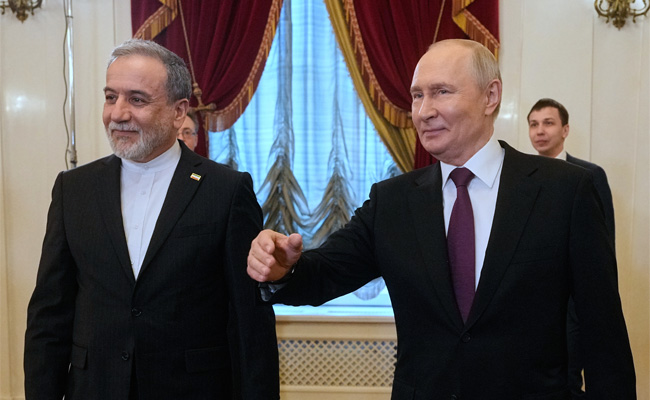
Moscow (PTI): Iran's Foreign Minister Abbas Araghchi on Monday met Russian President Vladimir Putin, who hailed the Iranian people for fighting bravely and heroically for their sovereignty and said Moscow is ready to do its best to help bring peace to West Asia as soon as possible.
Araghchi, who held talks with Omani and Pakistani leadership before arriving in Russia, met Putin in St. Petersburg and thanked him for supporting Iran, state-owned TASS news agency reported.
"Russia is ready to do everything in its power to ensure that peace in the Middle East is achieved as soon as possible," Putin said during his meeting with Araghchi, which was also attended by Russian Foreign Minister Sergey Lavrov.
Revealing that he received a message from Iranian Supreme Leader Mojtaba Khamenei last week, Putin asked Araghchi to convey his "gratitude for this message and best wishes for his health and well-being."
He praised the Iranian people for fighting "bravely and heroically" for their sovereignty, Iran's state-run PRESS TV reported.
"We really hope that, based on the courage and desire for independence, the Iranian people, under the guidance of the new leader, will weather this difficult period of trials and peace will come,” Putin said.
He also stressed that Russia “intends to maintain” its strategic relations with Iran.
Araghchi said that the world witnessed Iran’s strength in countering the US during the recent war, and that the Islamic Republic is a "stable and powerful establishment."
"With their courage, the Iranian people succeeded in resisting the US aggression and will be able to endure it,” he said.
He said that it became clear that Iran has “great friends and allies” like Russia, and conveyed “warmest greetings” from Supreme Leader Mojtaba Khamenei and President Masoud Pezeshkian to the Russian leader.
Araghchi said relations between Moscow and Tehran represent a “strategic partnership at the highest level” and will continue to develop "regardless of circumstances."
"We are grateful to you for the solid and strong positions in support of the Islamic Republic of Iran," he said.
Foreign Minister Lavrov said that the talks between President Putin and the Iranian Foreign Minister were "useful and constructive."
Kremlin Spokesman Dmitry Peskov later said that Russia is "ready to provide any good offices, any mediation services that are acceptable to the parties."
"We will be ready to do everything so that ultimately peace ensues, guaranteed peace, and that there is no return to hostilities," Peskov was quoted as saying by TASS.
He was asked how Moscow can assist in future negotiations on the Iranian settlement.
Araghchi arrived in Russia after his whirlwind trip to Islamabad, which, according to him, was “very productive” and involved “good consultations" with Pakistan's Army Chief Field Marshal Asim Munir, amid uncertainty over the second round of peace talks to resolve the war in West Asia.
"We held good consultations with our friends in Pakistan. The trip was successful. We assessed the outcome of our recent (meetings) and discussed in what direction and under what conditions talks can move on,” Araghchi said in a video posted on his Telegram channel upon his arrival in St Petersburg.
Referring to the second round of talks between the US and Iran to resolve the conflict in West Asia, Araghchi said: "Developments have taken place in the negotiations."
"Despite some progress in earlier rounds, the talks failed to reach their objectives due to the Americans' approach, the excessive demands they made, and the wrong approaches they adopted. Therefore, it was necessary to consult with our friends in Pakistan to review the latest situation,” Iran's official news agency IRNA quoted him as saying.
He said that the trip to Pakistan was a good opportunity to review developments related to the US-Israeli war against Iran, expressing confidence that “these consultations and coordination between the two countries will be highly significant.”
Araghchi arrived at St. Petersburg's Pulkovo Airport early Monday, where he was welcomed by Russian officials and Iran’s ambassador to Russia, Kazem Jalali, the report said.
The first round of peace talks between Iran and the US, held on April 11 and 12, failed to bring the desired result for the parties to the conflict.
The Iranian minister arrived in Islamabad for the second time on Sunday after a short visit to Oman, where he held talks with Sultan Haitham bin Tariq al-Said on security in the Strait of Hormuz and diplomatic efforts to end the Iran-US conflict.
After Araghchi left Pakistan for Oman on Saturday, President Donald Trump announced that US negotiators Steve Witkoff and Jared Kushner would no longer be going to Islamabad for talks with Iran, contending that Washington held all the cards on the matter.
Trump on Sunday reiterated that the US and Iranian officials can talk by phone for a peace solution to the conflict.
On Tuesday, Trump extended the two-week ceasefire with Iran indefinitely to give Tehran more time to prepare a unified proposal to end the war, just hours before the truce was set to expire.
The war began when the US and Israel jointly attacked Iran on February 28, killing Iranian Supreme Leader Ayatollah Ali Khamenei and several top commanders. The retaliation by the Islamic Republic extended the war to the entire Gulf region.