Centre asks states to strictly follow home-isolation guidelines to curb COVID-19 spread
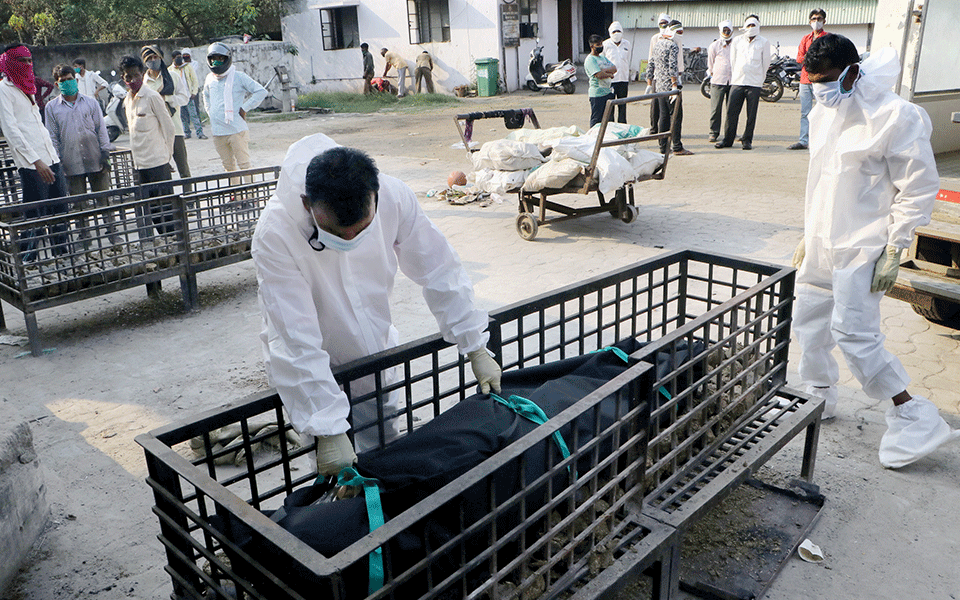
New Delhi: The Centre has asked states to ensure implementation of its guidelines on home isolation at the field level "in letter and spirit" to effectively contain the spread of the coronavirus, after taking note of instances of laxity.
The Ministry of Health and Family Welfare issued revised guidelines for home isolation on May 10 which continue to be effective as on date, an official statement said Friday.
According to the guidelines, very mild and pre-symptomatic COVID-19 patients can opt for home isolation, provided the patient has a room for himself/herself with toilet facility and has an adult attendant or caregiver.
Also, the patient should agree to monitor his/her health and regularly inform the status to the district surveillance officer for follow-up by surveillance teams.
An important clause in the revised guidelines is that the treating doctor should be satisfied about the patient opting for home isolation based on medical assessment and assessment of his/her residential accommodation, the government said.
In addition, the patient should fill in an undertaking on self-isolation and should follow home quarantine guidelines, it said.
"In this regard, some instances have been noticed wherein home isolation is allowed in a routine manner in certain states, and clauses of the revised guidelines are not followed in letter and spirit," it said.
This may lead to spread of the disease within the family members and neighbours, more so in urban settings such as dense urban agglomerations, the Centre said, adding the Health Ministry has requested states to ensure strict implementation of the guidelines at the field level to effectively curb spread of the COVID-19 pandemic.
"We have collectively been following the policy of test, trace, track and isolate and the same may not be feasible if the guidelines issued are not implemented in letter and spirit," Health Ministry Joint Secretary Lav Agarwal in his letter to states said.
"It is again reiterated that the urban congested settlements exercising the option of the home isolation may result in patient spreading the infection to family members and in the neighbourhood. In this context, it is requested to ensure strict implementation of the guidelines on home isolation at the field level," he said.
Let the Truth be known. If you read VB and like VB, please be a VB Supporter and Help us deliver the Truth to one and all.
All arrangements in place for second phase of polling in West Bengal on April 29: Poll official
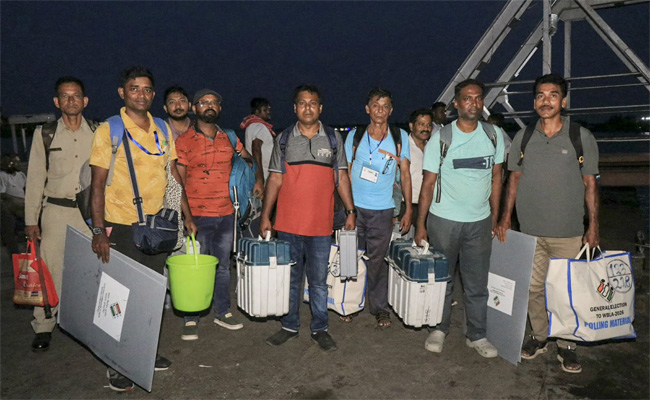
Kolkata (PTI): All arrangements have been made for the smooth conduct of the second phase of the West Bengal Assembly elections on April 29, Chief Electoral Officer Manoj Kumar Agarwal said on Monday.
Speaking to reporters, Agarwal asserted that there would be no bogus voting and no disturbances.
"We have made all arrangements. For every possible issue, there is a remedy that will be applied at the right place,” he said.
"The election process is being handled uniformly across the state and not viewed separately in phases," he said.
Referring to the first phase of polling held on April 23, Agarwal said voting was peaceful due to coordinated efforts of the administration, police, central forces, political parties and voters.
"Preparations have been further strengthened for the concluding phase," he said, adding that he had visited several districts and sensitive areas to review preparedness.
"There is strong enthusiasm among people to vote. The 93 per cent turnout in the first phase has set a new benchmark, and in many places, people are aiming to surpass that figure in the second phase," he said.
On incidents of unrest ahead of the polls, Agarwal said such occurrences were not new and similar incidents had taken place before the first phase, but the situation remained under control on polling day.
He said the state police and central forces were fully prepared to maintain law and order and ensure peaceful voting.
A total of 3,21,73,837 people -- 1,64,35,627 men, 1,57,37,418 women and 792 third-gender voters -- are eligible to cast their votes across 142 assembly segments in seven districts in the second phase, officials said.
Polling will be held at 41,001 polling stations, all of which will be covered by webcasting. A total of 2,321 companies of central forces have been deployed, with the highest deployment of 273 companies in Kolkata, they said.
Returning officers have also been directed to ensure the movement of polling personnel from booths to receiving centres under proper security arrangements immediately after the conclusion of voting, they added.
Agarwal said deployment of central forces for the second phase began on Sunday, adding that earlier there had been a relative shortage of forces.
"Taking advantage of that, miscreants indulged in incidents of unrest and intimidation," he said.
As many as 142 general observers, 95 police observers and 100 expenditure observers have been deployed, while drones fitted with cameras will be used to monitor the polling process.
A total of 1,448 candidates are in the fray in this phase. Bhangar in South 24 Parganas district has the highest number of candidates at 19, while Goghat in Hooghly district has the lowest at five.
Among the prominent candidates contesting in this phase are Chief Minister Mamata Banerjee and Leader of the Opposition Suvendu Adhikari in Bhabanipur, state ministers Sujit Bose in Bidhannagar, Firhad Hakim in Kolkata Port, Jyoti Priya Mallick in Habra, Bratya Basu in Dum Dum and Sovandeb Chattopadhyay in Ballygunge, and BJP's Arjun Singh in Noapara, Swapan Dasgupta in Rashbehari and Rudranil Ghosh in Shibpur.
Also in the fray are CPI(M)'s Minakshi Mukherjee in Uttarpara, Dipsita Dhar in Dum Dum Uttar against state minister Chandrima Bhattacharjee, Kalatan Dasgupta in Panihati against BJP’s Ratna Debnath, mother of the doctor raped and murdered at RG Kar Medical College and Hospital, and ISF MLA Nawsad Siddiqui in Bhangar.
Asked about the alleged attack on TMC MP Mitali Bag, Agarwal said, "Three aspects are emerging in the incident. In some places, it is being described as an intra-party conflict. Reports have been sent by the district magistrate and the police. The EC will examine all reports and the entire matter before commenting."
In the first phase, polling was held for 152 seats across 16 districts on April 23. A voter turnout of 93.19 per cent, the highest in the state's history, was recorded.