Centre bans Kashmir's Jamaat-e-Islami group
New Delhi: The Centre on Thursday declared the Jamaat-e-Islami group an “unlawful association” for a period of five years for activities “prejudicial to internal security and public order”.
In a notification, the Ministry of Home Affairs said the group has the potential to disrupt the unity and integrity of the country. The government claimed the Jamaat-e-Islami is in close touch with militant outfits and supports extremism and militancy in Jammu and Kashmir.
The government said if the group’s activities are not curbed immediately, it is likely to “escalate its subversive activities including attempt to carve out an Islamic State out of the territory of Union of India”, continue advocating the secession of Jammu and Kashmir, and propagate “anti-national and separatist” sentiments.
Jamaat-e-Islami is a socio-religious political organisation active in Jammu and Kashmir. It was created in 1942 and differs significantly from Jamaat-e-Islami Hind and Jamaat-e-Islami Pakistan in its orientation and ideology.
From 1965 to 1987, the organisation participated in elections including Assembly as well as Parliamentary elections. It was one of the prime opponents of Indira-Abdullah accord of 1975, earning it its first-ever ban from the government. However, since the onset of militancy in 1989, the organisation actively got engaged with separatist politics. While it was widely believed to be the parent political party of pro-Pakistan militant group Hizbul Mujahideen, Jamaat-e-Islami distanced itself publicly from the militant outfit in 1997.
This is the third time in its history that Jamaat-e-Islami has been banned. After militancy broke out in 1989, the organisation was banned again in 1990 for allegedly encouraging “unlawful activities”.
Since Friday, the Jammu and Kashmir Police has launched a massive crackdown on the leaders of Jamaat by arresting around 300 of its members.
Courtesy: scroll.in
Let the Truth be known. If you read VB and like VB, please be a VB Supporter and Help us deliver the Truth to one and all.
4 workers die after being buried under coal slurry in Jharkhand's Dhanbad
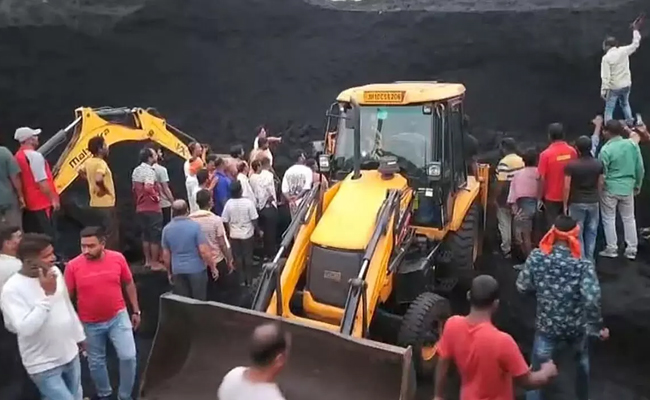
Dhanbad (Jharkhand) (PTI): At least four workers died after being buried under coal slurry in Jharkhand's Dhanbad district on Saturday, a police official said.
The incident took place at Moonidih coal washery in the command area of Bharat Coking Coal Limited (BCCL).
"Bodies of all four workers were dug out of debris during a rescue operation," Putki police station in-charge Waqar Hussain told PTI.
The incident took place when coal slurry was being loaded into trucks by workers, during which a large chunk of slurry fell and trapped several workers underneath, officials said.
The deceased have been identified as Manik Bauri, Dinesh Bauri, Deepak Bauri, and Hemlal Gope.
Meanwhile, the family members of the deceased and local villagers placed the bodies in front of the washery gate and began a protest.
They demanded compensation, jobs for dependents and action against those responsible for the incident.
Police and administration officials are trying to pacify the protesters, an official said.