Centre cuts borrowing estimate by Rs 70,000 cr
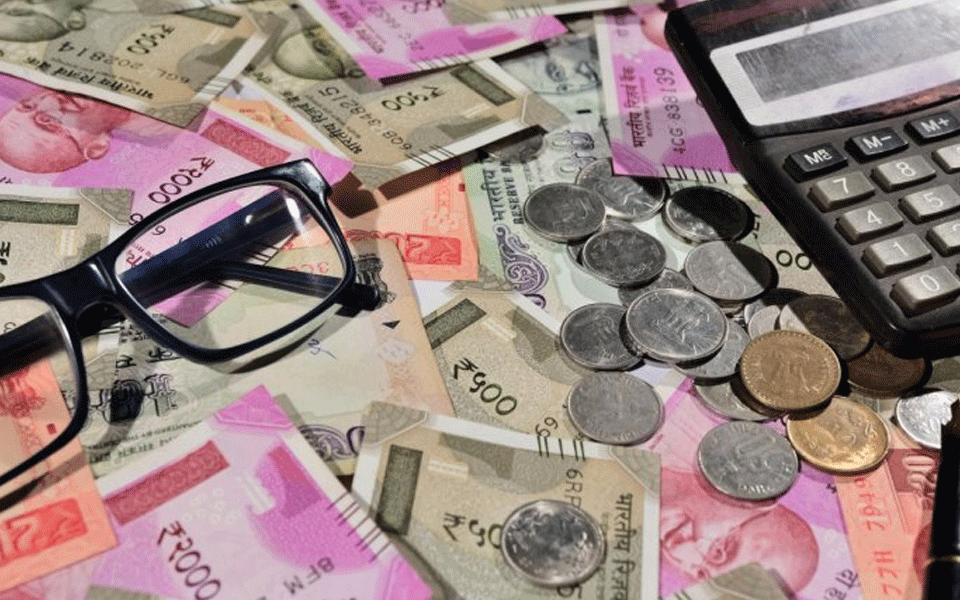
New Delhi, Sep 28 : Cutting its borrowing estimate by Rs 70,000 crore, the government on Friday said it will borrow only Rs 2.47 lakh crore in the second half (H2) of FY19.
With the borrowing of Rs 2.88 lakh crore in the first half, the total borrowing for the year would total Rs 5.35 lakh crore as against the budgeted Rs 6.05 lakh crore.
Announcing the cut, Economic Affairs Secretary Subhash Chandra Garg said both receipts and expenditures of the government were on track and there was no need to revise the fiscal deficit target of 3.3 per cent for the current financial year.
As per the borrowing programme that will end on March 8, the government will borrow Rs 11,000 crore every week till the beginning of November and Rs 12,000 crore every week thereafter, Garg said.
The Central government uses its benchmark bond scheme, government securities or G-secs, to raise funds from the open markets.
The government had in March expressed its intention to borrow less compared with the budgeted amount while announcing a borrowing of Rs 2.88 lakh in the first half of the fiscal.
"In the first half, our borrowing program was of Rs 2.88 lakh crore... we have decided to reduce the total borrowing requirement by Rs 70,000 crore. So gross borrowing programme for the second half is now only Rs 2.47 lakh crore," Garg told reporters.
He said the reduction in borrowing will be compensated by a mix of reduction in buyback of bonds and additional inflows from small saving schemes.
Giving the break-up of borrowing through its benchmark bond scheme, Garg said 10 per cent will come from bonds of one- to four-year tenure, 20 per cent from five- to nine- year tenure, 30 per cent from 10- to 14-year tenure, 15 per cent from 15- to 19-year tenure and 25 per cent from bonds of tenure over 20 years.
The government will also introduce inflation indexed bonds in the second half of the fiscal.
Garg said since it was a new instrument, there would be one or two issues in the October-March period.
Let the Truth be known. If you read VB and like VB, please be a VB Supporter and Help us deliver the Truth to one and all.
TN Assembly elections: Eight-month pregnant homemaker wins Thiru Vi Ka Nagar seat for TVK

Chennai (PTI): Before giving birth, she had already delivered a mandate—a symbol of hope for Thiru Vi Ka Nagar.
Echoing Delhi’s 2013 “common citizen” political churn associated with the rise of the Aam Aadmi Party (AAP), an eight-month-pregnant homemaker, M R Pallavi, has been elected as an MLA from Chennai’s Thiru Vi Ka Nagar constituency, emerging as one of the notable first-time faces of the Vijay-led TVK in the recently held Tamil Nadu Assembly elections.
In the narrow lanes of Thiru Vi Ka Nagar, a steady stream of media personnel has been making their way to Pallavi’s residence—a scene reminiscent of the result day in Delhi when journalists thronged the modest home of Rakhi Birla, who had won from Mangolpuri on an AAP ticket.
Pallavi, 36, a homemaker educated up to class XII, defeated the DMK candidate K S Ravichandran by a margin of 22,333 votes in the reserved Thiru Vi Ka Nagar Assembly constituency.
Tamilaga Vettri Kazhagam emerged as the single largest party by winning 108 seats, while DMK and AIADMK got 59 and 47, respectively.
Pallavi’s victory has drawn attention due to her personal circumstances. She campaigned extensively while eight months pregnant, going door-to-door to reach voters.
According to local accounts, she even fainted once during the campaign but continued her outreach.
She has not spoken to the media following her victory, as doctors have advised her to rest. Her husband, Rajesh, briefly recounted her campaign efforts.
A self-professed admirer of actor-turned-politician Vijay, Pallavi joined TVK soon after its formation and is now among its first-time legislators.
Doctors have advised her to be hospitalised around May 20, as she is expecting her second child. Ahead of that, voters in Thiru Vi Ka Nagar have entrusted her with representing them in the state Assembly.
Political observers say the rise of candidates like Pallavi signals a possible shift in Tamil Nadu’s political landscape, with voters backing a new party and candidates from non-traditional backgrounds.