Centre not required to seek Delhi HC nod before granting recognition to sports bodies: Supreme Court
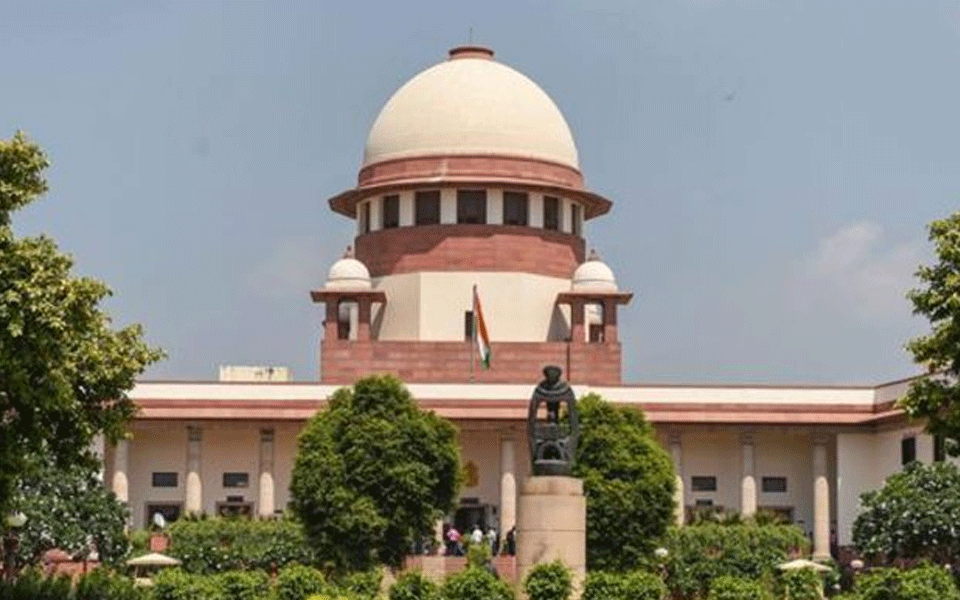
New Delhi: In a relief to the Centre and the Indian Olympic Association (IOA), the Supreme Court said on Thursday that they are not required to seek prior consent of the Delhi High Court before granting recognition to various sports federations in the country.
The apex court was hearing the Sports Ministry's appeal against the high court order which prohibited the authorities from taking decision on granting recognition to national federations without its prior nod.
The high court order was passed on a 2010 PIL filed by lawyer Rahul Mehra seeking observance of the National Sports Code and directions to the Sports Ministry and the IOA to ensure that National Sports Federations (NSFs) perform their duties well.
A bench comprising Justices D Y Chandrachud, Indu Malhotra and K M Joseph said the Centre was not required to seek consent of the high court before granting recognition to various sports federations under the National Sports Code.
In the hearing conducted through video conferencing, the bench said if anyone is aggrieved by the non-grant of recognition, they can move the court.
The counsel for the Centre said there are several federations and if it was to seek consent of the High Court before granting recognition to any federation, the whole process will come to a standstill.
The government also argued that the issue of granting recognition fell solely in the executive's domain and the High Court shouldn't have entered into it.
The top court took note of the fact that the PIL was pending since 2010 in the High Court and requested it that the plea be adjudicated upon expeditiously once and for all.
Earlier, the Sports Ministry and the IOA had said they have decided to approach the Supreme Court to challenge the Delhi High Court order which prohibits the ministry from taking any decision on grant of recognition to national federations.
On August 7, the ministry had requested the high court to modify the order and allow at least the grant of recognition to the NSFs but the court rejected that plea and asked for a National Sports Code compliance report.
The ministry had then sent across a questionnaire to the NSFs seeking the age and tenure details of their office-bearers. A total of 56 NSFs responded.
Let the Truth be known. If you read VB and like VB, please be a VB Supporter and Help us deliver the Truth to one and all.
AIITA welcomes Karnataka’s ban on obscene songs in school events
Bhatkal: The Karnataka unit of the All India Ideal Teachers Association (AIITA) has welcomed the Karnataka government’s decision to strictly ban school children from dancing to obscene songs during educational and cultural programmes in government, aided, and private schools across the state.
AIITA Karnataka State President M. R. Manvi congratulated the government for taking what he termed an important step to preserve the sanctity of education.
“Such decisions to safeguard the dignity of school children and uphold the values of education are the need of the hour. This rule should not be limited to government schools alone but must be strictly implemented in all private educational institutions as well,” he said.
He further urged the government to address other concerns within school programmes.
“The government should not only prohibit obscene dances in the name of school anniversaries, but also ensure that plays and dialogues that incite religious hatred are avoided. Schools should be centres of harmony, not platforms for spreading hatred,” he added.
According to a recent circular issued by the Department of School Education and Literacy, obscene dances are adversely affecting the mental health and moral values of students.
In this regard, schools have been advised to use songs that promote nationalism, positive thinking, the greatness of Kannada culture, and value-based traditions instead of inappropriate content during programmes.
The circular also emphasises that students should be dressed in decent attire.
AIITA also backed the department’s warning that disciplinary action would be taken against head teachers if such guidelines are violated. The association has further demanded that district Deputy Directors of Public Instruction strictly monitor the implementation of these rules.