Centre not willing to implement Constitution, says SC on delay in 33 pc quota for women
Nagaland civic polls
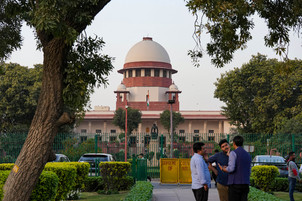
New Delhi, Jul 25: The central government is not willing to implement the Constitution, the Supreme Court remarked on Tuesday, as it slammed both the Centre and the Nagaland government over non-implementation of the constitutional scheme of one-third reservation for women in civic body elections in the northeastern state.
Observing that Nagaland is a state where women actively participate in every aspect of life, a bench of Justices S K Kaul and Sudhanshu Dhulia said the Centre cannot preclude reservation from being extended to women in civic bodies by saying it doesn't apply to tribal areas.
"Why is it not being implemented. What are you doing? Politically also you are on the same page. It is your government. You cannot get away by saying that there is some other in the State.
"The central government is not willing to implement the Constitution. At the slightest behest, you take action against the state governments. Where a constitutional provision is not being followed, you don not say anything to the state government. What active role have you played to see the constitutional scheme is implemented," the bench told Additional Solicitor General K M Nataraj, appearing for the Centre.
Nagaland has a coalition government led by the Nationalist Democratic Progressive Party (NDPP) and the BJP is a partner in the ruling dispensation.
At the outset, K N Balgopal, the Advocate General of Nagaland, submitted the state government is keen to come up with a new law to satisfy the court, and sought time to seek instructions from the state government.
The apex court said it has given numerous opportunities to the state government but it has done nothing.
Nataraj submitted before the court that 33 per cent quota should indeed be provided to women in urban local bodies in conformity with the Constitution.
When the bench asked why then was it not being implemented, the ASG said the situation in the state is not conducive for it.
"Give us some reasonable time and we will have a quietus to the entire situation," Nataraj said.
The top court said the Centre has been afforded umpteen opportunities but it has not done anything yet.
"You will take extreme stand against state governments which may not be amenable to you. Your own state government is violating the constitutional scheme and you don't want to do anything. How can you wash your hands of it?" the bench said.
Senior advocate Colin Gonsalves, appearing for the petitioners, said women are willing to participate if the chief encourages them. He said participation of women is being obstructed by those in power.
The bench then said in its order, "Advocate General for Nagaland for the nth time seeks to assure the court that the constitutional scheme will not be violated and he needs time to speak to the relevant political dispensation that the only way forward is to implement the constitutional provision..."
"In view of the impassioned plea of the AG, we are inclined to give one last of the last opportunity," the bench said.
The apex court clarified that it was not interfering with the customary laws of Nagaland.
"We may only say that whatever are the customary laws of Nagaland and given the special status of the State under Article 371A, are not being touched in any manner. This is a State where education, economic and social status of women is among the best. Thus our concern is why reservation for women cannot be implemented," it said.
The top court had earlier asked the Centre to clarify whether the constitutional scheme of one-third reservation for women in municipality and town council elections can be violated by Nagaland, where the assembly had passed a resolution to repeal the municipal act and resolved not to hold the elections to the urban local bodies (ULBs).
Observing that an "ingenious method" of repealing the Nagaland Municipal Act, 2001 was adopted to evade the undertaking given to the apex court about holding the elections, the apex court had said it is an issue of women empowerment.
The top court had on April 5 stayed the March 30 notification cancelling till further orders the election to the ULBs in Nagaland which were scheduled for May 16 after almost two decades.
Following pressure from tribal organisations and civil society groups, the Nagaland assembly had passed a resolution to repeal the municipal act and resolved not to hold the elections. These organisations said Naga customary laws do not allow women to participate equally in the political and socio-economic decision-making bodies.
On March 30, the State Election Commission (SEC) had issued a notification cancelling the election programme notified earlier "till further orders" in view of the repeal of the Act.
The apex court is hearing a petition filed by Peoples Union for Civil Liberties (PUCL) and others seeking 33 per cent reservation for women in the local bodies elections.
The petitioners have moved an application before the top court against the cancellation of the elections and urged it to take contempt action for "disobeying" its March 14 order.
Besides seeking quashing of the March 30 notification issued by the SEC cancelling the election schedule, the application has also sought setting aside of the Nagaland Municipal (Repeal) Act, 2023.
The SEC had earlier announced elections to the 39 ULBs in the state. Of the 39 ULBs, Kohima, Dimapur and Mokokchung have municipal councils, while the rest have town councils.
Several Naga tribal bodies and civil society organisations had opposed the ULB election under the Nagaland Municipal Act 2001, asserting it infringes the special rights for Nagaland guaranteed by Article 371-A of the Constitution.
The 2001 Act, which was amended later, made 33 per cent reservation of seats for women mandatory for holding the ULB elections, as directed by the Supreme Court.
ULB elections in the state have been long overdue with the last polls having been held in 2004.
Let the Truth be known. If you read VB and like VB, please be a VB Supporter and Help us deliver the Truth to one and all.
Putin meets Iran's FM Araghchi, says Russia ready to do its best to help bring peace to West Asia
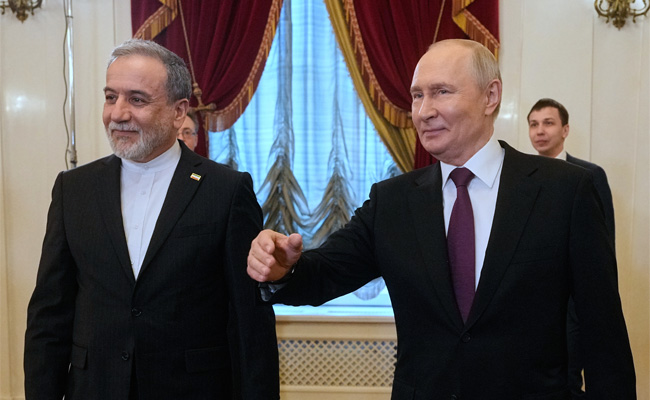
Moscow (PTI): Iran's Foreign Minister Abbas Araghchi on Monday met Russian President Vladimir Putin, who hailed the Iranian people for fighting bravely and heroically for their sovereignty and said Moscow is ready to do its best to help bring peace to West Asia as soon as possible.
Araghchi, who held talks with Omani and Pakistani leadership before arriving in Russia, met Putin in St. Petersburg and thanked him for supporting Iran, state-owned TASS news agency reported.
"Russia is ready to do everything in its power to ensure that peace in the Middle East is achieved as soon as possible," Putin said during his meeting with Araghchi, which was also attended by Russian Foreign Minister Sergey Lavrov.
Revealing that he received a message from Iranian Supreme Leader Mojtaba Khamenei last week, Putin asked Araghchi to convey his "gratitude for this message and best wishes for his health and well-being."
He praised the Iranian people for fighting "bravely and heroically" for their sovereignty, Iran's state-run PRESS TV reported.
"We really hope that, based on the courage and desire for independence, the Iranian people, under the guidance of the new leader, will weather this difficult period of trials and peace will come,” Putin said.
He also stressed that Russia “intends to maintain” its strategic relations with Iran.
Araghchi said that the world witnessed Iran’s strength in countering the US during the recent war, and that the Islamic Republic is a "stable and powerful establishment."
"With their courage, the Iranian people succeeded in resisting the US aggression and will be able to endure it,” he said.
He said that it became clear that Iran has “great friends and allies” like Russia, and conveyed “warmest greetings” from Supreme Leader Mojtaba Khamenei and President Masoud Pezeshkian to the Russian leader.
Araghchi said relations between Moscow and Tehran represent a “strategic partnership at the highest level” and will continue to develop "regardless of circumstances."
"We are grateful to you for the solid and strong positions in support of the Islamic Republic of Iran," he said.
Foreign Minister Lavrov said that the talks between President Putin and the Iranian Foreign Minister were "useful and constructive."
Kremlin Spokesman Dmitry Peskov later said that Russia is "ready to provide any good offices, any mediation services that are acceptable to the parties."
"We will be ready to do everything so that ultimately peace ensues, guaranteed peace, and that there is no return to hostilities," Peskov was quoted as saying by TASS.
He was asked how Moscow can assist in future negotiations on the Iranian settlement.
Araghchi arrived in Russia after his whirlwind trip to Islamabad, which, according to him, was “very productive” and involved “good consultations" with Pakistan's Army Chief Field Marshal Asim Munir, amid uncertainty over the second round of peace talks to resolve the war in West Asia.
"We held good consultations with our friends in Pakistan. The trip was successful. We assessed the outcome of our recent (meetings) and discussed in what direction and under what conditions talks can move on,” Araghchi said in a video posted on his Telegram channel upon his arrival in St Petersburg.
Referring to the second round of talks between the US and Iran to resolve the conflict in West Asia, Araghchi said: "Developments have taken place in the negotiations."
"Despite some progress in earlier rounds, the talks failed to reach their objectives due to the Americans' approach, the excessive demands they made, and the wrong approaches they adopted. Therefore, it was necessary to consult with our friends in Pakistan to review the latest situation,” Iran's official news agency IRNA quoted him as saying.
He said that the trip to Pakistan was a good opportunity to review developments related to the US-Israeli war against Iran, expressing confidence that “these consultations and coordination between the two countries will be highly significant.”
Araghchi arrived at St. Petersburg's Pulkovo Airport early Monday, where he was welcomed by Russian officials and Iran’s ambassador to Russia, Kazem Jalali, the report said.
The first round of peace talks between Iran and the US, held on April 11 and 12, failed to bring the desired result for the parties to the conflict.
The Iranian minister arrived in Islamabad for the second time on Sunday after a short visit to Oman, where he held talks with Sultan Haitham bin Tariq al-Said on security in the Strait of Hormuz and diplomatic efforts to end the Iran-US conflict.
After Araghchi left Pakistan for Oman on Saturday, President Donald Trump announced that US negotiators Steve Witkoff and Jared Kushner would no longer be going to Islamabad for talks with Iran, contending that Washington held all the cards on the matter.
Trump on Sunday reiterated that the US and Iranian officials can talk by phone for a peace solution to the conflict.
On Tuesday, Trump extended the two-week ceasefire with Iran indefinitely to give Tehran more time to prepare a unified proposal to end the war, just hours before the truce was set to expire.
The war began when the US and Israel jointly attacked Iran on February 28, killing Iranian Supreme Leader Ayatollah Ali Khamenei and several top commanders. The retaliation by the Islamic Republic extended the war to the entire Gulf region.