Centre opposes PIL in Supreme Court on PNB fraud, says probe already on
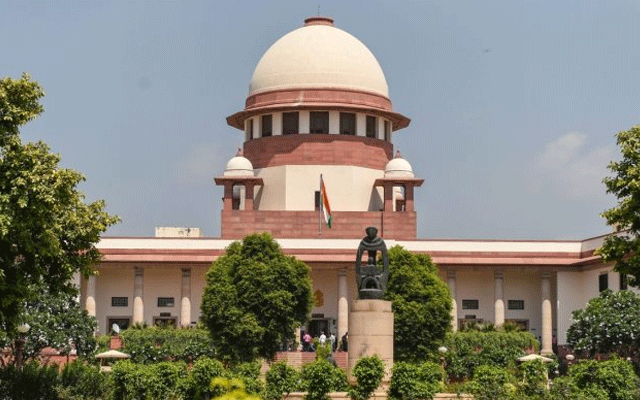
New Delhi: The Centre on Wednesday opposed a public interest litigation (PIL) seeking probe into the role of PNB's top management in the Rs 11,300 crore scam and extradition of diamond trader Nirav Modi who is alleged to be involved in it.
Opposing the PIL, Attorney General K.K. Venugopal told a bench of Chief Justice Dipak Misra, Justice A.M. Khanwilkar and Justice D.Y. Chandrachud that FIR had already been filed in the multi-crore Punjab National Bank fraud case and a probe was going on.
As Venugopal rose to oppose the PIL, petitioner lawyer Vineet Dhanda urged the bench to issue a notice to the Centre as the "kingpin of the scam Nirav Modi" had run away with the "common man's savings."
The court then witnessed some heated exchanges between Dhanda and the bench after Justice Chandrachud described the PIL as a "publicity oriented litigation."
"It is a publicity-oriented litigation. You have to make averment that the government is not investigating. We must allow the government to investigate. These are the petitions playing to the gallery. Let us not pre-empt the jurisdiction of the government (to investigate a scam)," Justice Chandrachud said.
Taking exception to the observation from the bench, Dhanda said: "The Court is insulting me," and if the PIL was being seen as "something to gain publicity from" then he would withdraw it and let the court take suo motu cognisance of the scam and look into it.
He told the bench that he had been practicing in the top court for the last 16 years and did not need to file PIL for publicity.
Telling the bench that the entire country was watching it, Dhanda said that the scam of such a magnitude has jolted the morale of the customers (account holders) and involved the interest of the country.
"If they (Government) are so efficient, why scams are taking place," Dhanda said, pointing to liquor baron Vijay Mallya leaving the country after making a Rs 9,000 crore hole in the coffers of a consortium of banks.
Dhanda said: "What he is opposing -- let him state in an affidavit."
At this Justice Chandrachud said: "The way you are pressing your plea, the purpose is to gain publicity."
Justice Khanwilkar asked Dhanda how he was arguing his plea in person. "Did you take the permission of the court for this." To which, Dhanda said that he was to be represented by his father J.P.Dhanda, who had fallen ill.
Telling the petitioner that court would like to hear the matter, Chief Justice Misra directed the next hearing to be held on March 16.
Let the Truth be known. If you read VB and like VB, please be a VB Supporter and Help us deliver the Truth to one and all.
Iran Foreign Minister Araghchi begins 3-day India visit
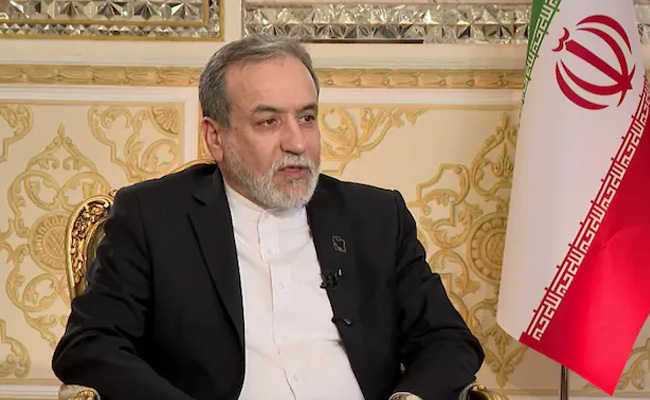
New Delhi (PTI): Iranian Foreign Minister Abbas Araghchi began a three-day official visit to India on Wednesday, marking the first high-level diplomatic engagement from Tehran since the outbreak of the US-Israel war with Iran more than two months ago.
Araghchi is visiting India primarily to attend a two-day meeting of BRICS foreign ministers beginning Thursday.
The Iranian foreign minister is set to hold wide-ranging bilateral talks with his Indian counterpart S Jaishankar, focusing on the escalating crisis in West Asia.
The situation surrounding the Strait of Hormuz is expected to feature prominently. The Indian side is likely to press for the safe passage of remaining merchant vessels through the strategic waterway, according to people familiar with the matter.
Araghchi and other foreign ministers of the BRICS member states are scheduled to call on Prime Minister Narendra Modi on Thursday.
"A very warm welcome to Foreign Minister of Iran, Seyed Abbas Araghchi, on his arrival in New Delhi for the BRICS Foreign Ministers' Meeting," External Affairs Ministry spokesperson Randhir Jaiswal said on 'X'.
The escalating crisis in West Asia and its impact on the global energy supply chain are expected to dominate deliberations at the BRICS foreign ministers' meeting.
India, as the chair of BRICS, is hosting the conclave of the foreign ministers ahead of the annual summit of the grouping in September.
It will be interesting to see if the foreign ministerial conclave manages to produce a consensus statement on the conflict in West Asia.
Sharp differences among the member states over the US-Israel war on Iran stalled India's efforts to build a consensus position on the conflict during a meeting of the grouping's deputy foreign ministers and special envoys on Middle East and North America last month.
No consensus statement on the conflict could be reached largely due to differences between the United Arab Emirates (UAE) and Iran. The two neighbouring countries have sparred in recent weeks over Iran's alleged attacks on energy infrastructure in the UAE.
"The active presence of the Islamic Republic of Iran in mechanisms such as BRICS represents a strategic choice to strengthen genuine multilateralism, expand equitable cooperation, and participate in shaping a more just order in international relations," Iranian Deputy Foreign Minister Kazem Gharibabadi said on 'X'.
"The BRICS foreign ministers' meeting in New Delhi can be an important opportunity for dialogue on the future of Global South cooperation, reforming international economic governance, developing independent trade, strengthening financial and banking ties, and reducing countries' dependence on discriminatory and unilateral mechanisms," he said.
Gharibabadi said Iran, with its geopolitical, energy, transit, scientific, and human capacities, can play an effective role in the BRICS agenda for balanced development, economic security, regional connectivity, and amplifying the voice of independent countries.
The Iranian deputy foreign minister is in New Delhi for the BRICS meeting.
"In this path, opposition to America's unilateral coercive measures and their illegal and anti-development effects is an inseparable part of defending economic justice and the rights of nations to development," he said.
After the West Asia conflict escalated, Iran urged India, as the current BRICS chair, to leverage its "independent role" to halt the US-Israel hostilities against Iran.
Global oil and gas prices have surged after Iran virtually blocked the Strait of Hormuz, a narrow shipping lane between the Persian Gulf and the Gulf of Oman that handles roughly 20 per cent of global oil and LNG (liquefied natural gas).
BRICS, originally comprising Brazil, Russia, India, China, and South Africa, expanded in 2024 to include Egypt, Ethiopia, Iran, and the UAE, with Indonesia joining in 2025.
It has emerged as an influential grouping as it brings together 11 major emerging economies of the world, representing around 49.5 per cent of the global population, around 40 per cent of the global GDP and around 26 per cent of the global trade.
The BRICS foreign ministers held their last meeting on the margins of the 80th session of the United Nations General Assembly (UNGA 80) in September 2025.