Centre targeting Muslims with Waqf (Amendment) Bill, lacks majority to pass it in Parliament: Mamata
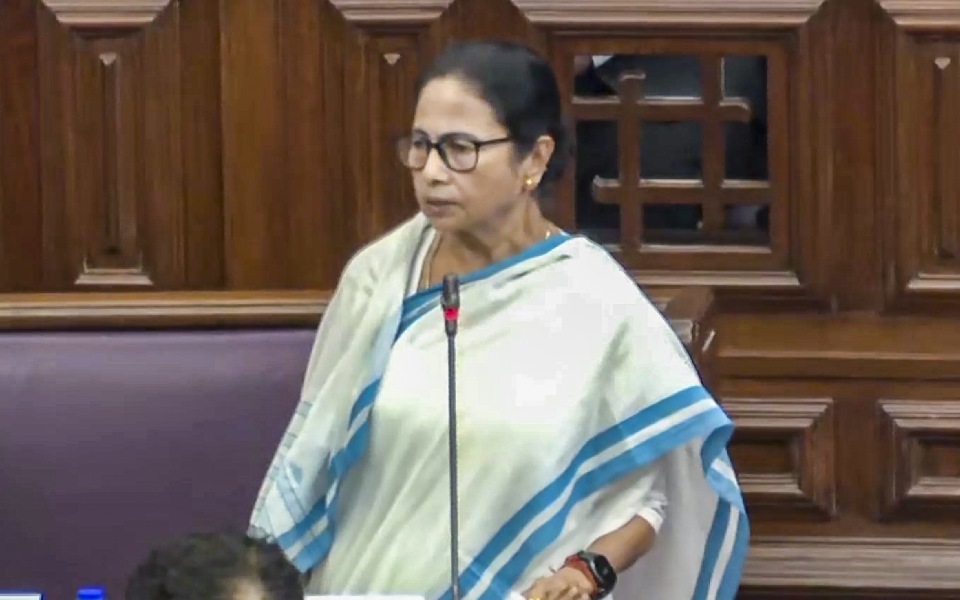
Kolkata, Dec 2: West Bengal Chief Minister Mamata Banerjee on Monday slammed the BJP-led central government over the Waqf (Amendment) Bill, accusing it of targeting Muslims and expressing doubts on its passage in Parliament.
Touching upon the reduction of the minority Hindu population in Bangladesh and the ongoing unrest in the neighbouring country, she questioned the Centre's alleged inaction in the matter.
The chief minister, during a debate in the West Bengal assembly on a resolution opposing the Waqf (Amendment) Bill, launched a scathing attack on the BJP-led central government, accusing it of "fostering divisiveness, neglecting Constitutional norms, and mishandling issues like Bangladesh's minorities, the NRC, UCC, and CAA".
Banerjee alleged that the Centre had "bypassed" state governments over the matter and criticised the "lack of dialogue" on the Waqf (Amendment) Bill 2024.
“The Centre did not consult us on the Waqf (Amendment) Bill,” she claimed.
Banerjee also questioned the timing and process of the proposed legislation, stating, "The budget session is in February. Will you not discuss this Bill with the state before that? Is there no time for it? Will you not consult the state? We raised objections after noticing an advertisement."
Apparently referring to her letter to the Centre on the Waqf (Amendment) Bill, she said, "I don’t know if they even acknowledged it."
She accused the Centre of pushing a "divisive agenda" by singling out Muslims.
"Why is a single religion being targeted in the name of this Waqf (Amendment) Bill? Why are Muslims being targeted? Would you dare to do the same with the properties of various Hindu temple trusts or churches? The answer is no. But, targeting a specific community suits your divisive agenda,” Banerjee claimed.
“Will the BJP be able to pass this Bill in Parliament as it lacks a two-thirds majority?” she asked.
Banerjee made the remarks during the first day of a two-day discussion on a resolution opposing the Waqf (Amendment) Bill, moved under Rule 169 by state Parliamentary Affairs Minister Sobhandeb Chattopadhyay.
Banerjee criticised what she termed "misleading narratives around Waqf properties", calling these baseless allegations.
"Religion is personal, but festivals are for everyone. Those who are suddenly changing their stance now used to say one thing yesterday, and today they say something completely different. It's all misleading and distorting. They're saying that wherever you touch, it becomes Waqf. They claimed that even our MPs have said this. Such are baseless remarks,” she claimed.
The Trinamool Congress chief criticised the BJP for "making opposition members silent" during the Joint Parliamentary Committee (JPC) deliberations on the Bill.
“In the JPC, opposition members are not allowed to speak. That is why they have boycotted it,” Banerjee claimed.
She claimed that a Joint Parliamentary Committee (JPC) was formed because of public pressure and alleged that her party’s MPs were excluded from discussions.
"Their visits were cancelled. They were supposed to come to Kolkata. Why are they afraid of Kolkata? Surely, there’s something fishy about this," she claimed.
Banerjee emphasised that constitutional norms must be respected.
"We cannot interfere with others’ independence. The Constitution does not give us that right. Do you (BJP) have a majority? First, it has to be passed in Lok Sabha, then Rajya Sabha. You will need a two-thirds majority to pass this," she remarked.
On the situation in Bangladesh, the CM said the Union government should take steps to protect Hindus in the neighbouring country.
"If the minority population in Bangladesh has decreased, is that our fault? Why didn’t the central government address this issue? Were they sitting idle? We tried to bring many from there but couldn’t. Many Hindus wanted to come here. We provided food for them, but you don’t know that. Many Muslims also came here," she claimed.
Banerjee pointed out the alleged communal undertones in political rhetoric by the BJP leaders, saying, "Are Muslims living only in this country? Don’t they live in other countries? Then why do you target Bengal? Whether fortunate or unfortunate, this country got divided into three parts."
She recounted the Beldanga incident, where communal tensions flared a few weeks back.
"During the Kartik Puja, abusive remarks were made against me in lighting displays. In another place, there were abusive remarks about a specific community in the lighting. Despite multiple warnings, they didn’t listen, leading to clashes. I stayed awake the entire night, along with the DGP and the chief secretary."
"A few mischievous people indulge in riots, and the common people suffer," she added.
Let the Truth be known. If you read VB and like VB, please be a VB Supporter and Help us deliver the Truth to one and all.
Trump says EU has until July 4 to approve last year's trade deal or it will face higher tariffs
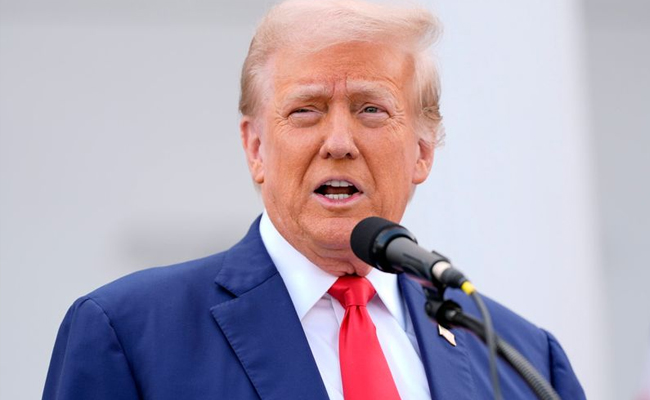
Washington (AP): President Donald Trump has said in a social media post that goods from the European Union would face higher tariff rates if the 27-member bloc fails to approve last year's trade framework by July 4.
The announcement on Thursday appeared to be a deadline extension after the president said last Friday that EU autos would face a higher 25 per cent tariff starting this week. Trump made the updated announcement after what he described as a "great call" with European Commission President Ursula von der Leyen.
Still, the US president was displeased that the European Parliament had yet to finalize the trade arrangement reached last year, which was further complicated in February by the US Supreme Court ruling that Trump lacked the legal authority to declare an economic emergency to impose the initial tariffs used to pressure the EU into talks.
"A promise was made that the EU would deliver their side of the Deal and, as per Agreement, cut their Tariffs to ZERO!" Trump posted. "I agreed to give her until our Country's 250th Birthday or, unfortunately, their Tariffs would immediately jump to much higher levels."
It was unclear from the post whether Trump was implying that the tariff rates would jump on all EU goods or the increase would only apply to autos.
His latest statement indicates he might be backing away from his earlier threat on EU autos by giving the European Parliament several more weeks to approve the agreement.
Under the original terms of the framework, the US would charge a 15 per cent tax on most goods imported from the EU.
But since the Supreme Court ruling, the administration has levied a 10 per cent tariff while investigating trade imbalances and national security issues, aiming to put in new tariffs to make up for lost revenues.