'Chakka jam': Farmers in Punjab, Haryana block roads
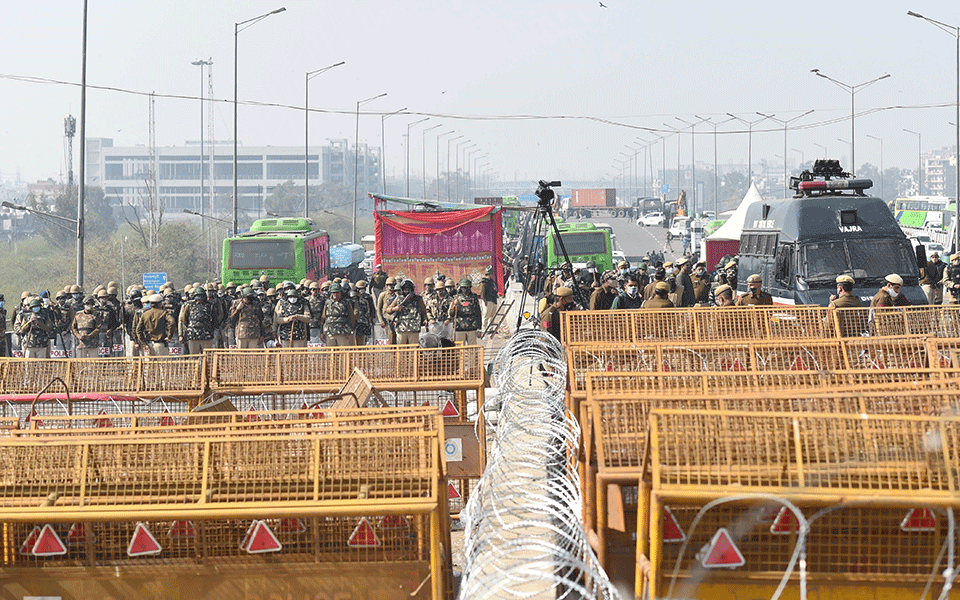
Chandigarh: Farmers protesting against the Centre's new agri laws and other issues blocked roads at several places in Punjab and Haryana on Saturday on the call given by the farmers' unions for a nationwide 'chakka jam'.
Farmers' unions had on Monday announced a countrywide 'chakka jam' from 12 noon to 3 pm on February 6 when they would block national and state highways in protest against the Internet ban in areas near their agitation sites, harassment allegedly meted out to them by authorities, and other issues.
The police have stepped up security and made all arrangements for traffic diversion, said officials, adding adequate police personnel were deployed in Punjab and Haryana.
Protesting farmers owing allegiance to different farmers' bodies blocked state and national highways at several places on Saturday, causing inconvenience to commuters.
Bharti Kisan Union (Ekta Ugrahan) general secretary Sukhdev Singh Kokrikalan said they are holding road blockades at 33 places in 15 districts including Sangrur, Barnala and Bathinda in Punjab.
In the morning, farmers started assembling at their earmarked protest sites for 'chakka jam' in both the states.
"Elders and youth have gathered here to participate in chakka jam. It will be peaceful," said a protester at the Punjab-Haryana border in Shambhu near Ambala.
"We want that the government should repeal these three laws as they are not in the interest of the farming community," said another protester.
Protesting farmers said emergency vehicles including ambulances and school buses will be allowed during the 'chakka jam'.
Thousands of farmers have been protesting since late November at Delhi's borders with Haryana and Uttar Pradesh, demanding a rollback of the Farmers' Produce Trade and Commerce (Promotion and Facilitation) Act, 2020, the Farmers (Empowerment and Protection) Agreement on Price Assurance and Farm Services Act, 2020 and the Essential Commodities (Amendment) Act, 2020.
The protesting farmers have expressed apprehension that these laws would pave the way for the dismantling of the minimum support price (MSP) system, leaving them at the "mercy" of big corporations.
However, the government has maintained that the new laws will bring better opportunities to farmers and introduce new technologies in agriculture.
Let the Truth be known. If you read VB and like VB, please be a VB Supporter and Help us deliver the Truth to one and all.
Maharashtra sets up state vaccination task force to strengthen immunisation programme

Mumbai (PTI): The Maharashtra government has set up a State Vaccination Task Force to strengthen the regular immunisation programme and review the progress of related campaigns, a health department official said on Monday.
The State Vaccination Task Force will comprise at least 29 members and will be headed by the administrative head of the health department, he informed.
The government has also constituted separate district-level and municipal vaccination task forces to improve implementation and address challenges at the grassroots level, he said.
Municipal task forces, chaired by respective civic commissioners, have been constituted in view of the vast urban population in Maharashtra and the role of civic bodies in implementing different health programmes.
The district-level task forces will function under the chairmanship of collectors.
"Complete immunisation of children at the appropriate age is an extremely simple, cost-effective and highly effective measure to reduce child mortality and the prevalence of diseases among kids. Immunisation is a powerful tool for reducing illness in children," maintained the official.
To ensure full vaccination of all children, the state government implements various campaigns from time to time as per the central government guidelines, he pointed out.
"Active participation and cooperation of other relevant government departments are essential (in making these campaigns successful)," according to the official.
The state-level body will review the regular immunisation programme, associated campaigns and vaccine-preventable diseases in detail. It will also conduct focused assessments of high-risk districts and municipal corporations, including vacancies at district, municipal and sub-district levels, availability of cold chain equipment, resource gaps and training requirements, he noted.
The state task force will review allocation and utilisation of funds for immunisation and ensure timely action by officers concerned based on reports from district and municipal task forces and state-level monitoring mechanisms, the official said.
It will also ensure active coordination and participation of other government departments in immunisation drives, while district and municipal task forces will carry out similar functions at their respective levels, the official added.