Challenge to turn India's growth rate to double digits : PM Modi
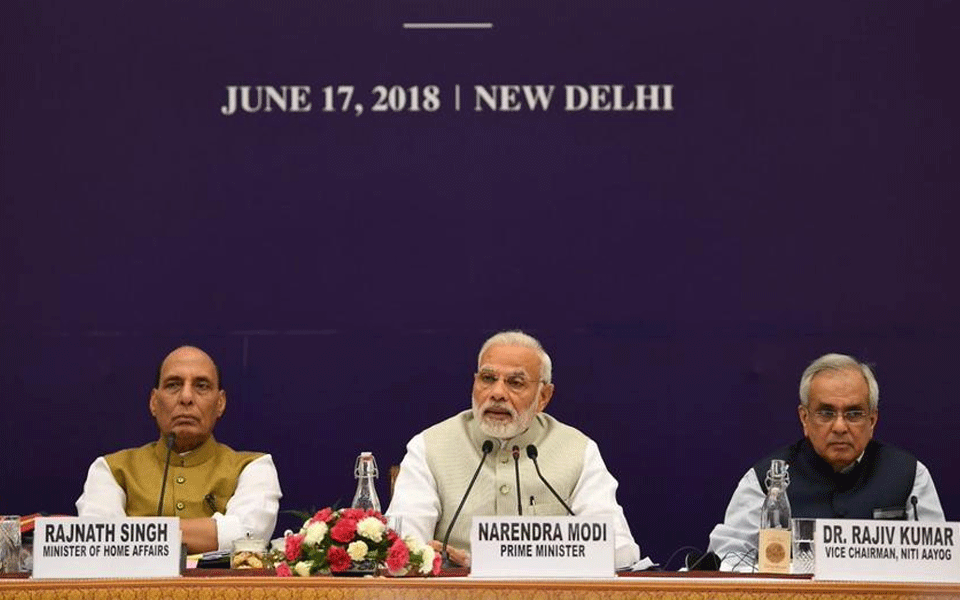
New Delhi, June 17 : Prime Minister Narendra Modi on Sunday said the Indian economy grew at a healthy 7.7 per cent in the fourth quarter of 2017-18 and the challenge now is to turn this to "double digits".
"The challenge now is to take this growth rate to double digits, for which many more important steps have to be taken. The vision of a New India by 2022 is now a resolve of the people of our country," Modi told the fourth meeting of the NITI Aayog Governing Council.
A broad range of issues will be discussed at the meeting including measures taken to double farmers' income, development of aspirational districts, progress of flagship schemes like Ayushman Bharat, National Nutrition Mission, Mission Indradhanush and the celebration of the 150th birth anniversary of Mahatma Gandhi.
The Governing Council is the premier body tasked with evolving a shared vision of national development priorities, sectors and strategies with the active involvement of states in shaping the development narrative.
It reviews the work done during the previous year and deliberates upon the future developmental priorities.
The Prime Minister welcomed Chief Ministers and other delegates saying the governing council was a platform that can bring about "historic change". The Chief Ministers of Delhi, Odisha, Goa, Manipur, Mizoram, Sikkim and Tripura were not present.
He assured that the Centre would provide all the required assistance to flood-hit states.
Modi praised the Chief Ministers for playing a key role in policy formulation, through sub-groups and committees on issues such as Swachh Bharat Mission, Digital Transactions and Skill Development.
Modi announced that 1.5 lakh Health and Wellness Centres are being constructed under the Ayushman Bharat scheme and about 10 crore families will be provided health assurance worth Rs 5 lakh every year.
He added that a comprehensive approach was being adopted for education under the Samagra Shiksha Abhiyan.
He said all aspects and parameters of human development needed to be addressed and improved.
"The Gram Swaraj Abhiyan has emerged as a new model for implementation of schemes and this has so far been extended to 45,000 villages."
The target was universal coverage in seven important welfare schemes: Ujjwala, Saubhagya, Ujala, Jan Dhan, Jeevan Jyoti Yojana, Suraksha Bima Yojana and Mission Indradhanush, Modi said.
"India has no shortage of capabilities, capacities and resources and in the current financial year states are receiving over Rs 11 lakh crore from the Centre, which represents an increase of about Rs 6 lakh crore, from the last year of the previous government," Modi said.
This gathering represented the "hopes and aspirations of the people of India" and it was also the responsibility of this gathering to make all efforts to fulfil them, he added.
Let the Truth be known. If you read VB and like VB, please be a VB Supporter and Help us deliver the Truth to one and all.
Death toll climbs to 16 in van-SUV collision in MP's Dhar
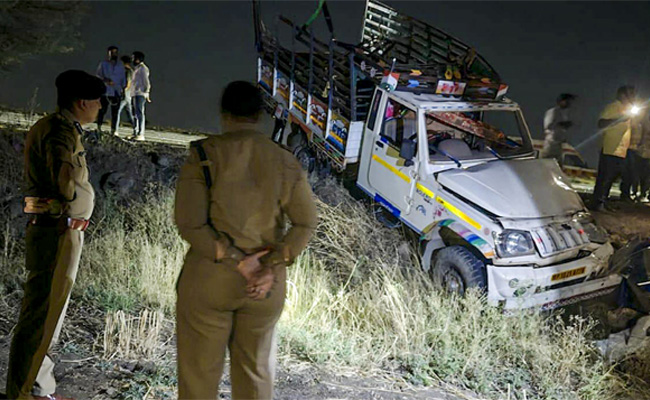
Dhar (MP) (PTI): The death toll in the collision between a pick-up van and an SUV in Madhya Pradesh's Dhar district has risen to 16, officials said on Thursday.
The van carrying labourers overturned and collided with a Sports Utility Vehicle (SUV) coming from the opposite direction near Chikliya crossing on the Indore-Ahmedabad National Highway on Wednesday night, they said.
Twelve fatalities were initially reported after the incident. Four more persons later succumbed to their injuries, taking the toll to 16, officials said.
"A very tragic incident occurred in Dhar. I was informed that 46 persons (mostly labourers) were travelling in a pickup vehicle. It overturned and caused an accident. We have received information about the deaths of 15 people. This is very unfortunate," Indore Divisional Commissioner Dr Sudam P Khade told reporters.
Later, one more person succumbed to his injuries, Dhar district hospital's civil surgeon Dr Mukund Burman said.
ALSO READ: ICSE, ISC results: Girls outperform boys, pass rate over 99%
Prime Minister Narendra Modi and MP Chief Minister Mohan Yadav have issued instructions to ensure all arrangements are made, and treatment is provided to the injured persons, and that no one is left without care, Khade said.
The divisional commissioner and Inspector General Anurag were monitoring relief operations at the incident spot.
"Seven injured persons have been referred for treatment to Indore. Fifteen people are undergoing treatment here. The patients here are currently stable, but if they need to be referred (elsewhere), everything will be done," Khade said.
"In Indore also, we have deployed a team of doctors and are making all arrangements so that there is no delay or problem in treatment," he added.
The incident occurred between 8.30 and 9 pm on Wednesday. The labourers were returning home in the van from Baggad in Dhar district when the driver lost control of the vehicle near Chikliya crossing.
The Tirla police have registered a case and are investigating the accident.
PM Modi on Wednesday expressed grief over the incident. An ex gratia of Rs 2 lakh each from PMNRF would be given to the next of kin of the deceased, and the injured would receive Rs 50,000.
CM Yadav said instructions have been given to provide Rs 4 lakh each to the families of the deceased, Rs 1 lakh each to the seriously injured, and Rs 50,000 each to the injured.
Dhar district in-charge minister Kailash Vijaywargiya said instructions have been given to the local administration to ensure that the injured receive proper treatment.
Leader of Opposition, Umang Singhar, a native of Dhar district, also expressed grief over the accident.