Lander Vikram located on Lunar surface: ISRO chief
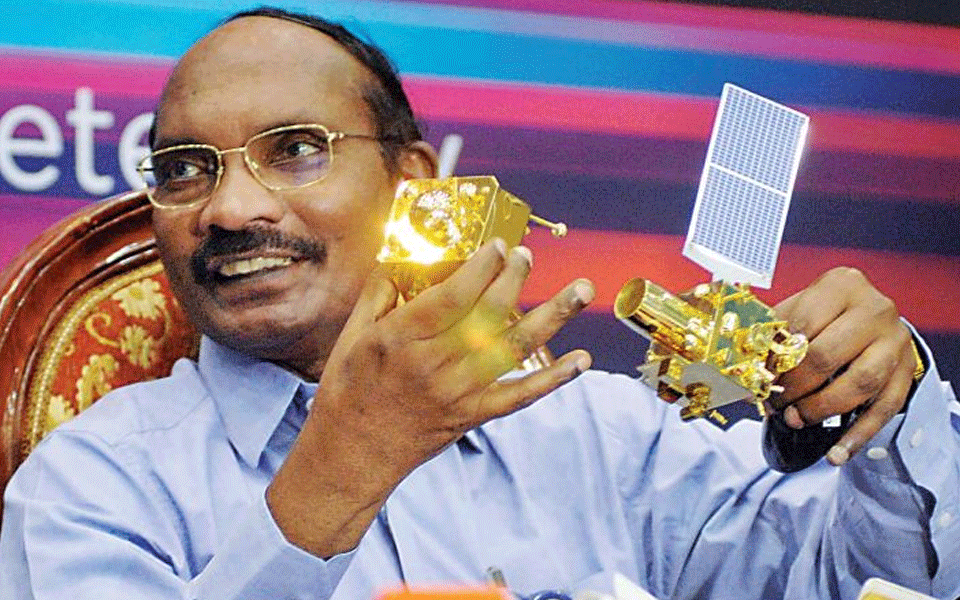
Bengaluru: The Chandrayaan-2s Vikram module has been located on the Lunar surface and it must have been a hard-landing, ISRO chairman K Sivan said on Sunday, in an admission that the planned soft-landing wasnt successful. Yes, we have located the lander on the Lunar surface. It must have been a hard-landing, Sivan told PTI.
He said the lander rover Pragyan is housed inside it was located by on-board cameras of the Chandrayaan-2 orbiter. Asked if the lander was damaged during the hard-landing, he said: That we do not know.
Sivan said efforts to establish contact with the lander were continuing. India's mission to soft-land on moon suffered a setback during the wee hours on Saturday, with 'Vikram' module losing communication with ground stations, just 2.1 km from the lunar surface during its final descent.
Considered as the most complex" stageof the country's second expedition to the moon, the Lander was on a powered decent for a soft-landing when it lost the communication.
"Vikram Lander descent was as planned and normal performance was observed up to an altitude of 2.1 km. Subsequently, communication from the lander to ground stations was lost," Sivan had said.
"The data is being analysed", he had added at the Mission Operations Complex at ISRO Telemetry, Tracking and Command Network (ISTRAC) here.
The successful landing would have made India the fourth country after erstwhile USSR, the US and China to achieve a soft-landing on the moon, also the first to launch amission to the unexplored south pole of the Moon.
The Chandrayaan-2 orbiter is healthy and safe in the Lunar orbit, an ISRO official said after the lander lost contact with ground stations minutes before the touchdown on Moon's surface.
"The orbiter is healthy, intact, functioning normally and safely in the Lunar orbit," the official told PTI. The mission life of the 2,379-kg orbiter is one year. The orbiter payloads would conduct remote-sensing observations from a 100-km orbit.
Chandrayaan-2, a follow-on mission to the Chandrayaan-1 mission undertaken more than a decade ago, comprises an orbiter, lander (Vikram) and rover (Pragyan).
The orbiter carries eight scientific payloads for mapping the lunar surface and study the exosphere (outer atmosphere) of the Moon.
ISRO on September 2 successfully carried out the separation of lander Vikram (with rover Pragyan housed inside) from the Chandrayaan-2 orbiter.
The Vikram module, which was supposed to carry out various tests on the lunar soil, had completed the rough braking phase as planned and entered the phase of fine braking at an altitude of 2.1 km, when it lost communication.
'Vikram', named after Dr Vikram A Sarabhai, the father of the Indian Space Programme, was designed to execute a soft-landing on the lunar surface, and to function for one lunar day, which is equivalent to about 14 earth days.
The rover was to roll down from the lander explore the surrounding lunar terrain, a few hours after the planned soft-landing. The Chandrayaan-2 is a Rs 978-crore unmanned moon mission (satellite cost Rs 603 crore, GSLV MK III cost Rs 375 crore).
India's Geosynchronous Satellite Launch Vehicle, GSLV MkIII-M1 successfully launched the 3,840-kg Chandrayaan-2 spacecraft into the Earth's orbit on July 22.
The spacecraft began its journey towards the moon leaving the earth's orbit in the dark hours on August 14, after a crucial manoeuver called Trans Lunar Insertion that was carried out by ISRO to place the spacecraft on "Lunar Transfer Trajectory."
The spacecraft successfully entered the lunar orbit on August 20 by performing Lunar Orbit Insertion (LOI) manoeuver.
On September 2, 'Vikram' successfully separated from the orbiter, following which two de-orbiting manoeuvres were performed to bring the lander closer to the Moon
Let the Truth be known. If you read VB and like VB, please be a VB Supporter and Help us deliver the Truth to one and all.
Bridge portion collapses on Jammu outskirts; 3-4 labourers feared trapped, 1 rescued

Jammu (PTI): A portion of a small bridge collapsed in the Bantalab area on the outskirts of Jammu city on Friday, trapping at least three to four labourers under the debris, while one injured worker was rescued, official sources said.
Authorities have closed the road link following the collapse of the portion of the bridge.
The incident occurred when labourers were carrying out repair work on a retaining wall near the bridge that was damaged in last year's flash floods, the sources said.
According to the sources, a section of the bridge suddenly gave way, burying workers engaged at the site under the rubble.
Police, Army and State Disaster Response Force (SDRF) teams launched rescue operations to extricate those buried under the debris. They pulled out one injured labourer and shifted him to a hospital, the sources said.
Family members of the labourers present at the site said around six workers engaged at the site at the time of the incident came under the debris when the structure collapsed. The family members said while two of the labourers managed to escape, four got trapped.
The sources said those trapped included the husband of a woman labourer, a mason, an unmarried labourer and a relative of the contractor.
There was no official confirmation on the exact number of persons trapped under the debris till the filing of this report.
The rescue operations are ongoing.