Change of strategy: Naxals in Bastar using human effigies with dummy guns to take on troopers
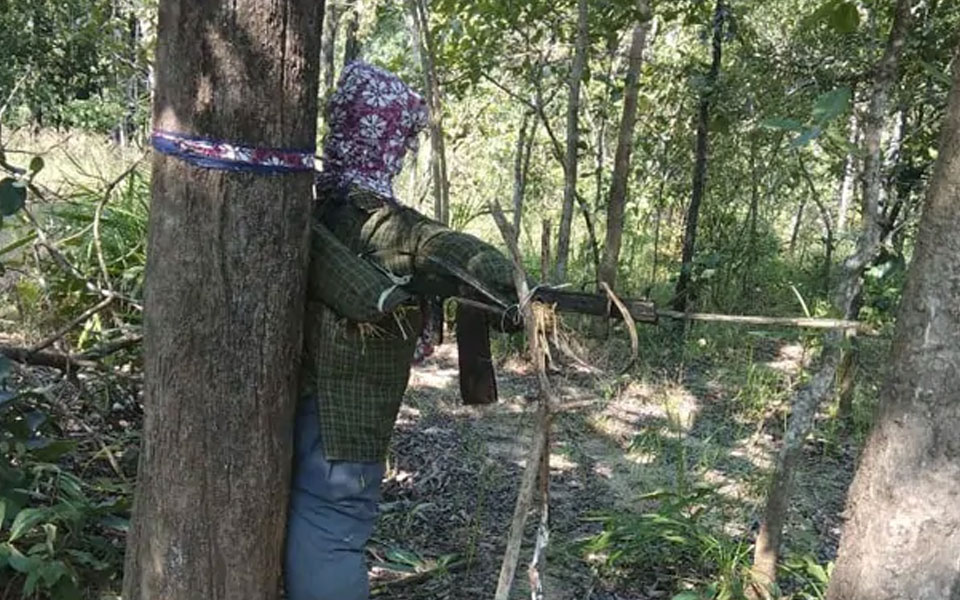
Raipur, Dec 1 : Facing reverses in their traditional stronghold, Naxals in Chhattisgarh's Bastar have come up with a new strategy, apparently based on the Vietnamese model of guerrilla warfare, wherein effigies with fake guns are positioned strategically in the forest to take on the troopers.
Naxals have suffered heavy casualties in a string of encounters with security forces in the restive zone in the last few months.
The security forces had recovered 13 such effigies planted by Naxals from three different places in the dense forests of the insurgency-hit Sukma district in the last eight days, a police official said Saturday.
According to the police, the ultras are using the human body dummies to mislead and distract the security forces when they conduct anti-Maoist operations in their core areas.
"As a part of their operational strategy, Naxals have for the first time used such effigies that resemble a person to mislead the security forces in the forests," Sukma Superintendent of Police (SP) Abhishek Meena told PTI.
He said the 13 effigies, along with the dummy guns, were recovered from Amapenta and Rasapalli in the Kistaram area and from Chintagufa.
"In the case of Chintagufa, where five such effigies were recovered on November 29, an IED (improvised explosive device) was also found placed near one such dummy", the SP added.
These effigies, made with paddy straw and dried grass and clad in civilian clothes, were found positioned behind trees, he said.
Meena added that "wooden firearms" were found placed in the hands of the effigies, which made those appear from a distance as men armed with guns hiding in the forest.
"Naxals seem to have devised this strategy with two-three purposes. They might be using these dummies to ambush the security forces and to create an impression that ultras are present in large numbers at a given spot," the SP explained.
He said distracting the attention of the security forces and creating a psychological pressure on them could be another strategy behind planting the dummies.
"Moreover, the planting of IEDs along with the effigies indicates that causing damage to the security forces through bomb explosions could also be a motive," Meena said.
Responding to a query on how the ultras could have possibly derived the new idea, the SP said though such tactics were used in several traditional wars, it was used by Naxals for the first time.
"In the Vietnam war, the Viet Cong guerrilla fighters had used such tactics against the American forces. Naxals, who had been following the guerrilla warfare tactics used in that war, have probably taken a cue from there," he said.
Meena added that the security forces had recovered a large number of documents of the "military commission" of the Maoists during two recent encounters in Sakler and Muler villages of Sukma, which were being studied.
"An analysis of the documents is likely to reveal several military strategies of Naxals. This experiment of using effigies might have been mentioned in those," he said.
Security forces were instructed to be cautious in dealing with such effigies in the forest, Meena said.
Meanwhile, a security expert said Naxals kept on experimenting new strategies to assess the reaction of the security forces.
"Naxals keep on experimenting with tactics after watching war and action films as well as documentaries, especially those made in Hollywood.
"They want to see the reaction of the security forces to their new tactics, in a bid to chalk out a complete military strategy," Girishkant Pandey, Head of the Department, Defence Studies at the Government Science College here, said.
The idea of planting effigies to divert the attention of the security forces was a part of the same strategy, he added.
"Apart from the Vietnam War, the German troops had used effigies, dummy weapons as well as tanks to distract their opponents in north Africa during the Second World War," Pandey said.
Let the Truth be known. If you read VB and like VB, please be a VB Supporter and Help us deliver the Truth to one and all.
Tumakuru: Dalit family allegedly prevented from entering temple; accused arrested

Tumakuru: Police in Turuvekere have arrested a 65-year-old man for allegedly obstructing a Dalit family from entering a temple and making caste-based remarks, officials said on Saturday.
The accused, identified as Rajanna, has been booked under provisions of the Scheduled Castes and Scheduled Tribes (Prevention of Atrocities) Act based on a complaint filed by Rangaramu T. of Thuyalahalli village.
According to the FIR, the incident took place on April 18 around 5:30 pm when Rangaramu T. and his family visited the Sri Ranganathaswamy temple in Mallur village to offer prayers. It states that the accused allegedly objected to their entry and made remarks referring to caste hierarchy and questioning their presence inside the temple premises.
The FIR further states that the accused made additional remarks asserting that such entry into the temple was not permitted and asked the family to leave. It also mentions that the complainant was subjected to mental harassment through these statements.
Following the complaint, DySP Om Prakash Gowda along with revenue officials and police visited the spot and conducted an inspection.
Further investigation is underway.