Chhattisgarh: 21 Naxals surrender in Kanker; hand over 18 weapons, including AK-47s
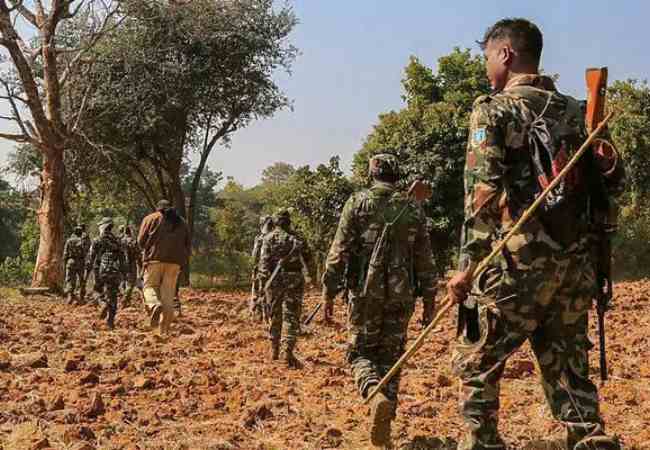
Kanker (PTI): As many as 21 Maoist cadres surrendered in Chhattisgarh's Kanker district on Sunday after handing over 18 weapons to authorities, a police official said.
They laid down arms under the 'Poona Margem: Rehabilitation through Reintegration' initiative started by Bastar Range police, the official added.
"The 21 includes Division Committee Secretary Mukesh. Thirteen are women ultras. The 21 comprise four divisional committee members, nine area committee members and eight part of the outlawed movement's lower rungs. They all belong to the Kuemari/Kiskodo Area Committee of the Keshkal Division (North Sub-Zonal Bureau) of the Communist Party of India (Maoist)," the official said.
Legal procedures are being carried out for the rehabilitation and reintegration of these 21 cadres into society, he added.
Speaking on the development, Chhattisgarh Chief Minister Vishnu Deo Sai said youth misled by the false ideology of Maoism have now started understanding that the path of development, not guns, is the right option for the future.
"The 'Puna Margem' has ended the anti-people Maoist ideology and established peace in Bastar. Today, under 'Puna Margem - Rehabilitation to Regeneration' initiative in Kanker district, 21 Naxalites renounced the path of violence and surrendered. This is significant proof of the success of our 'Surrender and Rehabilitation Policy- 2025' and 'Niyad Nella Naar Scheme', which is bringing a new wave of trust and change to Naxal-affected areas," he said on X.
Sai said his government, under the guidance of Prime Minister Narendra Modi and Union Home Minister Amit Shah, has won the trust of the people of Bastar, due to which Maoist organizations are steadily weakening and a large number of them are abandoning the path of violence.
Asserting that his government was fully committed to the rehabilitation and revival of the surrendered Naxalites, the CM said the backbone of Naxalism has been broken in the Bastar region, which is rapidly moving towards peace and development.
"Our double-engine government is committed to making the country Naxal-free by March 31, 2026," he added.
Earlier, on October 17, a total of 210 Naxalites, including Central Committee Member Rupesh alias Satish, carrying a cumulative reward of Rs 9.18 crore had surrendered in Jagdalpur in Bastar district. They also handed over 153 weapons.
On October 2, as many as 103 Naxalites, 49 of them carrying a collective bounty of more than Rs 1.06 crore, had surrendered in Bijapur district of Bastar region.
Let the Truth be known. If you read VB and like VB, please be a VB Supporter and Help us deliver the Truth to one and all.
Man booked for duping 7 persons of Rs 91 lakh on promise of awarding govt works

Mumbai (PTI): The Mumbai police have registered a case against a man for allegedly duping seven persons of Rs 91 lakhs on the promise of awarding them works of different government departments, an official said on Tuesday.
The accused was identified as Satish Kadam, a resident of Nanded in Marathwada region, an official said.
A complaint was filed by Hanumant Vadje, who alleged that the accused cheated him and six others of around Rs 91 lakh by promising to give them various works of Urban Development and Social Justice Department, he said.
The fraud occurred between 2024 and 2026, with Kadam collecting money in cash and into his accounts, police said, adding he had returned some amount to them partially.
Multiple cheques issued by the accused bounced, prompting the victim to lodge a complaint at the Marine Drive police station. Based on the complaint, a case of cheating and criminal breach of trust was registered against him.
The case is under further investigation, the official said.